







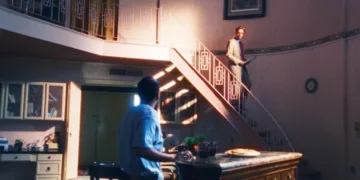
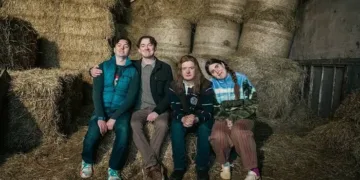

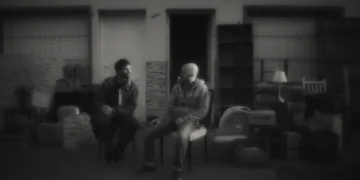
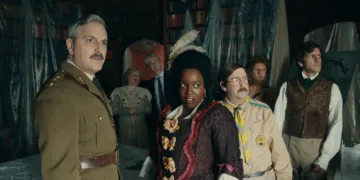





To receive a name is to receive an inheritance, a history. For filmmaker Éanna Mac Cana, that inheritance arrived as a diagnosis: Burkitt’s lymphoma. The name, a clinical label for the hostile tenant in his cells, belonged to another man, a ghost from medicine’s past.
This documentary is Mac Cana’s response, a séance on film. He places his own corporeal suffering—the stark, lonely reality of treatment—into a dialogue with the life of Denis Burkitt, the Irish surgeon who chased this very disease across a continent decades ago.
The film becomes a disquieting conversation between two men bound by a single medical term. It is an inquiry into how a legacy is formed, not in stone, but in the fragile tissue of the bodies that come after.
A Tangled Lifeline: Patient and Pioneer
The film’s architecture rests on a fault line between two consciousnesses, two imprisonments. One is Mac Cana’s, a world shrunk to the dimensions of a hospital room, a sterile box where the body’s betrayal is the only truth. His diaristic footage conveys a state of profound interiority, a hallucinatory passage through treatment where the self feels alien and autonomy is a distant memory.

We are shown the world through his captive eyes: the slow crawl of a fly on the windowpane, a universe of freedom in miniature mocking his stasis; the fine layer of dust on a remote, a testament to static time. In one potent sequence, he films his mother from his tenth-floor window as she cycles away, a receding speck of life vanishing from his sterile orbit, a brutal depiction of disconnection. His story is one of radical vulnerability, of a body besieged.
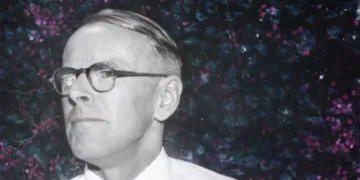
Then there is Denis Burkitt, a figure of restless momentum pulled from the archives. A childhood accident that cost him an eye gave him a camera, an instrument to frame the world he would seek to conquer. His devout faith propelled him from Fermanagh to Uganda, a different kind of confinement within a rigid set of beliefs that demanded action.
He worked within the machinery of the British Colonial Medical Service, a man driven by what he saw as a divine map. The film cuts between Mac Cana’s confinement and Burkitt’s relentless motion, between modern sickness and historical discovery. The visual echo of Mac Cana’s departing mother with archival film of Burkitt leaving his own family is unnerving, suggesting a strange, shared thread of fate, a closed loop across time.
Fever-Dream Cinematography and Sound
This is not a work of simple reportage; it is an induced state, a transmission of a mind under duress. The visual language has the texture of a fever-dream, a collision of disparate realities that blurs the line between the observer and the observed. Mac Cana’s raw, immediate digital video feels cold, almost forensic, capturing the impersonal horror of modern medicine.

In contrast, Burkitt’s archival footage glows with the warm, grainy saturation of a fading memory, a world that feels both more vital and irrevocably lost. The film’s most arresting stylistic choice is the superimposition of Burkitt’s hand-drawn medical charts and anatomical sketches onto Mac Cana’s contemporary world. A map of cellular pathology is laid over a human face; the scientific past literally bleeds into and infects the personal present.
This visual palimpsest makes the connection between the two men visceral, suggesting time itself has collapsed. The sound design acts as the film’s nervous system, a quiet but persistent throb of discomfort that mimics the body’s own involuntary rhythms—a heartbeat in a silent room, a breath held in fear. Over this, Mac Cana’s narration is a poetic whisper across time, an invocation directed at his namesake: “Denis Burkitt, your name, my cancer.” It is the sound of a haunting made audible.
Mapping a Cure: Science, Serendipity, and a Safari
The film reconstructs Burkitt’s intellectual quest with the precision of a procedural, yet it remains an existential tale. It is a story about the human compulsion to impose order onto a fundamentally chaotic universe. It begins with a medical anomaly—a child’s swollen jaw in a Ugandan hospital.
What Burkitt first dismissed as a “curiosity” became a pattern when a second case appeared, a flicker of logic in the dark. From this spark of recognition came an epic undertaking: a 10,000-mile “medical safari” across Africa in a second-hand Ford station wagon, a tiny vessel of reason navigating an ocean of the unknown.
He was not merely traveling; he was charting, imposing a grid of human logic upon a landscape of suffering that was vast and indifferent. The film pinpoints his critical intellectual leap, an act of almost poetic transference. He applied the same mathematical mapping techniques his father, an amateur ornithologist, had used to document bird populations in Fermanagh.
He repurposed a way of seeing from one discipline to solve a problem in another, viewing the spread of tumors as he might the migration of robins. The result was a revelation, a moment of profound serendipity. The map of the cancer’s distribution almost perfectly matched the map of malaria. The pattern pointed to an insect-borne virus, a tangible cause that could be fought. This act of pure reason would lead to a treatment that saved millions of lives, Mac Cana’s included.
Beyond the Biography: Legacy and Ethics
A life saved does not erase the questions of its saving. The documentary admirably refuses to build a simple monument to Burkitt, instead choosing to sift through the complicated soil of his legacy. It interrogates the very nature of his work, acknowledging that his righteous quest was conducted within the problematic apparatus of a colonial system.
That system, which saw a continent as a laboratory, is the unspoken partner in his discovery. The “medical safari,” for all its scientific nobility, carries the disquieting echo of other colonial expeditions built on extraction. The film forces us to consider the ethics of his gaze. Both men use a camera, but the power dynamic is vastly different. Burkitt’s beautiful, gold-hued images of his Ugandan patients, children frozen in their suffering, raise necessary questions of consent and representation.
What does it mean to document a sickness when the person afflicted has no voice in the record? When he administered a speculative therapy to a child on his own kitchen table, was it heroic improvisation or a symptom of a worldview where some bodies were more experimental than others?
The film offers no easy answers, presenting Burkitt as a man of his time, a figure of immense and genuine compassion whose methods were entangled with the unexamined privilege of his position. He is a pioneer, a savior, and a ghost whose work is both a blessing and a burden to the man who inherited his name.
Burkitt premiered in June 2024 at Docs Ireland and has been shown at various film festivals, including opening the InScience Film Festival in the Netherlands in March 2025. In April 2025, it won Best Debut Film at the Academia Film Olomouc.
Full Credits
Director: Éanna Mac Cana
Writers: Éanna Mac Cana
Producers: Christopher Kelly
Executive Producers: Áine Walsh Kelley
Cast: Éanna Mac Cana, Christopher Kelly, Áine Walsh Kelley, Stuart Sloan
Director of Photography (Cinematographer): Chris Kelly
Editors: Éanna Mac Cana, Stuart Sloan
Composers: Moon Paw Print, Paddy McKeown, Rónán McFeely, Éanna Mac Cana
The Review
Burkitt
Burkitt is a rare cinematic meditation, a séance on film that connects a man’s body to the ghost of his diagnosis. It is a visually arresting, intellectually searing inquiry into the tangled lines of legacy, science, and the ethics of looking. A profound and unsettling work that rejects easy answers and instead offers a beautifully rendered set of questions about the names that define us.
PROS
- Intelligent dual-narrative structure connecting patient and pioneer.
- Highly inventive and atmospheric visual style.
- Raises deep ethical questions about legacy and medicine.
- Effective and unsettling sound design that amplifies the film's mood.
CONS
- Deliberate, contemplative pacing may not suit all viewers.
- Its dense, philosophical nature demands significant viewer attention.
- The clinical and personal subject matter can be emotionally difficult.