


























A prison is almost too perfect a setting for a horror movie about anger. Every hallway is built around confinement, every social interaction carries the possibility of violence, and nearly everyone inside has a reason to lose control. Joko Anwar takes that pressure and gives it a supernatural rule: rage can get you killed. Once that rule becomes clear, Ghost in the Cell stops behaving like the prison movie it first appears to be and starts turning familiar genre situations inside out.
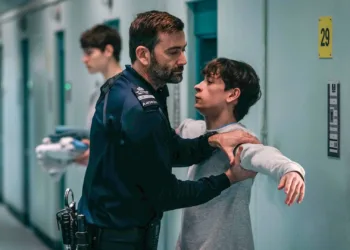
The setup is straightforward enough. Journalist Dimas is accused of murdering his editor after the man is horrifically mutilated, even though the crime appears far beyond anything Dimas could have done. He is sent to Labuan Angsana, a brutal prison already divided by gangs, intimidation, and abusive authority. Soon after he arrives, inmates begin dying in similarly elaborate ways. Their bodies are twisted into grotesque displays, and the mystery gradually points toward a malevolent presence connected to Dimas.
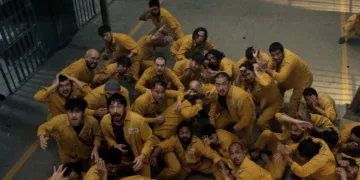
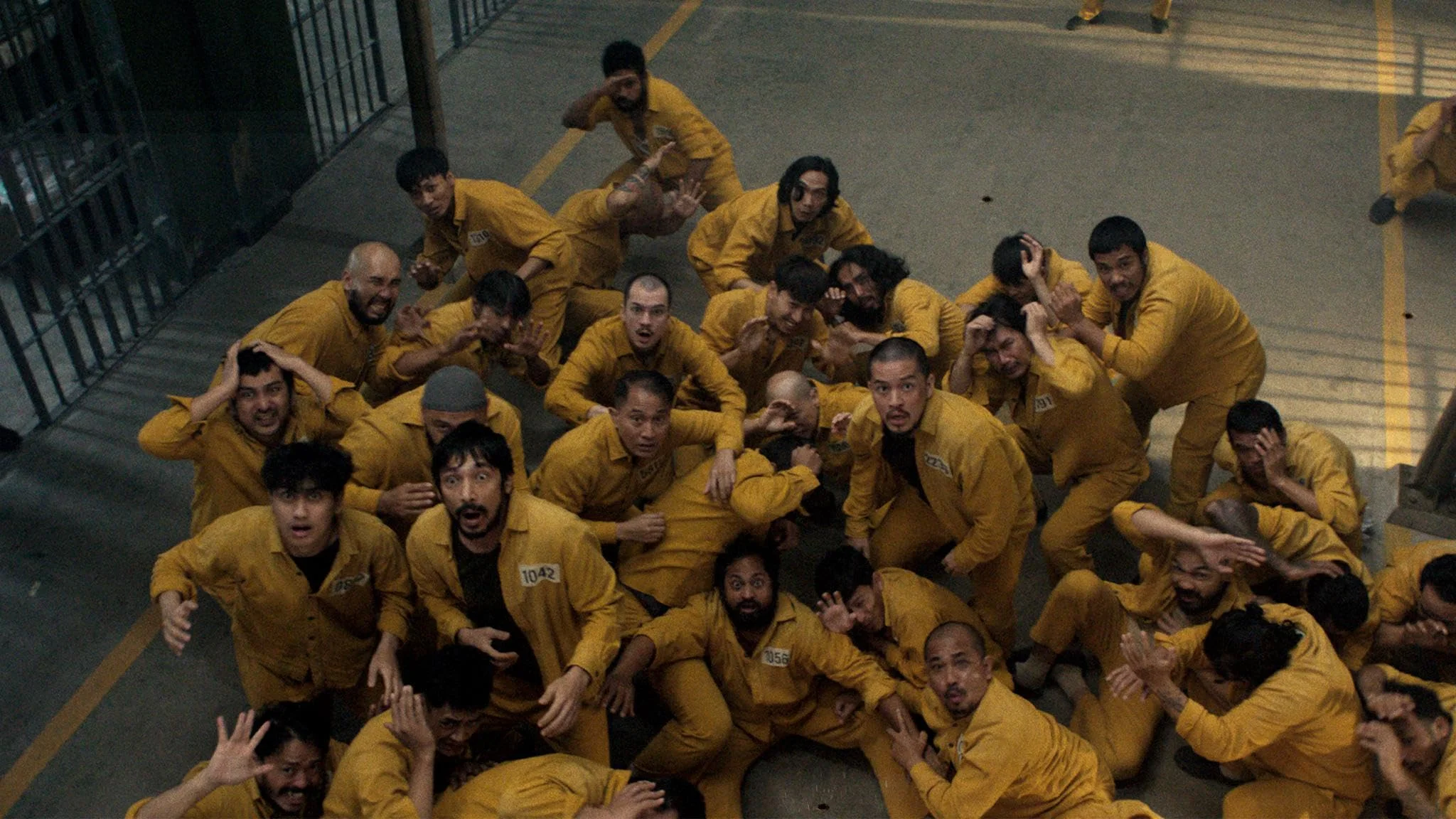
What makes the film interesting is the rule the prisoners eventually discover. The entity is drawn to anger, which appears through a red aura, so survival depends on calming down before that emotional state becomes fatal. That sounds like the setup for a joke, and Anwar absolutely knows it. Hardened inmates start praying, negotiating truces, dancing, and scrambling for any method that might turn their emotional temperature down before the thing hunting them arrives. The clever part is how often the comedy, action, and horror all come from that same rule.
One sequence has Anggoro, the prisoner who becomes the group’s natural leader, shifting between fighting and dancing as he tries to keep himself from tipping into the dangerous state that attracts the entity. Action choreography usually works by building rhythm through movement, impact, and escalation. Here, Anwar deliberately keeps interrupting that rhythm.
A fight develops momentum, then the character suddenly has to move in a completely different way to stay alive. The joke lands because the dancing looks ridiculous in the middle of violence, but the supernatural threat remains serious enough that the gag never dissolves the danger.
That balance keeps appearing in the prisoners’ awkward group dancing, which could easily have existed as a disposable comic scene. Instead, it has a practical function inside the story. These men are not performing because the movie suddenly wants to become silly. They are terrified, and the only available defense happens to make them look absurd.
Anwar finds similar tension in smaller moments. In the communal shower, camera movement plays briefly with the expectation that an unseen presence may be watching before the framing turns into a visual joke. Dimas struggling with a slippery, hair-covered bar of soap under Tokek’s threatening attention stretches an intimidating prison encounter toward uncomfortable comedy. The film keeps testing how long dread can sit beside ridiculous behavior before one cancels out the other. Most of the time, Anwar judges that distance remarkably well.
The prison itself helps. Single-location films can become visually repetitive because the audience quickly learns the space, but Anwar keeps his camera moving through cells, corridors, showers, and communal areas so the setting rarely feels static. The same interiors can register as a cage in one sequence and an action arena in the next, which gives the movie room to change tone without pretending it has escaped its confinement.
The gore carries its own visual logic. Victims are not left as ordinary bodies. They are arranged into horrific compositions, beginning with Dimas’s editor hanging from the ceiling fan and continuing through mutilated inmates displayed almost like installations. The effects appear to combine physical makeup and prosthetic work with digital enhancement, and the important thing is how tactile the results feel. Limbs, flesh, and blood retain enough physical weight that the supernatural violence does not become abstract.
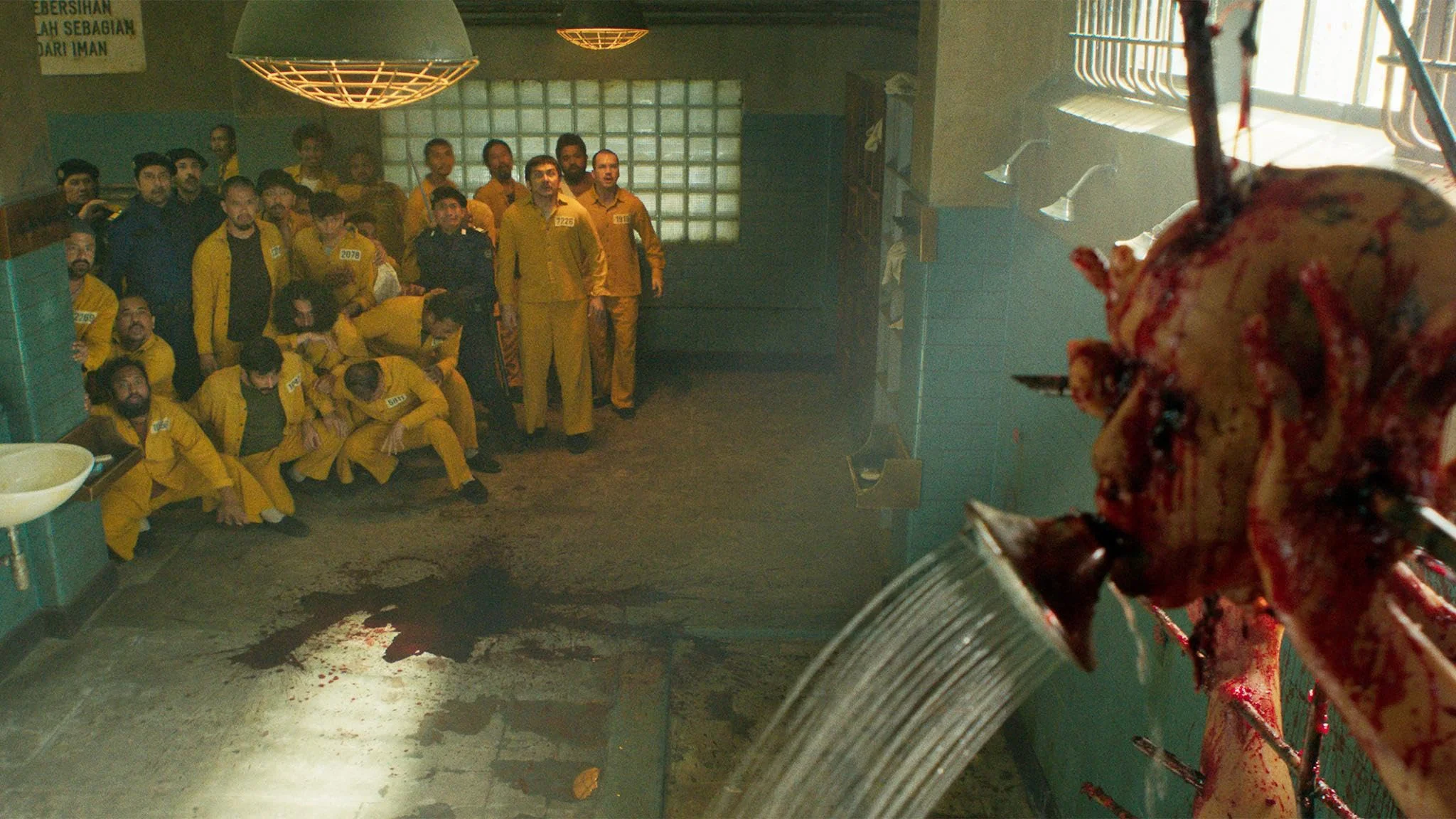
There is also a strange deliberateness to each corpse. The entity seems interested in presentation. That gives the deaths personality beyond their shock value and makes every discovery feel slightly different from a standard monster attack. Anwar wants the audience to recoil, but he also wants us looking long enough to notice the construction.
Amid all that chaos, Abimana Aryasatya gives the film a necessary center as Anggoro. He is familiar on paper: the decent prisoner who wants to keep his head down, serve his remaining time, and return to his family. What gives him weight is the contradiction built into that goal. He wants peace, yet his instinct is to intervene when someone else is being abused. Early conflict with the guards makes that impulse clear, and a later visit from his children gives Aryasatya room to show why getting out matters beyond basic freedom.
That makes Anggoro unusually well suited to this particular supernatural problem. Long before anyone understands the red-aura rule, he is already trying to resist the prison’s constant invitation to violence. The haunting turns that personal effort into the central survival mechanic of the film.
The larger social ideas are less evenly developed. Dimas’s reporting connects the plot to illegal mining and corruption, while the prison itself offers plenty of material about abusive authority, rival factions, exploitation, and the possibility of reform. Those concerns are present in conversations and character dynamics, but the supernatural storyline has far greater energy. The film is strongest when its ideas arrive through behavior, such as enemies being forced to cooperate because anger itself has become dangerous.
A few plot solutions are rougher. The discovery of the aura system depends on an awfully convenient accident that gives one prisoner the ability to perceive what is happening. Later passages also repeat the anger-threat-calming pattern after the audience already understands it. The rule is inventive enough to sustain the film, though its repeated application makes portions of the final stretch feel less surprising than the earlier set pieces.
What stayed with me was how thoroughly Anwar commits to his central idea. Ghost in the Cell takes a place defined by confinement, aggression, hierarchy, and retaliation, then builds a horror movie where survival requires cooperation, emotional control, and occasionally some very awkward dancing. A mutilated body can make you wince, a fight can snap into slapstick, and a ridiculous movement can suddenly become the smartest thing anyone in the room could do. That is a difficult tonal trick, and Anwar makes it look almost natural.
Ghost in the Cell premiered internationally at the Berlin International Film Festival on February 13, 2026, before its theatrical release in Indonesia on April 16, 2026. The horror-comedy follows a group of inmates in a high-security prison who must overcome their rivalries when a mysterious, otherworldly entity begins hunting them down.
Where to Watch Ghost in the Cell (2026) Online
Full Credits
Title: Ghost in the Cell
Distributor: GSC Movies, Well Go USA Entertainment
Release date: February 13, 2026 (Berlin International Film Festival), April 16, 2026 (Indonesia)
Running time: 1 hour 46 minutes (106 minutes)
Director: Joko Anwar
Writers: Joko Anwar
Producers and Executive Producers: Tia Hasibuan
Cast: Endy Arfian, Abimana Aryasatya, Yoga Pratama, Aming, Bront Palarae, Arswendy Bening Swara, Marissa Anita, Rio Dewanto
Director of Photography (Cinematographer): Ical Tanjung
Editors: Joko Anwar
Composer: Aghi Narottama
The Review
Ghost in the Cell
Ghost in the Cell turns a wonderfully strange supernatural rule into the engine for its horror, action, and comedy. Joko Anwar keeps the prison visually alive, makes the grotesque body displays feel disturbingly tactile, and finds real tension in scenes where survival may depend on dancing instead of fighting. Abimana Aryasatya gives the chaos an emotional anchor. A convenient aura discovery and some late repetition weaken the final stretch, while the corruption thread never matches the supernatural plot's energy. Still, its tonal control and inventive set pieces make it a bloody delight.
PROS
- Inventive anger-based supernatural premise
- Excellent tonal balance
- Strong, tactile gore effects
- Energetic confined-location filmmaking
- Abimana Aryasatya gives the film heart
CONS
- Aura discovery feels convenient
- Final act repeats established beats
- Corruption subplot lacks equal weight