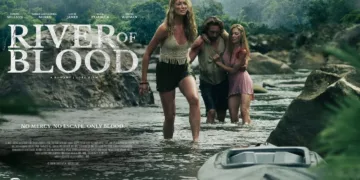




























The architecture of a survival horror film is often built upon a foundation of isolation and trespass. River of Blood begins by assembling these familiar materials with care. The film presents a kayaking trip into the verdant, labyrinthine jungles of Southeast Asia, a setting that promises both breathtaking beauty and hidden dangers.
We are introduced to two British couples, their vacation already showing signs of fracture from unspoken resentments and personal history. Ajay, a man whose common Indian name hints at a backstory the film never explores, travels with his partner Maya, while their friends, the affluent Ritchie and his wife Jasmine, fund the adventure.
When a miscalculation leaves them stranded, the group finds themselves in the domain of an uncontacted tribe with a taste for human flesh. This setup is potent, a classic scenario pitting modern anxieties against a primal, unforgiving force. It establishes the expectation of a harrowing descent into a world where the rules of civilization no longer apply.
A Drama of Diminishing Returns
Once the survival premise is established, the film diverts its resources to the interpersonal conflicts, a choice that ultimately starves the horror. The script invests heavily in a melodrama that feels tonally dissonant, recalling the high-pitched emotionalism of mainstream Bollywood but without the cultural context or cinematic language that makes it effective there.
In a Hindi film, a story of infidelity and jealousy is often the central pillar, supported by music, elaborate plotting, and a clear moral universe. Here, the affair between Ajay and Jasmine is presented as a flat, joyless transgression, while Ajay’s resentment of Ritchie’s wealth feels more like petty whining than a deep-seated psychological wound. These conflicts are not given the space or weight to become meaningful, so they function instead as irritating interruptions.
The characters themselves are thin archetypes. Ajay is a caricature of wounded male pride, while Ritchie’s well-meaning generosity is written with a condescending edge that makes him difficult to like. Their bickering makes it nearly impossible for an audience to invest in their survival; one almost begins to root for the jungle. Amidst this weak characterization, a few performances offer a glimpse of what could have been.
David Weyman manages to imbue Ritchie with a surprising earnestness, particularly in his moments of vulnerability, making his eventual fate almost sympathetic. Likewise, Joseph Millson is a standout as Nick, the group’s guide. He radiates a calm competence and charisma, representing a grounded professionalism that the film quickly discards, leaving a void that the remaining characters cannot fill.
A Horror Film Afraid of the Dark
For a movie that plants its flag in the notorious cannibal subgenre, River of Blood shows a profound and baffling timidity. The film’s lineage, stretching back to the controversial “video nasties” of the 1970s and 80s, is built on a willingness to confront taboos and display visceral horror. This film does the opposite, systematically avoiding the very elements that define its genre.

The execution is remarkably restrained, feeling less like a stylistic choice and more like a failure of nerve. Atmospheric dread is substituted with poorly timed and predictable jump scares that are not earned with any preceding tension. Most of the violence and all the significant kills happen off-camera, a technique that can be effective in cinema navigating strict censorship but here feels like a cop-out.
This sanitized approach creates a sense of absurdity that shatters immersion. The antagonists, meant to be terrifying symbols of a primal world, are depicted wearing modern, store-bought shorts. This single detail, comical in its incongruity, reveals a fundamental lack of commitment to building a believable world. The pacing further exacerbates the problem.
The camera lingers on tedious arguments over trivial matters while the few horror set pieces, like a capture or a ritual, are rushed and underdeveloped. The film spends an eternity on the journey—the walking, the complaining, the bickering—and almost no time on the terrifying destination it promised. It is a genre picture that seems embarrassed by its own genre, resulting in an experience that is neither shocking nor suspenseful.
A Beautiful View of an Empty Story
The greatest frustration offered by River of Dlood is the ghost of a more intelligent film that haunts its periphery. The script makes shallow gestures toward social commentary, briefly mentioning that deforestation and corporate exploitation are the reasons for the tribe’s savage practices. This theme, which Indian parallel cinema and even socially conscious commercial films have explored with nuance and power, is treated here as a disposable plot device.

Filmmakers from Satyajit Ray to more contemporary voices have shown how to weave critique into a narrative fabric, grounding it in authentic human experience. This movie does the opposite, using a complex real-world issue as a lazy, paper-thin motivation for its villains. It feels less like commentary and more like an excuse.
What the film does achieve, with undeniable success, is capturing the beauty of its location. The cinematography is the single element that works without reservation. The oppressive humidity, the menacing stillness of the river, and the way light filters through the dense canopy are all rendered beautifully.
The Thai landscape becomes a character in itself, one far more interesting than any of the humans who occupy it. This visual strength, however, ultimately serves to highlight the narrative emptiness. It provides a rich, atmospheric canvas, but the story painted on it is a thin, forgettable sketch. Its journey into the jungle leads not to a dark heart of horror, but to a hollow core.
“River of Blood” is an action-adventure horror film released on August 1, 2025, with a limited theatrical release and available on video-on-demand services like Prime Video and Apple TV. The film was filmed in Thailand and follows a group of kayakers who venture into a jungle inhabited by a tribe of cannibals.
Full Credits
Director: Howard J. Ford
Writers: Tom Boyle
Producers and Executive Producers: Howard J. Ford, Tom Boyle, Rikke Ennis, Frederik Nelsson
Cast: Joseph Millson, Sarah Alexandra Marks, Louis James, Ella Starbuck, David Wayman
Director of Photography (Cinematographer): Rungroj Park Rojanachotikul
Composer: Anthony Wade, Jack Wade
The Review
River of Blood
River of Blood squanders its potent premise and stunning location on a timid, toothless execution. It swaps genuine horror for tedious melodrama, populating its beautiful scenery with unlikable characters. By gesturing toward deep themes of exploitation without any meaningful follow-through, the film feels both hollow and hypocritical. It is a survival story with no suspense and a cannibal film with no bite. Its visual appeal is undeniable but serves only to highlight the profound narrative emptiness at its core, making for a deeply frustrating and forgettable viewing experience.
PROS
- Stunning cinematography that beautifully captures the Thai jungle locations.
- Creditable performances from actors David Weyman and Joseph Millson.
CONS
- A weak script featuring one-dimensional and irritating characters.
- Constant interpersonal drama that undermines suspense and terror.
- A sanitized and timid approach to horror that fails its subgenre.
- Shallow and abandoned attempts at social commentary.
- Poor pacing that privileges tedious arguments over horror sequences.