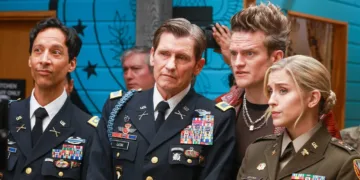





























Going Dutch comes back for Season 2 on the Stroopsdorf military base in the Netherlands, keeping Colonel Patrick Quinn parked in exile at a low-intensity assignment. The setting runs on leisure, bicycles, and a kind of calm that reads like a provocation to an officer trained to measure his worth in readiness and aggression.
The comedy keeps circling the same pressure point: Quinn wants crisp discipline, while the people around him treat the workday like it has room for cheese breaks and emotional wellness. Maggie Quinn has her own professional responsibilities to juggle, and she still has to absorb the splash damage from her father’s abrasive temperament. Major Abraham Shah remains the steady presence in the room, which makes Quinn’s mood swings feel louder without anyone raising their voice.
Season 2 broadens these relationships and adds personal complications, using the peace of Stroopsdorf to examine what a career soldier does with himself when the job offers no active threats. That absence becomes a clean stage for bureaucracy, identity, and the small humiliations of modern service. The series also keeps its comedy grounded. It stays with the absurdity of daily life in a place where the most pressing battles arrive wearing paperwork.
The Human Element of Military Bureaucracy
Season 2 shifts its narrative emphasis toward character work that feels more deliberate than the earlier run. Patrick Quinn starts to resemble a person more than a volume knob. Denis Leary plays him with quiet frustration, replacing the earlier reliance on constant shouting with something sharper: a man trying, and failing, to regulate himself in a world that refuses to match his intensity.
The show builds small scenes around restraint, giving Quinn opportunities to pause, swallow a reaction, and then react anyway. Those moments matter because they reveal how much effort he is spending simply to exist at Stroopsdorf. His rare concessions land with weight, since the character treats compromise like a tactical retreat. The gruff exterior stays in place, though the season keeps hinting at protective instincts that slip out around the squad.
Celeste Shah’s arrival pushes a romantic triangle into the foreground, and it changes the atmosphere on the base. The tonal shift is immediate. Public affection becomes a kind of ambient noise that Maggie can hear even while she tries to stay focused on her job. Watching Shah and Celeste move through their routines, including those coordinated morning runs, forces Maggie to confront feelings she has kept packed away.
Also Read




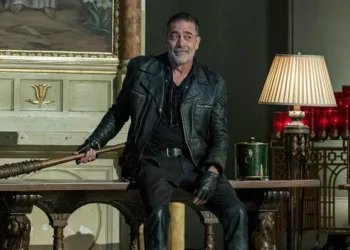

The show stages this as a steady accumulation of irritation and self-control. Maggie aims for stoicism. Her posture says “fine,” while her attention keeps drifting back to what she wants to ignore. Quinn notices the change, because Quinn notices everything that looks like weakness, including the version of it his daughter refuses to name out loud.
The supporting players gain definition beyond their initial outlines. Corporal Papadakis chases validation through physical improvement and tactical achievement, and his attempts to impress Quinn give the humor a sincere edge. He wants approval, and the season lets that want sit in the open without turning it into a speech. Dana Conway operates like a practical anchor, viewing military life through survival math. Medals carry less appeal for her than efficient side businesses.
That mindset grounds the base in something recognizable: people making do, taking shortcuts, and finding small ways to win in a system that rarely hands out clean victories. Jan remains the steady reminder that the American presence is still a guest in a country that has its own rhythms. His deadpan delivery keeps puncturing Quinn’s aggressive posturing, and the show uses that dryness to keep the environment feeling lived-in. With this cast in place, the stakes stay personal. Nobody is saving the world here. They are trying to get through the day with their pride intact.
Clashing Values on Neutral Ground
Stroopsdorf functions as a collision point for two worldviews that refuse to share the same operating system. Quinn embodies a culture built on constant readiness and dominance. The Dutch environment around him favors social harmony and relaxation, and the show has fun treating everyday icons like tulips and cheese as obstacles in Quinn’s imagination. He wants the base to feel like a combat posting. The town treats the U.S. presence like a minor administrative footnote. That casual indifference needles him more than any direct threat could, because it denies him the drama he believes his job requires.
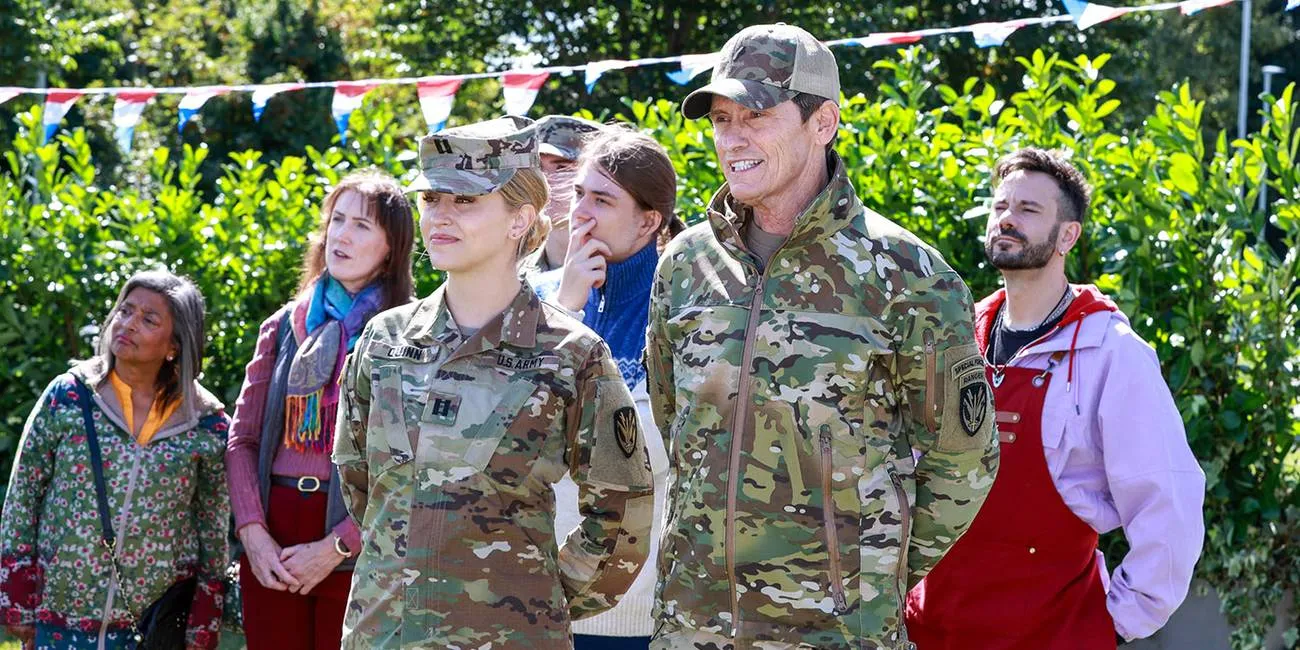
The season’s political tension runs through Katja Vanderhoff, who uses her history with Quinn as fuel for her own career momentum. Her push to reclaim base land for the town turns a past breakup into an ongoing public dispute, and the show wisely frames the conflict through petty specifics.
They argue about the removal of a bowling alley. They argue about where a farmer’s market should go. The scale stays stubbornly small, and that is the point. Quinn wants a grand enemy. The season keeps handing him municipal issues dressed up as existential battles, and his inability to resize his reactions becomes one of the cleanest comedic engines the show has.
Bureaucracy becomes the primary antagonist, and Season 2 commits to that choice with discipline. The characters battle legal technicalities and ancient contracts. The fine print in military agreements ends up shaping their lives more than any combat manual.
Zoning laws and paperwork drive the story beats, which gives the series a plausible view of modern service at a place that has traded danger for administrative choke points. The base treats a missing snack bar stock like a genuine crisis, because the institution has room for panic and no place to spend it. Quinn keeps trying to fight a system made of forms and polite smiles. The season keeps meeting him with rules that have no face to yell at, and that mismatch produces some of the strongest comic situations.
Forging Meaning in a Peaceful Landscape
Season 2 keeps returning to a blunt question: what is a soldier for when war never shows up? The characters answer by inventing crises that let them feel useful. The lobster smuggling plot captures this instinct with almost clinical clarity. Shah and Papadakis take something mundane and turn it into a tactical operation, treating the survival of those animals with the urgency of a high-stakes mission. The comedy works because the behavior comes from a real need: belonging to something organized, something that demands competence, something that can be “won.”
Quinn’s rivalry with General Davidson brings ego into focus as a plot driver. Quinn clings to his past reputation with fierce possessiveness, and the season gives that fixation a specific object: the Quinn Maneuver, and its removal from training manuals. He treats that removal like an insult carved into stone, and the perceived slight pushes him to treat simulated combat like a last stand for relevance. Laser tag becomes the battleground for a man trying to prove he still matters. The show plays this straight enough to keep it funny, since Quinn refuses to adjust his intensity for a game that is designed to be harmless.
Leadership becomes another recurring theme, filtered through Quinn’s outdated ideas about masculinity. He rejects de-escalation methods, choosing escalation as his default language. His decision to use a knife to motivate Papadakis for a fitness test shows how quickly he turns a simple task into an ordeal. The season keeps escalating that mindset until it tips into a training exercise involving a disco ball, which Quinn converts into a defensive tool during laser tag.
The image is ridiculous, and the ridiculousness serves a clear narrative function: it exposes the gap between Quinn’s combat training and his current reality. The younger soldiers adapt in quieter ways. They build meaning through community and daily connection, choosing fulfillment that does not require conflict. The series avoids turning them into heroes. They stay messy, flawed, and human, trying to find a reason to wear the uniform each day.
The Mechanics of Modern Sitcom Craft
Season 2 leans on visual storytelling to reinforce its themes, using reactions and environments as narrative signals. Danny Pudi stands out here, communicating his character’s thought process through small facial shifts that land with precision.
His responses to Quinn’s strange orders often carry more weight than the dialogue itself, because the show lets the camera sit on the moment long enough for the audience to read the calculation. The Dutch scenery becomes a quiet running commentary. It is beautiful, serene, and persistently distracting for a military cast that looks misplaced inside it. The locations keep reminding you that these characters have been dropped into a world that does not need them to perform heroism.
The scripting keeps a fast pace and favors sharp dialogue over sentimental speeches. The writers trust the cast to convey emotion through silence or a glance, which helps the show address character flaws without rushing to fix them. People remain stubborn. People remain petty. People remain themselves. The humor stays dry and observational, built out of awkward human interactions inside a rigid system that keeps asking for rules and offering very little clarity about why the rules exist.
The lack of a laugh track supports that approach, encouraging tighter timing and a stronger reliance on situational irony. Jokes arrive through rhythm, pauses, and the friction between what Quinn wants and what Stroopsdorf is willing to provide. The series carries a cinematic feel that gives the material more texture, and it helps the base itself register as a character.
Stroopsdorf blends the dullness of a government office with the charm of the Netherlands, and the high production values make the place feel lived in. That grounded style separates Going Dutch from workplace comedies that lean on louder beats, keeping the focus fixed on the specific reality of these people in this particular posting.
Going Dutch is a sharp military workplace comedy that originally premiered on Fox on January 2, 2025. The series follows an arrogant, unfiltered U.S. Army Colonel, Patrick Quinn, who is “exiled” to a command position at a nearly purposeless base in the Netherlands after a career-stalling rant. The second season made its debut on January 15, 2026, continuing the story of Quinn’s attempt to restore military discipline in a culture that prioritizes work-life balance and bicycles. For those looking to catch up or follow the new episodes, the series is available to watch live on Fox or can be streamed the following day on Hulu.
Full Credits
Title: Going Dutch
Distributor: Fox, Hulu
Release date: Season 1 premiered January 2, 2025, Season 2 premiered January 15, 2026
Rating: TV-14
Running time: 22–30 minutes
Director: Jason Winer, Trent O’Donnell, Declan Lowney, Maurice Marable, Kimmy Gatewood, Todd Biermann
Writers: Joel Church-Cooper, Rene Gube, Laura Moran, Jason Belleville, Gian-Paul Bergeron, Natalie Rotter-Laitman, Jonterri Gadson, Kirsten Jakob
Producers and Executive Producers: Denis Leary, Joel Church-Cooper, Jack Leary, Edmund Sampson, Hilary Winston, Laura Moran, Jason Belleville, Rene Gube, Bill Malone, Sean O’Riordan, James Dean
Cast: Denis Leary, Taylor Misiak, Danny Pudi, Laci Mosley, Hal Cumpston, Arnmundur Ernst Björnsson, Catherine Tate, Milana Vayntrub, Joe Morton, Dempsey Bryk, Parker Young
Director of Photography (Cinematographer): Owen McPolin
Editors: Tony Orcena, Mike Fly, Jordan Hayles, Kyle Martin
Composer: Gabe Witcher
The Review
Going Dutch season 2
Going Dutch remains a sharp workplace comedy that avoids common sitcom traps. The second season succeeds by focusing on the friction between Patrick Quinn’s rigid military ego and a world that simply does not care about his rank. Denis Leary delivers a controlled performance that highlights the frustration of a career soldier in a peaceful setting. While the pacing feels fast, the character growth and dry humor provide a satisfying experience. It is a smart look at modern identity and the absurdity of bureaucracy.
PROS
- Sharp and rhythmic dialogue.
- Excellent comedic chemistry between Denis Leary and Danny Pudi.
- Effective use of the Dutch setting to emphasize cultural friction.
- Original approach to the military genre without relying on active combat.
CONS
- The fast pacing can make smaller subplots feel rushed.
- Multiple character arcs require close attention to catch every joke.