

























![Kingdom Hearts Collection [I-III] Review](https://gazettely.com/wp-content/uploads/2026/10/Kingdom-Hearts-Collection-I-III-1-360x180.webp "Kingdom Hearts Collection [I-III] Review: KHII Holds Steady as Newer Entries Fluctuate 37")





Turners Falls feels paused in time. Brick paper mills sit silent beside the river. They register as relics of an industrial past. This Massachusetts town frames a story about memory and its weight. Calvin Cole lives in a house shaped by absence. He is a combat veteran whose mind remains an unsettled battlefield.
His days follow quiet rituals meant to hold the darkness at bay. One afternoon a small sound in a shop breaks that brittle control and he attacks a man. The altercation leads to his arrest. Clarence, a local officer who coached Calvin in hockey years earlier, intervenes. He convinces a judge to exchange prison for sixty days of therapy.
At the same time Whitney St. Germain is released from a military prison after thirty years away. He returns seeking his daughter Alice, who is Calvin’s former wife. These characters converge in a town that feels as stuck as their private lives. The narrative centers on the difficulty veterans face when reentering a society that has no ready role for them.
The Mechanics of a Broken Mind
Calvin and Whitney form a pragmatic bridge across shared experience. Their military history separates them from the town and gives them a private language. That connection helps them steady themselves in a world that moved on while they were gone. The film treats Calvin’s mind with clinical specificity. The script foregrounds his traumatic brain injuries and tracks how his brain processes fear.
We see him in Eye Movement Desensitization and Reprocessing sessions that read as procedural and exact. Those therapy scenes avoid quick fixes and present treatment as difficult work. Virginia Madsen’s Dr. Elecia Knox carries weariness and economic pressure. She has a demanding supervisor and this detail makes her feel like a person with limits. Alice embodies the human cost of living with a veteran.
She refuses a passive role in Calvin’s path and demands accountability. Her exhaustion captures what happens when someone close is emotionally absent. Darryl, Calvin’s best friend, offers an alternate survival strategy. He uses humor to mask darker impulses and demonstrates that trauma can appear as a practiced smile.
The interactions among these characters are messy and particular. The film resists tidy solutions and shows how letting another person in requires time and mutual effort. Those scenes stress that healing depends on relationships as much as therapy.
The Cold Logic of the System
Veterans Affairs is portrayed as a cold, malfunctioning machine. Ms. Hazel stands in for that bureaucracy and she treats veterans as ledger entries. In one scene she calls the therapy group animals, a phrase that signals dehumanization. The film links mental health to material insecurity. Calvin’s job loss at the mill compounds his struggle.
Without a financial safety net his recovery faces constant friction. The script argues that medical care alone is not sufficient. Recovery also needs stable housing and a way to make a living. The community plays an active role in that work. Clarence represents a local authority who chooses empathy over punishment and sees Calvin as a neighbor.
The story turns away from foreign battlefields and toward the battlefield of domestic neglect. It raises questions about how a society treats those it dispatched to war and shows the gulf between public praise and actual support. Systemic failures appear in the characters’ daily routines. The film presents those failures plainly and refuses to soften the difficulty. It positions the veteran as a citizen whose survival depends on an available community.
A Palette Painted in Blues and Browns
The visual design uses Massachusetts in fall to establish mood. Natural beauty sits beside decaying factories. Early scenes favor cold blue tones that reinforce the clinical atmosphere of the court and the VA office. As characters achieve moments of peace the palette shifts toward warmer browns and earth tones, signaling subtle internal change in Calvin.
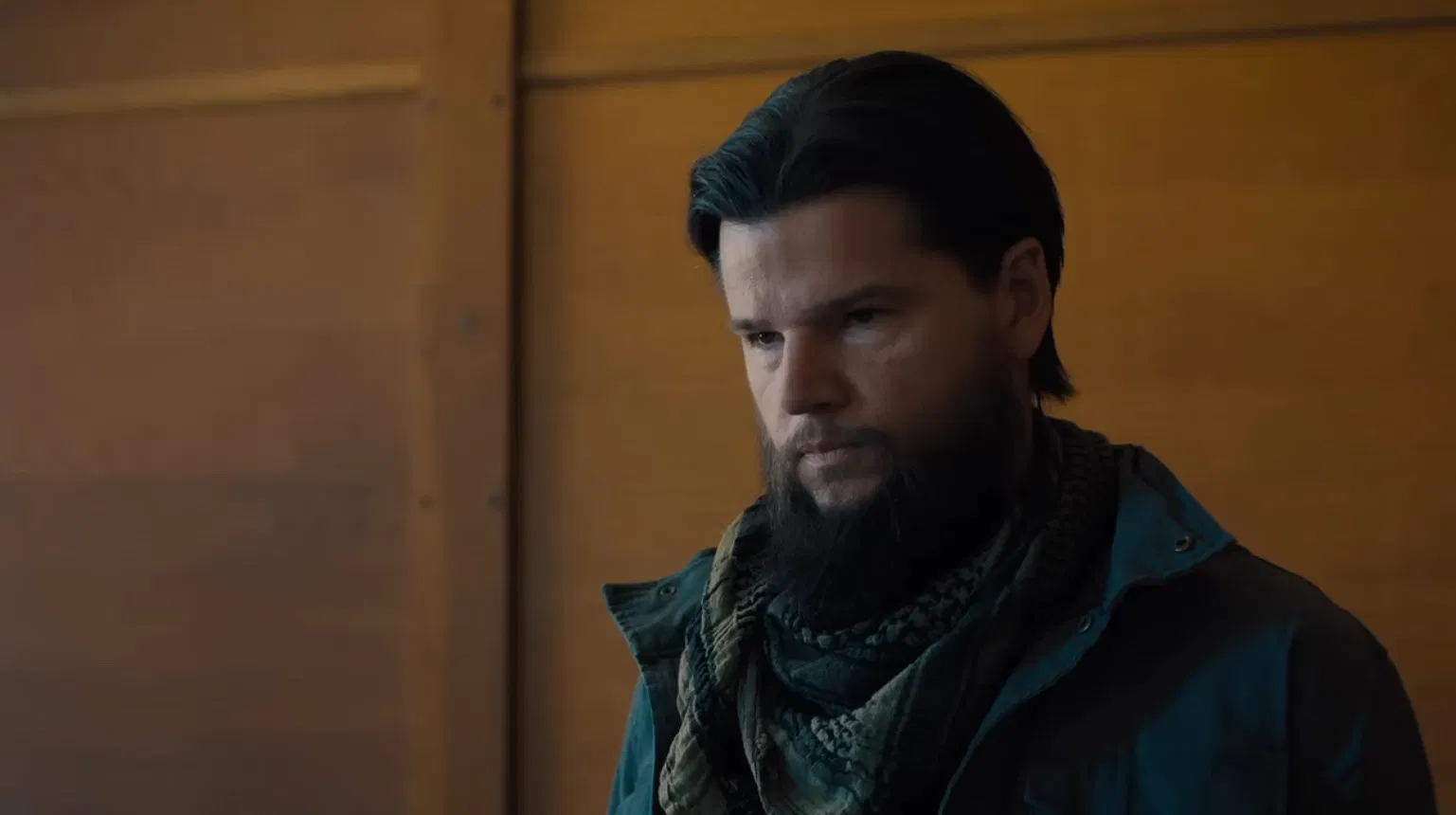
The film’s pacing is deliberate and patient; it mirrors the slow tempo of real recovery. Trauma arrives through compact flashbacks triggered by ordinary objects. A whistle or a smile can reopen the noise of war, and those moments provide context for Calvin’s explosions without relying on long expository speeches. The sparse soundtrack gives space to the town’s ambient sounds and the actors’ voices. Silence becomes a tool for intensity in key scenes.
The camera keeps a close proximity to faces and captures pain through small gestures and eye contact. That visual focus emphasizes internal experience and maps the uneven rhythm of healing. Progress appears uneven, measured in small decisions to continue. The film’s visual language asks the audience to linger with discomfort and rewards that patience by making emotional moments feel earned.
Sheepdog is an emotionally resonant indie drama that made its world premiere at the Boston Film Festival on September 20, 2024. Following a successful run on the festival circuit, where it earned 15 awards, the film was released in limited theaters by Allen Media Group on December 17, 2025, before expanding to over 500 screens nationwide on January 16, 2026. As of early 2026, the film is primarily available to watch in theaters across the United States.
Full Credits
Title: Sheepdog
Distributor: Allen Media Group
Release date: December 17, 2025 (Limited), January 16, 2026 (Wide)
Rating: R
Running time: 128 minutes
Director: Steven Grayhm
Writers: Steven Grayhm
Producers and Executive Producers: Steven Grayhm, Lynn K. D’Angona, P. Colin Kane, Matt Dallas, Jose Martinez Jr., Joe Newcomb, Brint Ryan, Kory Ryan, Ric Smith
Cast: Steven Grayhm, Vondie Curtis-Hall, Virginia Madsen, Lilli Cooper, Dominic Fumusa, Matt Dallas, Maggie Geha, Tamara Hickey
Director of Photography (Cinematographer): Evans Brown
Editors: Brent McReynolds
Composer: Rycky Ruke, Gary Rugala
The Review
Sheepdog
Sheepdog succeeds as a somber study of the invisible wounds left by combat. Steven Grayhm offers a performance of quiet intensity while Vondie Curtis Hall provides a necessary, soul-stirring counterpoint. The film works best when it examines the gritty reality of recovery and the failures of the systems meant to help. While the slow pacing might feel heavy, it honors the actual timeline of human healing. This is a haunting and grounded reflection on resilience.
PROS
- Authentic and vulnerable performances from the central ensemble cast.
- Unique focus on specific therapy modalities like EMDR rarely seen in film.
- Atmospheric use of the Western Massachusetts industrial setting to mirror internal decay.
- A nuanced critique of institutional neglect that avoids simple political tropes.
CONS
- The narrative structure occasionally feels overstuffed with secondary subplots.
- Deliberate pacing requires significant patience from the audience.
- Certain character resolutions occur off-screen, which lessens the emotional payoff.







