

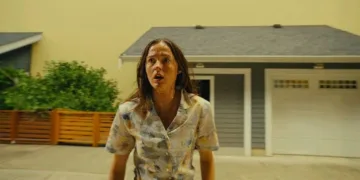











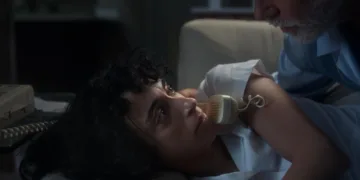


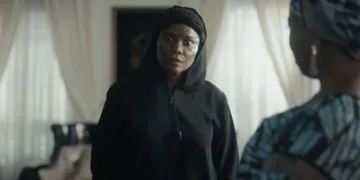









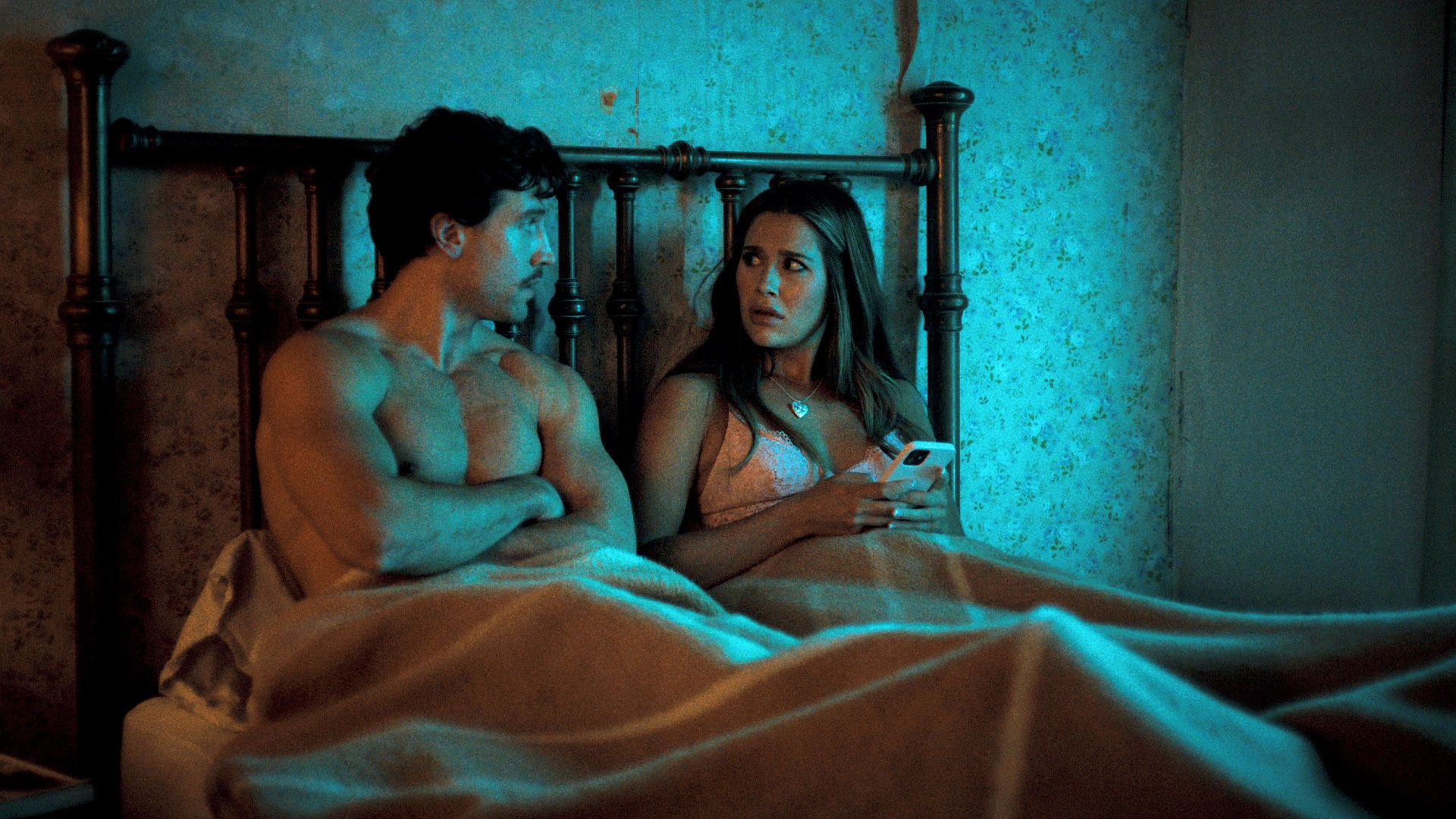

Writer-director Jay Reid opens Sick Puppy by dropping the viewer straight into a queasy meeting point of routine work and lethal deviance. His feature debut announces itself as a pitch-black horror comedy and a precise psychological thriller, with little patience for genre warm-ups. The story follows Charlie, played by Natasha Calis with unnerving composure, a cheerful and attentive veterinary nurse whose job requires her to comfort anxious pets and administer lethal injections with a calm, practiced voice.
That professional mask clashes with the domestic life waiting for her at home. Her husband John, played by Brett Geddes, works a normal suburban job as a landscape gardener while hiding a monstrous private routine. In the cold concrete basement beneath their home, he abducts young women, muzzles them, and keeps them caged like household animals.
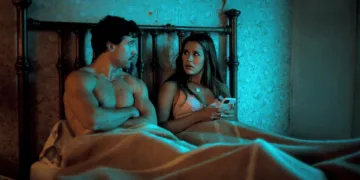
The plot truly starts moving when John offers Charlie a bizarre marriage bargain. He will give up serial killing if she quits smoking. The trade sends him into local pottery classes as a substitute outlet for his impulses, while Charlie carries the psychological strain of keeping their quiet suburban marriage intact.
The Elasticity of Marital Rationalization
The script builds its horror through deadpan domestic logic. Reid treats unspeakable crimes with the rhythm of household management, bringing the absurd intimacy of reality television such as 90 Day Fiancé into contact with extreme violence. The story studies complicity with a steady hand, tracking how far a spouse can stretch justification once emotional survival becomes the operating principle.
Charlie’s routine becomes the film’s most disturbing organizing device. She goes to work, manages appearances, and handles the physical aftermath of John’s crimes. Blood must be mopped. Evidence must be hidden. Burial sites must be tracked. Marriage, apparently, has chores.
That structure gives the film an ironic dual rehabilitation arc. John attempts to climb out of his psychological darkness through ceramics, a solution so painfully inadequate that it circles back into grim comic logic. His restraint places Charlie under greater pressure. With outside threats closing in, she begins to unravel. The story charts her slow awakening to the visceral reality of violence, and the shift works because it grows from the marriage’s warped internal rules.
Also Read





Reid’s strongest idea lies in the way moral collapse arrives by inches. The film understands decay as a series of small permissions, each one easier to excuse after the last. Its pacing, though, has an uneven shape. The opening movement leans into raw captivity and gritty discomfort, then the film turns into a satirical character study of a complicit housewife. That pivot keeps the viewer uncertain, which suits the material. The final act has a rougher task, since the script has to resolve its thriller machinery, domestic satire, and psychological reversal at once. Some of that machinery grinds.
Compartmentalization and Destabilizing Forces
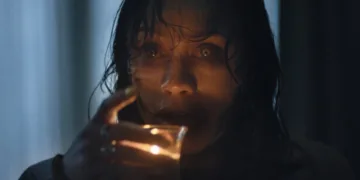
A premise this extreme needs actors who can ground it without sanding down its ugliness. The cast manages that difficult balance. Natasha Calis gives the film its anchor through a performance built on exhaustion and compartmentalization. Her Charlie feels like a woman surviving through flexible logic, adapting her morality to whatever lets the day continue. Calis avoids cartoonish villainy and keeps the character rooted in fatigue, denial, and a very practical kind of panic.
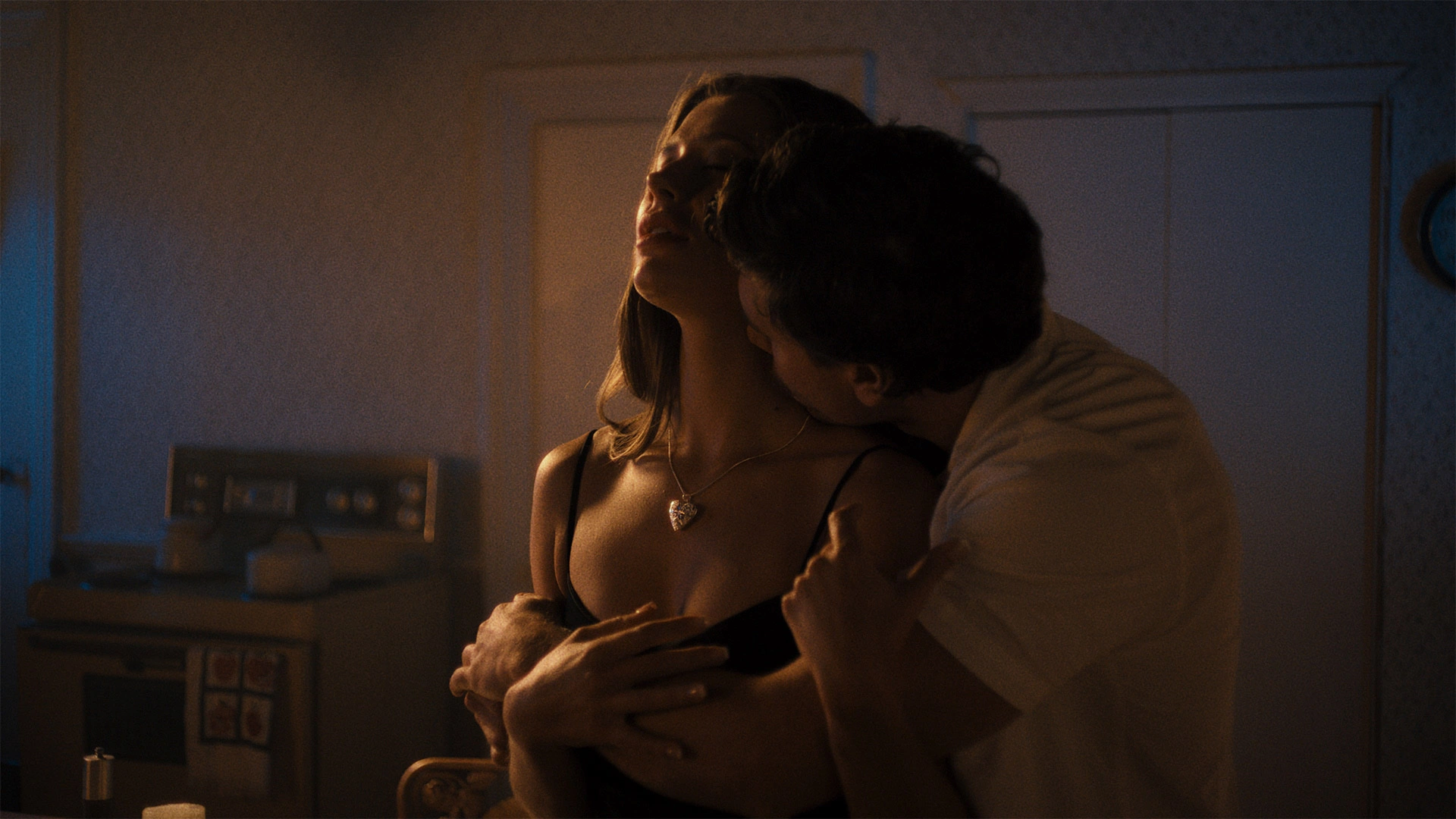
Brett Geddes gives John an unsettling split between awkward domestic neediness and predatory danger. He can appear like a clumsy suburban husband trying to be useful, then reveal the menace of someone long accustomed to violence. The performance works because it never lets one side erase the other. John’s desire to improve his marriage and his history as a killer occupy the same body, which makes his pottery-class redemption attempt both funny and repellent.
The fragile balance breaks when Rachel Boyd enters as Mia, a flirtatious seventeen-year-old schoolgirl. Mia becomes the screenplay’s sharpest destabilizing force. Her aggressive, calculated teasing punctures the couple’s shared fantasy of control. Boyd plays her with erratic, volatile energy, giving Mia a danger that scrambles the household’s power structure and makes John look strangely manageable by comparison.
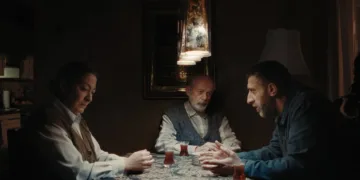
Dylan Taylor adds another source of pressure as Dale Karloff, a local police officer with a deeply troubled high school history with Charlie. Dale’s presence circles the home and forces Charlie and John to defend their secrets with growing strain. Precious Chong supports the central cast as Charlie’s fully oblivious employer at the veterinary clinic. Together, the ensemble keeps the absurdity tethered to human desperation, which preserves the film’s psychological weight.
Visual Splits and Auditory Dissonance
Reid’s direction gives the film a clear visual grammar. The bright, sterile, well-lit veterinary clinic stands apart from the dark concrete basement, creating a clean division between Charlie’s public role and private nightmare. The clinic is all order, procedure, and soothing language. The basement is confinement, impulse, and rot. That separation gives the story a spatial structure that mirrors Charlie’s mental compartmentalization.
The production design sharpens that idea inside the home. Distinct yonic wallpaper patterns turn the domestic space into an image of psychological entrapment. Early scenes also draw a pointed parallel between caged animals waiting for euthanasia at Charlie’s clinic and the human captivity hidden beneath her living room floorboards. The connection is blunt by design, yet it fits a film that treats the language of care as something that can be twisted into control.
The comedy depends on emotional dissonance. The film rarely reaches for conventional punchlines. Its humor comes from ordinary marital complaints unfolding beside extraordinary violence. Charlie and John argue about missed television dates and cleanup duties in proximity to active crime scenes, which gives the story its sickest domestic rhythm. Reid handles the horror with restraint, using enough visceral detail to disturb while keeping the emphasis on psychological discomfort.
Sound and editing strengthen that unease. Quiet household noises are interrupted by harsh industrial cues, jolting the viewer back toward the violence under the floor. The technical choices keep suburban calm and domestic horror in constant collision. That sustained discomfort is the film’s most reliable engine, even during stretches where the plot has trouble aligning all of its pieces. Sick Puppy works best as a study of marriage as self-deception, with murder treated as the most grotesque item on a shared to-do list.
The darkly comedic psychological horror thriller Sick Puppy initially made waves on the festival circuit, celebrating its world premiere at London’s FrightFest in August 2025. Following its successful festival run, the independent Canadian production secured distribution and officially rolled out to select cinemas and video-on-demand (VOD) platforms on May 22, 2026. Audiences looking to watch this twisted marital character study can find the film available for digital purchase or rental on major streaming networks, including Apple TV and Amazon Prime Video.
Where to Watch Sick Puppy (2025) Online





Full Credits
Title: Sick Puppy
Distributor: Dark Sky Films
Release date: August 25, 2025 (FrightFest Premiere), May 22, 2026 (Theatrical and VOD Release)
Running time: 94 minutes
Director: Jay Reid
Writers: Jay Reid
Producers and Executive Producers: Natalie Dale, Jay Reid
Cast: Natasha Calis, Brett Geddes, Rachel Boyd, Dylan Taylor, Tony Nappo, Precious Chong, Julia Dyan
Director of Photography (Cinematographer): Jordan Kennington
Editors: Mike Gallant
Composer: Blitz//Berlin
The Review
Sick Puppy
Sick Puppy succeeds as a challenging, pitch-black marital satire that transforms extreme deviance into a mundane domestic hurdle. Jay Reid handles the film's dark absurdity with impressive control, grounded by Natasha Calis’s exceptional, layered performance as a complicit housewife. While the narrative pace faces notable friction in the final act, the film’s sharp visual contrasts and biting commentary on human justification offer a genuinely unsettling experience. It remains a deeply uncomfortable yet thoroughly compelling look at how easily devotion can rot into absolute complicity.
PROS
- A highly original premise that successfully treats serial murder through the lens of ordinary domestic compromise.
- Strong lead performances from Natasha Calis and Brett Geddes that ground the absurdity in believable human desperation.
- Excellent visual and auditory contrast between suburban normalcy and basement horror.
- Viciously controlled dark humor that stems from genuine emotional dissonance rather than cheap shock value.
CONS
- The mechanical pacing encounters friction and stalls during the final act.
- The script struggles to resolve its competing tonal frequencies near the end.
- Certain secondary characters feel pulled from a different film, occasionally disrupting the established atmosphere.