



















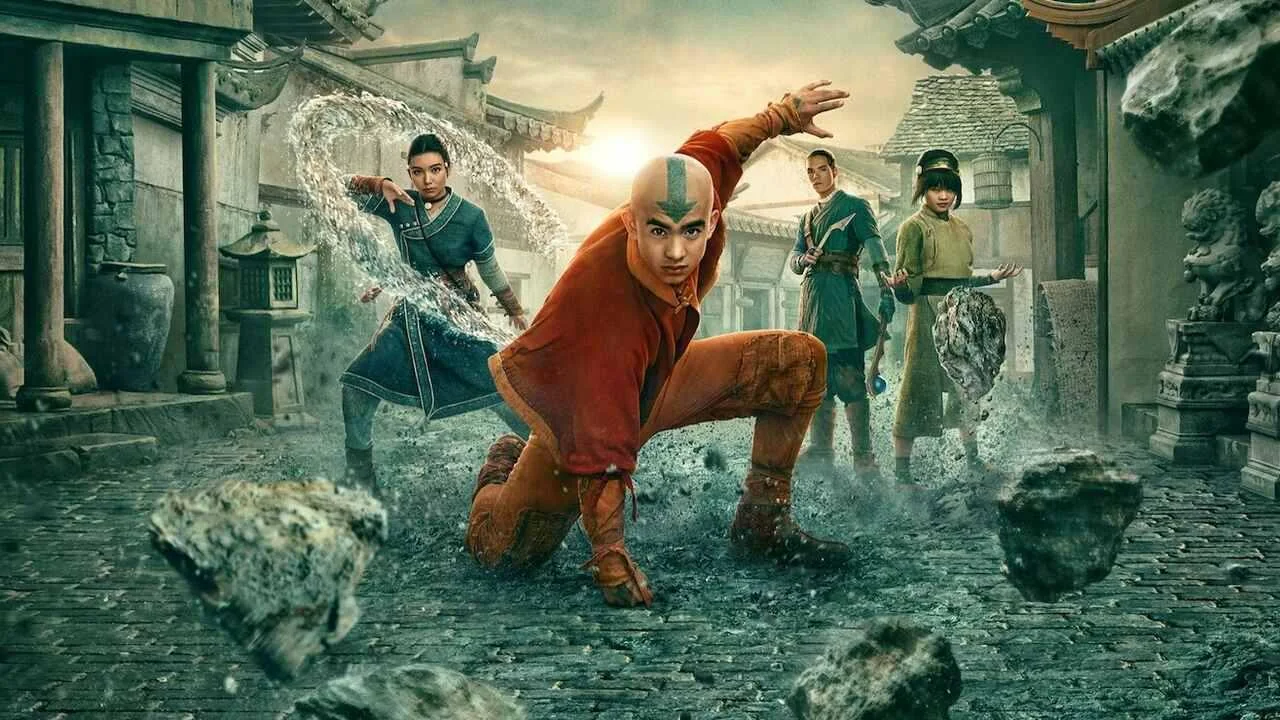

Ba Sing Se turns refuge into etiquette. Nobody has to deny the war loudly when the city has already trained its people to speak around it, smile through it, and treat silence as civic virtue. That choice gives Netflix’s Avatar: The Last Airbender Season 2 its strongest reason to exist as live-action television. The first season often seemed trapped between reverence and reinvention, caught in the awkward posture of an adaptation trying to satisfy memory before building its own dramatic language. Season 2 moves with greater confidence because it finds a governing idea: power does not always arrive as flame and conquest. Sometimes it arrives as procedure.
The new season adapts Book Two: Earth, with Aang, Katara, and Sokka traveling through the Earth Kingdom as Aang searches for an earthbending teacher. Fire Lord Ozai’s campaign keeps expanding, Prince Zuko and Uncle Iroh live as fugitives, and Azula steps into a sharper position as the Fire Nation’s chosen instrument of ambition. The structure is tighter, sometimes too tight, with seven episodes forcing major material into a crowded shape. Yet the season has a clearer argument than its predecessor. It treats war as a social condition, not merely a series of battles.
That shift matters. The Earth Kingdom is not presented as a clean moral counterweight to the Fire Nation. It has refugees, prisoners, collaborators, frightened citizens, officials protecting their status, and institutions devoted to the management of truth. The season improves because it understands that a fantasy world becomes richer when safety begins to look suspicious.
A Quest With Less Innocence
Aang’s search for an earthbending teacher gives the season a familiar adventure spine, but the writing is smarter when it lets that quest collide with civic collapse. Early scenes with the displaced people of Omashu establish the cost of war without turning civilians into background decoration. Sai the Mechanist and Amita fleeing Fire Nation soldiers place ordinary families inside the conflict before the season moves toward grander political machinery. Suki’s arrival with the Kyoshi Warriors adds momentum to the escape, and her reunion with Sokka gives the action a human flicker that the show badly needs.
The King Bumi material complicates Aang’s heroic instinct in a clean, useful way. Aang wants to free his old friend from captivity. Bumi refuses because captivity has become a form of protection for his people. It is the kind of moral knot the first season rarely held long enough. Aang’s power cannot solve the problem because the problem has been built from consequences. A rescue can become provocation. Heroism can make civilians pay the bill.
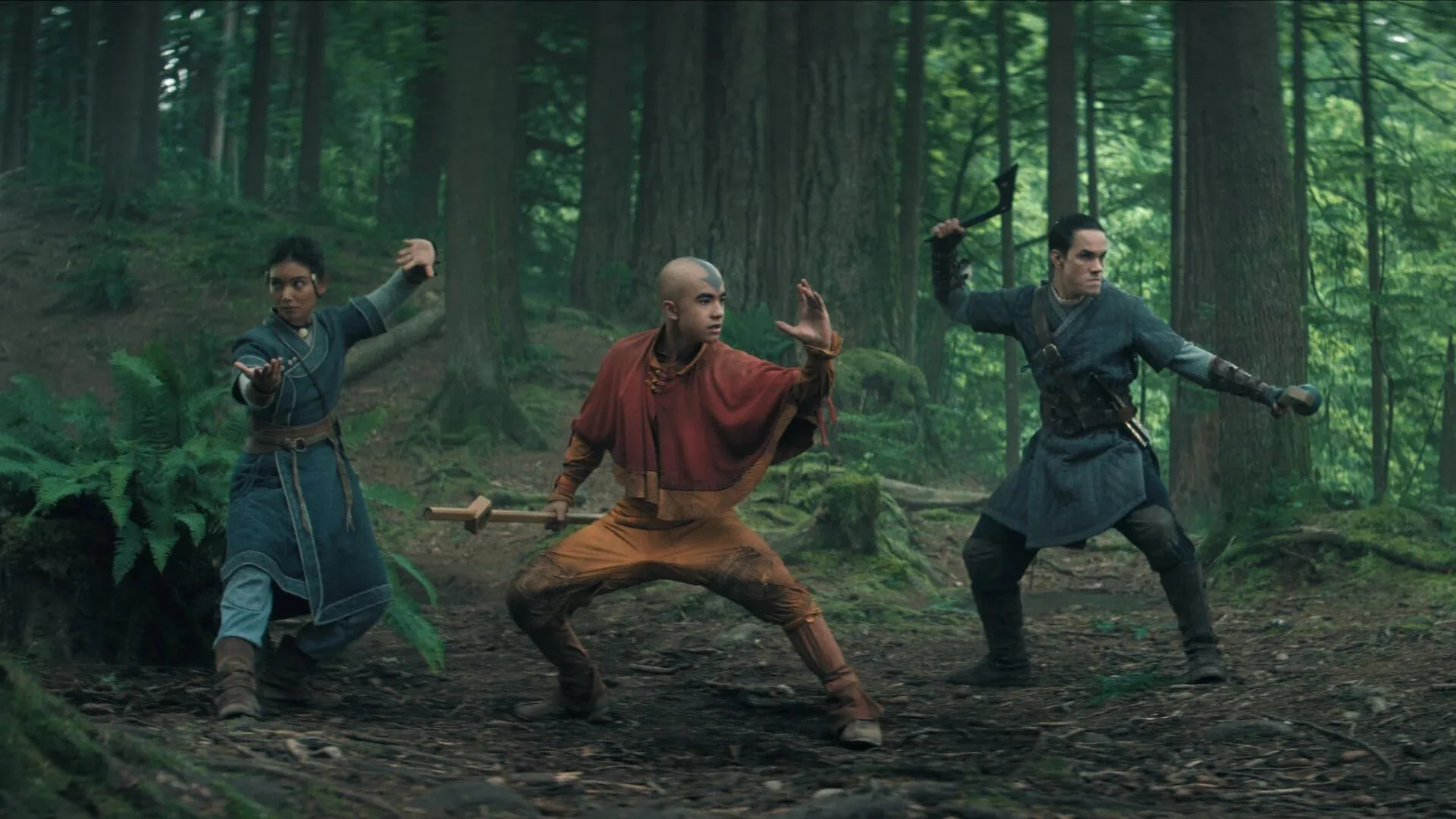
The Serpent’s Pass sequence works in a different register. Its mountain route, displaced travelers, and sea serpent attack give the premiere an action spectacle with practical pressure. Katara helping Aang move water across the pass is a stronger use of bending than simple display because it ties skill to care. Her healing lesson during the crisis turns waterbending into a language of responsibility, not decoration. Sokka’s joke about the path winding like a snake, followed by Katara’s dry reply, preserves a small pocket of the old comic rhythm. The season needs those pockets. Without them, the heavier tone would become a uniform.
Once the story enters Ba Sing Se, the season finds its most productive setting. The city’s walls promise shelter, but its order feels rehearsed. Long Feng and the Dai Li turn governance into theater. Interrogation replaces open combat. Information becomes contraband. Citizens perform calm because panic would expose the lie everyone has been asked to maintain. The result is a political thriller smuggled into a family fantasy, and it gives the live-action format a pressure the animated version did not need to carry in the same way.
Children Carrying Adult Systems
Gordon Cormier’s Aang has visibly aged, and the season makes that physical reality part of its emotional texture. The change helps the show. Aang now looks like a young teenager being asked to metabolize genocide, diplomacy, combat training, and spiritual duty in public. The boyishness remains, but it no longer functions as cover. When Long Feng treats him as a political asset rather than a child, the scene crystallizes the season’s view of power. Institutions do not care that Aang is young. They care that he is useful.
Cormier is strongest when Aang’s fear sits under restraint. His anger can still feel thin in the most heated moments, but the quieter scenes serve him well. Aang’s burden becomes visible in the pauses before he answers adults who have already decided what he represents. The writing understands him best when it lets him be overwhelmed without making helplessness his personality.
Katara remains the character most harmed by the adaptation’s uneven distribution of attention. Kiawentiio brings clarity whenever Katara is allowed to act from conviction, especially in scenes built around waterbending, healing, or protecting frightened people. The pass sequence gives her practical authority. Yet the scripts still lean on her as emotional stabilizer too often, softening the force that should define her. Her empathy works because it has teeth. The season remembers this in flashes, then returns her to support mode just as she begins to command the frame.
Sokka benefits from the opposite clarity. Ian Ousley’s performance understands that Sokka’s insecurity and usefulness come from the same place. He cannot bend, so he watches. He jokes because timing is one of the few weapons he can control. His awkward connection with Suki gives the season sweetness without turning romance into a detour. Their exchanges are small, halting, and welcome. In a story where nations keep turning children into symbols, Sokka’s ordinariness becomes its own quiet resistance.
Toph’s introduction supplies the season with a jolt of necessary friction. Miya Cech plays her as blunt without making bluntness a gimmick. Her earthbending has a different philosophy from Aang’s movement. He evades, redirects, and searches for air in every conflict. Toph plants herself and makes the world answer. Her blindness is integrated into how she senses power, space, and threat, not treated as a moral lesson for others to applaud. The scenes involving her family sharpen the point: Toph is resisting a household that mistakes protection for control. In Ba Sing Se, that private fight mirrors the public one.
Fire Nation Wounds and Family Hunger
The Fire Nation storyline remains the adaptation’s most emotionally disciplined material. Zuko’s exile with Iroh begins in humiliation rather than spectacle: vegetables, hiding, labor, a prince forced into the peasant anonymity his upbringing taught him to despise. Dallas Liu gives Zuko a trapped physicality, shoulders tense, eyes always measuring insult against opportunity. When Iroh reminds him, “We are fugitives,” the line lands because Zuko still thinks disgrace can be outrun if he finds the right target.
Zuko’s desire to leave Iroh and hunt Aang again is framed as regression, but the season wisely refuses to make it simple foolishness. Zuko has been raised inside a system where love is conditional and identity is granted by usefulness. Chasing Aang is his old religion. Without it, he has to face the emptiness beneath the title he lost.
Paul Sun-Hyung Lee’s Iroh gives the season its deepest moral unease. The show’s strongest addition is its refusal to let Iroh’s warmth erase his history. His geniality remains, but Earth Kingdom spaces force him into contact with the human wreckage of Fire Nation conquest. The former general cannot hide forever inside tea, jokes, and uncle wisdom. The season does not destroy his tenderness. It makes tenderness answer for what came before it.
Azula’s expanded role gives the royal family drama sharper social bite. Elizabeth Yu plays her cruelty as discipline learned from a father who rewards performance and calls it destiny. Ozai’s willingness to pardon Zuko wounds her precisely because it reveals that favor is never secure. Her menace grows from that insecurity. She does not simply want power. She wants proof that power has chosen her. That hunger makes her dangerous in a way fire alone cannot.
Adaptation as Translation, Not Obedience
Season 2 succeeds most when it stops treating adaptation as a checklist. The move toward Ba Sing Se earlier in the season gives the live-action version a stronger spine, even if the cost is visible. Whimsy gets reduced. Appa and Momo receive less room. Some beloved side material is compressed until it feels present by obligation rather than dramatic need. Appa’s disappearance, placed late, loses much of the slow ache it should create. Jet’s redemption, Long Feng’s manipulation, and Aang’s fear of the Avatar State all compete for space in a season that clearly needed another episode.
Still, several remixes prove the value of translation over obedience. Iroh’s past becomes a present-tense reckoning. Ba Sing Se’s eerie civic denial becomes a full surveillance drama. Toph’s family story connects naturally to the season’s wider suspicion of protective control. Sokka’s lighter beats and Katara’s healing are folded into crisis rather than treated as comic or sentimental pauses. These choices understand television rhythm. They turn inherited material into playable drama for a new medium.
The tonal reset is cleaner than Season 1’s. The show no longer keeps crashing from bright banter into grim violence with no connective tissue. It has chosen maturity, and that choice often works. The danger is that maturity can become a flattening agent if every room is dim, every exchange loaded, every joke rationed like wartime bread. The season avoids that fate most of the time because the character dynamics still carry warmth. Aang’s trust in Katara, Sokka’s nervous wit around Suki, Toph’s refusal to flatter anyone, and Iroh’s bruised gentleness keep the world from becoming purely severe.
Visually, the season remains uneven. The bending has improved, and the water serpent sequence gives the premiere scale. Earthbending gains force once Toph arrives because her stance sells impact before the effects finish the job. Yet the show still leans too heavily on dark lighting, virtual environments, and CG bodies that briefly detach the characters from physical space. Ba Sing Se’s walls and civic interiors look imposing, but too many scenes feel sealed inside streaming-era shadow. A world defined by elemental contrast should not so often look afraid of color.
The second season of Avatar: The Last Airbender is strongest as a cultural argument about managed reality. The Fire Nation burns villages, but Ba Sing Se teaches people to call smoke weather. That idea gives the season its adult force. Its flaws are real: cramped arcs, underused creatures, uneven visual texture, and a Katara still waiting for the writing to match her importance. Its gains are larger. The adaptation now understands that the child chosen to save the world must first learn how many adults benefit from pretending the world is fine.
The second season of the Avatar: The Last Airbender premiered on June 25, 2026, and is available to stream globally on Netflix. Aang, Katara, and Sokka journey deep into Earth Kingdom territory in search of an earthbending master and a way to warn the world about the Fire Nation’s plans before a looming comet arrives.
Where to Watch Avatar: The Last Airbender Season 2 Online


Full Credits
Title: Avatar: The Last Airbender Season 2
Distributor: Netflix
Release date: June 25, 2026
Rating: TV-14
Running time: 50 minutes (average)
Director: Jabbar Raisani, Jet Wilkinson, Roseanne Liang, Sanjay Patel
Writers: Christine Boylan, Phinneas Kiyomura, Helen Shang, Teresa Huang, Gabriel Llanas, Keely MacDonald
Producers and Executive Producers: Jabbar Raisani, Dan Lin, Lindsey Liberatore, Michael Goi, Christine Boylan
Cast: Gordon Cormier, Kiawentiio, Ian Ousley, Dallas Liu, Paul Sun-Hyung Lee, Elizabeth Yu, Daniel Dae Kim, Miya Cech
Director of Photography (Cinematographer): Michael Goi, Stewart Whelan
Editors: Various
Composer: Takeshi Furukawa
The Review
Avatar: The Last Airbender Season 2
Netflix’s Avatar: The Last Airbender Season 2 turns the Earth Kingdom into the adaptation’s first truly persuasive argument for itself. Ba Sing Se gives the season political menace, Toph sharpens the group dynamic, and Zuko and Iroh carry the emotional charge with rare discipline. The shorter episode count leaves Appa’s disappearance and several side arcs undernourished, and the visual palette still fights its own mythic scale. Yet the season has shape, conviction, and cultural bite.
PROS
- Strong Ba Sing Se storyline
- Excellent Zuko and Iroh material
- Toph makes an instant impact
- Sharper political stakes
- Better tonal control
CONS
- Seven episodes feel cramped
- Appa’s arc loses weight
- Dim lighting weakens action
- Katara remains underwritten
- Some CG feels weightless