









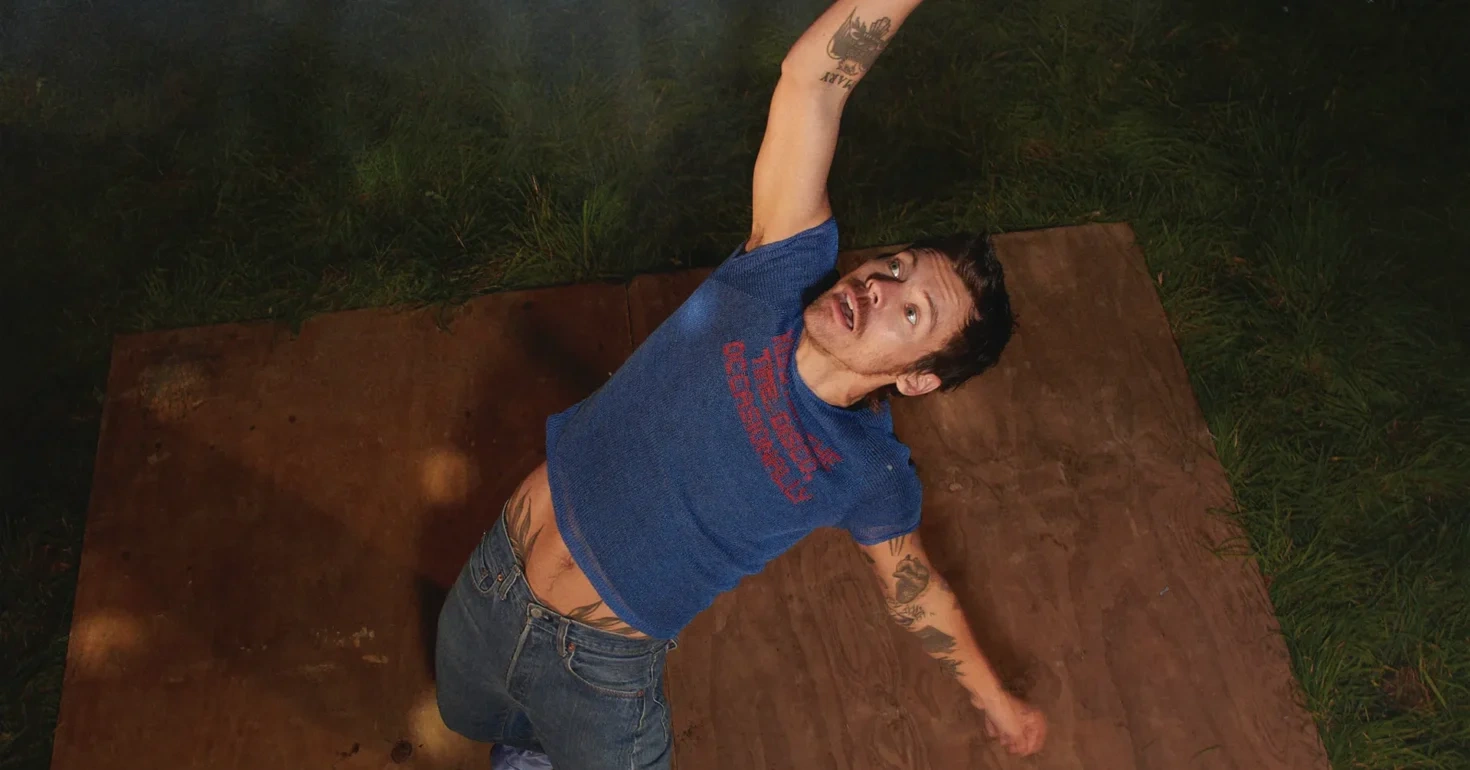

Twenty-three thousand people know the words to songs that have existed for less than a day. That sounds like a marketing statistic until Harry Styles leans into “Aperture,” hears “we belong together” returned from every side of Manchester’s Co-op Live Arena, and briefly looks as delighted as the people screaming it back.
Harry Styles: One Night in Manchester captures Styles introducing Kiss All the Time. Disco, Occasionally, his fourth solo album, by playing it straight through before allowing the familiar hits into the room. After roughly three years away from touring and new records, he could have engineered his return around nostalgia.
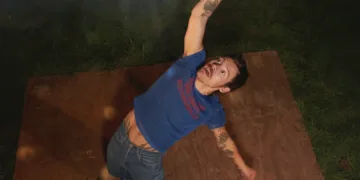
The special instead puts him beside a synth rig in a cropped blue sweater, teasing electronic textures from “Aperture” while the audience adjusts to a Harry Styles show built around dance music. The surprise is how little adjustment they need.
Shot for Netflix, the concert has the scale expected from Styles without constantly advertising its expense. The stage sits in the middle of the arena. Short runways extend toward the crowd. Microphone stands, cables and equipment remain visible. Styles returns to the stage looking less like someone unveiling a grand reinvention than a musician eager to find out what his new songs can do when thousands of bodies are moving beneath them.
Harry’s Disco Finds Its Pulse
“Aperture” is the clearest argument for hearing this album live. Its slow electronic build gives Styles room to work at his equipment before the chorus expands and the audience takes possession of it. The recorded song’s polish gives way to something warmer and slightly unruly. You can feel the arrangement breathing.
That feeling follows into “American Girls,” where the bass line carries the song forward with greater urgency, and “Ready, Steady, Go!” turns its dance-punk rhythm into an excuse for Styles to crouch, swing his hips and throw himself around the stage. None of his movements feel tightly choreographed. He appears to discover them half a second before performing them, which is probably why they are so enjoyable to watch.
The large ensemble changes the emotional temperature of the album. Laura Bibbs and Lorren Chiodo add trumpet, flute and supporting vocals, while strings and the House Gospel Choir give the quieter songs extra body. “Coming Up Roses” benefits from that patience. Styles lets the romantic ballad sit gently before the musicians gather around his voice, turning a restrained song into a shared exhale.
Some material still struggles. “Season 2 Weight Loss” is driven by a fascinating polyrhythmic drum pattern, and the band clearly enjoys pulling at its different rhythmic threads. The song surrounding that percussion never quite catches up. “Paint By Numbers” receives sweeping strings, yet the arrangement seems to be searching for an emotion the melody has not supplied.
Styles acknowledges the unfinished quality of these live versions. He mentions that the album will not always be played in sequence once the proper tour begins, and he even introduces “Season 2 Weight Loss” too early after losing track of the outs. The mistake is tiny. It also makes the night feel alive.
Put the Phones Away
The cameras spend a surprising amount of time near the stage floor. Styles is photographed through cables and microphone stands, followed from behind his shoulder, then suddenly placed against the full width of the choir and arena. These shifts give the special a sense of proximity without pretending that Co-op Live is a club.
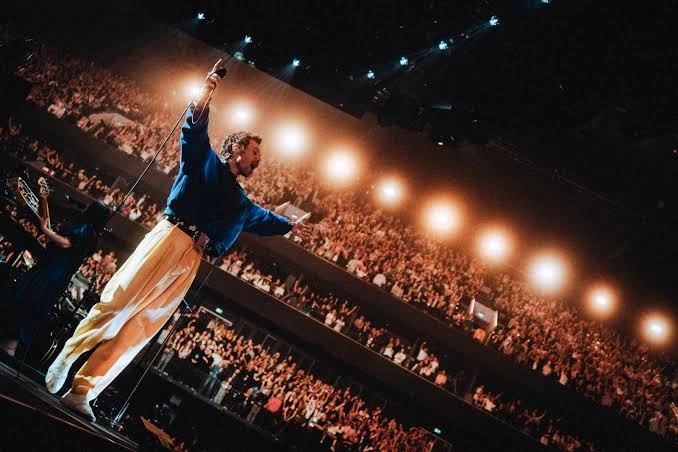
The audience helps. Phones are sealed in recording-blocking pouches, and disposable cameras have been distributed among the fans. Before Styles arrives, flashes burst across the building from people relearning the forgotten danger of having a finite number of photographs.
Once the music starts, the effect becomes emotional rather than nostalgic. During “Dance No More,” thousands of voices shout a newly released lyric together. “Pop” earns instant hysteria from the line about mixing two flavours. Styles tells the crowd during “Are You Listening Yet?” to dance and sing if they happen to know the words. They know them.
That immediate participation is the special’s strongest feeling. Styles repeatedly thanks his listeners and says he has rediscovered the privilege of being present in people’s lives through music. He repeats the sentiment enough that it could become arena-script sentimentality. His face keeps disrupting the cynicism. During several of these speeches, he looks close to tears, while the people surrounding the stage react with the kind of noise that makes hearing yourself difficult.
The filmmaking understands that connection is the event. It rarely interrupts with decorative visual tricks. The camera watches Styles absorb the crowd, send energy back, then receive an even louder response. Pop concerts can become demonstrations of machinery. This one keeps returning to people.
The Old Songs Hit Differently
“Carla’s Song” closes the new album portion with a wider, stadium-sized sound before Styles disappears for the traditional fake ending. He jokes about the ritual himself, then returns and gives Manchester what it has been waiting for.
“From the Dining Table” is the quiet surprise. “Golden” changes the room immediately. “Watermelon Sugar” pushes the temperature higher. Then the keyboard figure from “As It Was” arrives and exposes, within seconds, what much of Kiss All the Time. Disco, Occasionally lacks.
The hook is instant. The melody already seems to be moving before Styles sings. Watching the arena react, it becomes impossible to ignore the gap between a strong new song and one of Styles’ great pop songs. Yet the comparison also reveals why this concert works. Styles can carry the hazier material because he understands how to make an audience feel physically involved in it.
Before “Sign of the Times,” he speaks about chaos, hopelessness, love and kindness. The language is earnest and familiar. The song says it better. Once the first notes arrive, the arena’s noise gives way to a different kind of attention, and Styles’ debut solo single suddenly feels connected to the uncertainty he has been talking about. Then he does something stranger. He goes back to the synth desk and plays “Aperture” again.
Returning to the opening song could feel like a pop star forcing a new single into our memory. Instead, “we belong together” sounds different after ninety minutes of watching Styles and his audience prove the phrase through repetition, movement and noise. The song has changed because the room has changed it. That is what the best concert films preserve.
The spectacular live concert film Harry Styles. One Night in Manchester premiered globally on March 8, 2026, and is available to stream exclusively on Netflix. Taped on March 6 at the Co-op Live Arena in front of over 20,000 passionate fans, the film captures the global pop icon delivering a full, sequential live performance of his fourth studio album, Kiss All the Time. Disco, Occasionally., on the exact day of its physical release. Audiences with an active subscription can experience this visually cinematic musical event directly through the Netflix app on all major streaming devices.
Where to Watch Harry Styles. One Night in Manchester (2026) Online


Full Credits
Title: Harry Styles. One Night in Manchester
Distributor: Netflix
Release date: March 8, 2026
Rating: TV-14
Running time: 97 minutes
Director: Paul Dugdale, Povilas Varvoulis, Ant Barrett
Writers: Harry Styles, Paul Dugdale
Producers and Executive Producers: Ben Winston, Emma Conway, Fulwell 73, Erskine Records Production Team
Cast: Harry Styles, Elin Sandberg, Lorren Chiodo, Niji Adeleye, Pauli Lovejoy, Mitchell Rowland, Sarah Jones, House Gospel Choir
Director of Photography (Cinematographer): Brett Turnbull
Editors: Paul Dugdale, Editorial Department Crew
Composer: Harry Styles, Kid Harpoon, Tyler Johnson
The Review
Harry Styles: One Night in Manchester
Harry Styles: One Night in Manchester works because the camera catches a performer rediscovering the physical pleasure of his own music. “Aperture” grows from synth pulses into an arena-wide chant, the choir gives “Coming Up Roses” fresh warmth, and the phone-free crowd turns every shared lyric into something unusually immediate. A few new songs lose shape beside “As It Was,” whose hook still hits like electricity. Then Styles returns to “Aperture,” circles back to “we belong together,” and makes the repetition feel emotional rather than calculated.
PROS
- “Aperture” thrives onstage
- Warm, expansive live arrangements
- Intimate stage-level camerawork
- Strong phone-free crowd energy
- Styles' effortless audience connection
CONS
- Some new songs lack strong hooks
- “Season 2 Weight Loss” feels underwritten
- Gratitude speeches become repetitive
- “Paint By Numbers” lacks emotional force