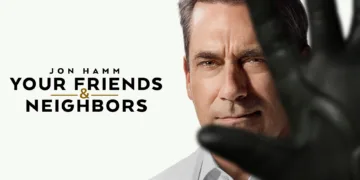









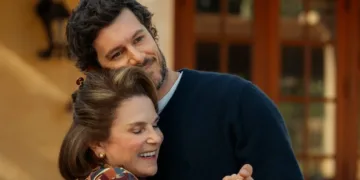












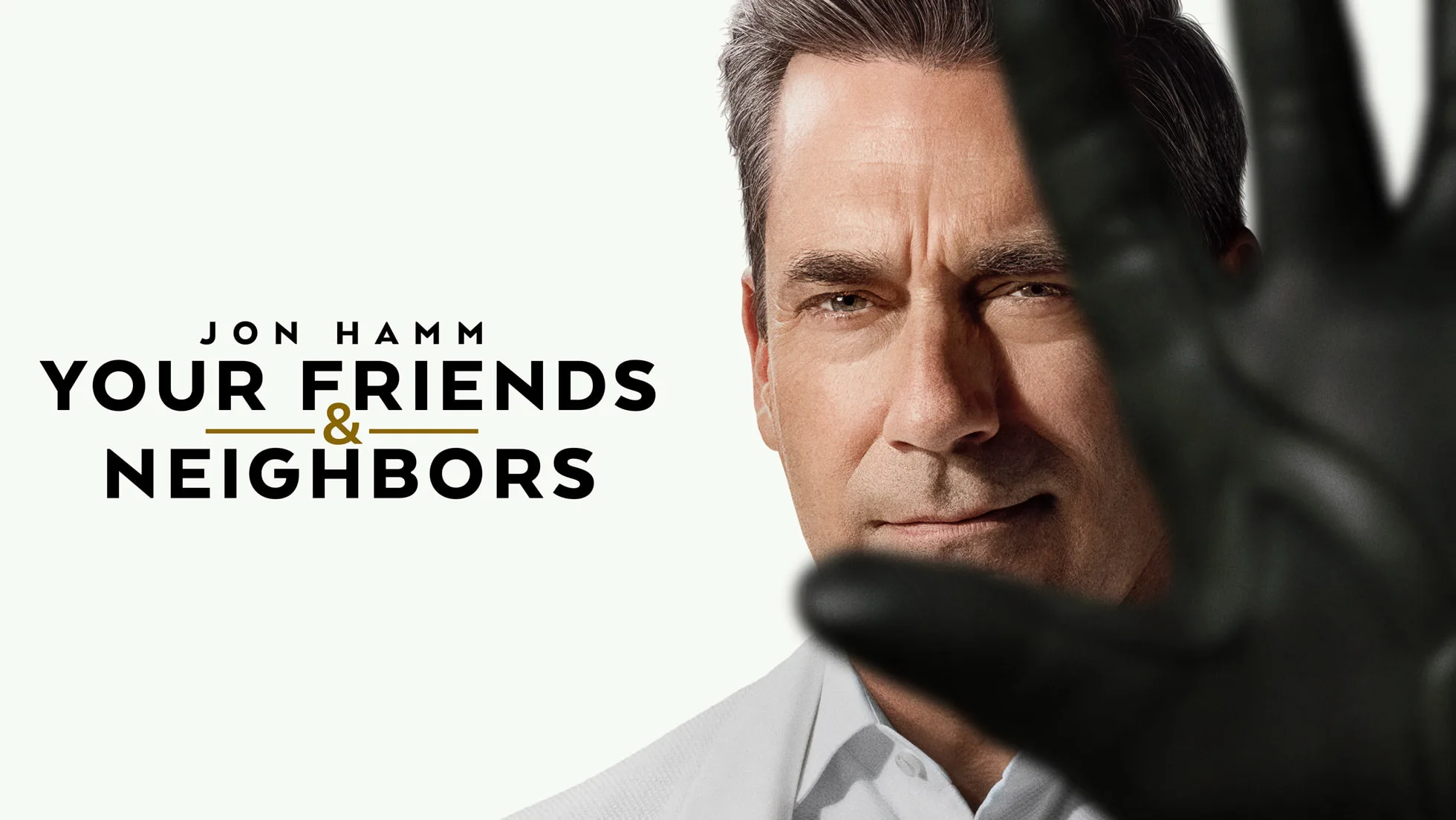

Your Friends & Neighbors returns for a second season on Apple TV+ with its most pressing question still unanswered: what kind of show does it actually want to be? Created by Jonathan Tropper and anchored by Jon Hamm as Andrew “Coop” Cooper, the series follows a disgraced hedge fund manager who, freshly exonerated of murder charges, continues robbing his wealthy neighbors in the fictional New York suburb of Westmont Village. Coop steals from people who would not notice the loss, fences the goods through a network of reluctant accomplices, and returns to their cocktail parties the same evening.
The premise carries genuine satirical potential, and Season 2 brings a significant new addition in James Marsden’s Owen Ashe, a billionaire newcomer whose arrival shakes the suburb’s carefully maintained social order. The show still cannot quite decide if it is a crime caper, a social satire, or a prestige dramedy about middle-aged self-destruction. Season 3 has already been confirmed, which means Tropper and his team have time to sharpen that answer. For now, Season 2 is a richer, darker, and considerably more entertaining outing than its predecessor.
Too Many Plates, Not Enough Table
Season 2 opens with Coop in a noticeably better mood. Exonerated, unbothered, and freely declining his old hedge fund job as an act of pointed defiance toward former boss Jack Bailey, he doubles down on his burglary operation alongside Elena (Aimee Carrero), the Westmont housekeeper who actually depends on the income. The contrast is not incidental. Elena steals to survive; Coop steals for the sensation of it. The show establishes this distinction early and, to its credit, does not let it quietly disappear.
Coop’s voice-over narrations return, his smooth pitchman cadence describing stolen items with the precision of a luxury catalogue: a Montblanc pen worth $165,000, a watch north of $225,000. It is one of the season’s most effective running devices, turning the audience into reluctant connoisseurs of obscene wealth.
The problem arrives when the crime thread has to compete for space with everything else the show attempts simultaneously. Ten episodes carry a family drama, a romantic tangle, a billionaire antagonist subplot, teenage identity crises, and a workplace revenge arc, all running at once. Some of these work. Many do not. Episode 6, “For Everything Else, There Was Bowling,” pauses the noise effectively, grounding the season in something quieter and more human. It is the rare episode that trusts stillness.
The season’s climax arrives with a genuine cliffhanger that earns its surprise, but several dramatic pivots before it feel rushed rather than earned, as though the writers banked their energy for the finale at the expense of mid-season coherence. The tonal swing between crime caper and emotional melodrama never fully steadies. At its sharpest, the show produces real schadenfreude; watching Westmont’s privileged class quietly cannibalize each other is satisfying in the way only well-observed absurdity can be. At its most scattered, it feels like a writers’ room that started with five different shows and agreed to shoot all of them.
Star Power Doing Heavy Lifting
Jon Hamm has spent his post-Mad Men career making a persuasive case that he is one of the finest character actors working in a leading man’s frame. His work as Coop in Season 2 continues that argument. The performance is looser this season, less burdened. Coop takes pleasure in his unconventional life rather than suffering through it, which makes him significantly easier to spend time with. Hamm is especially sharp in the quieter scenes: nursing scotch in front of an old film, or standing in a room full of people he is actively robbing while wearing the same polite smile he wore as their financial advisor.
The film obsession is a smart character detail. Hitchcock posters on the wall, late-night screenings of classic noir, a man who narrates his own life with the cadence of someone convinced he is the protagonist of a movie. It all holds together, and Hamm sells it without leaning too hard on it.
The season’s decisive casting win is James Marsden as Owen Ashe. Marsden plays Ashe as a man operating at a frequency slightly above what human social interaction can comfortably accommodate: charismatic, chemically assisted, and quietly terrifying. His scenes with Hamm generate a specific kind of tension, two very different kinds of self-assurance in the same room, neither willing to blink first. Ashe’s true nature emerges gradually, and Marsden is precise enough to make the slow reveal feel earned rather than withheld.
Amanda Peet carries the season’s emotional weight with minimum fuss. Mel’s arc is the most densely packed of any character: fired from her job, adrift socially, facing perimenopause, and still tangled in unresolved feeling for Coop. Peet handles this without melodrama, finding the quiet exhaustion underneath each scene. Her chemistry with Hamm is the show’s most reliable source of genuine feeling.
Olivia Munn delivers what may be her strongest screen work to date as Sam, a social pariah whose orbit intersects dangerously with Ashe’s. Hoon Lee’s Barney, Coop’s best friend and business manager, gets a morally complex season of his own. Lena Hall makes a strong impression as Coop’s sister Ali, a talented musician living with bipolar disorder, though her screen time feels insufficient for the character’s potential. Randy Danson’s Lu, the acerbic pawnbroker, remains reliably dry and sharp in a supporting role. The teenage storylines centered on Tori (Isabel Gravitt) and Hunter (Donovan Colan) are the season’s weakest thread, feeling grafted on rather than organically connected to the show’s central concerns.
Gawking at the Price Tag
Westmont Village is built on performance. Nobody here earned their status so much as inherited, married into, or financialized their way toward it, and the show understands that status maintenance is the suburb’s true full-time occupation. The price tags that flash on screen when Coop steals something are one of the season’s cleverest devices: a $165,000 pen, a watch that costs what most families earn in five years. The audience recoils and leans forward at exactly the same moment. That reaction is the show’s thesis, such as it is.

The Elena-Coop dynamic carries the season’s most honest class commentary. She steals because she has to; he steals because hedge fund capitalism left him with a gap where purpose used to be. The show does not resolve this dissonance, and it is better for leaving it open. Coop is framed as a quasi-Robin Hood figure, but the show is smart enough not to fully endorse that reading. He is the hero by convenience rather than by moral clarity.
The aging thread runs through the season with unexpected resonance. Coop’s back gives out during a break-in, a comic moment that accumulates genuine weight over subsequent episodes. He is too old for this. He also has nothing else. Mel’s perimenopause arc runs a parallel track: both characters are caught between the lives they built and the ones they are slowly being forced to rebuild. The water imagery that recurs throughout the season, characters submerged in pools and dream sequences, reinforces this quietly: people held down by their own choices.
The show’s political awareness operates at a murmur. A sauna-room joke about the current administration gets a laugh and then gets dropped. The show sees the absurdity of the world its characters inhabit but declines to press its advantage. This is a deliberate calibration rather than an oversight. Your Friends & Neighbors wants to be enjoyed, and it has correctly identified that an evening of schadenfreude is less effective with a lecture attached. The satire flatters the viewer for noticing the joke. That is, perhaps, as far as it is willing to go.
Polished to a Fault
The production design of Westmont Village does exactly what it should: it makes wealth look beautiful and faintly suffocating at the same time. The homes are aspirational and somehow airless. The social spaces, country clubs, charity galas, super-yachts, feel both enviable and vaguely punishing. This visual register suits the material, and Hamm wears it well, a man perfectly shaped to fit a world he has privately decided to pick apart.
Tropper’s writing is at its most effective in the Coop-Ashe exchanges, where two worldviews are allowed to collide without either character fully gaining the upper hand. The Elena-Coop dynamic produces a different quality of scene: sharper, more economically honest, occasionally very funny. The weakest writing surfaces in the teenage subplot and in moments where the show spells out what it should trust the actors to convey. The dark comedy lands when the show stands back and lets the absurdity breathe.
The series sits in a recognizable literary tradition, the suburban malaise of John Cheever and John Updike filtered through the aesthetics of prestige streaming. It is not attempting the structural rigour of Succession or the biting anthropology of The White Lotus. It is a well-made show that values entertainment, leans on extraordinary star power, and occasionally produces something sharper than its surface suggests.
Season 2 is a meaningful step forward. The crime mechanics are more confident, the tone is lighter without becoming frivolous, and Marsden’s arrival gives the show a genuine antagonist worth circling. What it still needs is discipline: fewer subplots, a firmer commitment to its crime-thriller spine, and the confidence to trust that its central premise is strong enough to carry a season on its own.
The acclaimed dark comedy crime drama Your Friends & Neighbors premiered its first season on April 11, 2025, and quickly became a standout hit for Apple TV+. Following the story of a disgraced hedge fund manager who resorts to petty theft in his wealthy suburb only to stumble upon dangerous local secrets, the series returned for its second season on April 3, 2026. Viewers can stream the entire series exclusively on Apple TV+, where the show continues to explore the dark underbelly of affluent suburban life.
Where to Watch Your Friends & Neighbors Season 2 Online


Full Credits
Title: Your Friends & Neighbors Season 2
Distributor: Apple TV+
Release date: April 11, 2025 (Season 1), April 3, 2026 (Season 2)
Rating: TV-MA
Running time: 48–62 minutes per episode
Director: Jonathan Tropper, Craig Gillespie
Writers: Jonathan Tropper, Jennifer Yale, Josh Stoddard, Evan Endicott
Producers and Executive Producers: Jon Hamm, Jonathan Tropper, Connie Tavel, Jamie Erlicht, Zack Van Amburg
Cast: Jon Hamm, Amanda Peet, Olivia Munn, James Marsden, Hoon Lee, Mark Tallman, Lena Hall, Aimee Carrero, Eunice Bae, Isabel Gravitt, Donovan Colan
Director of Photography (Cinematographer): Nicolas Karakatsanis
Editors: Dylan Tichenor, Affonso Gonçalves
Composer: Dominic Lewis
The Review
Your Friends & Neighbors Season 2
Season 2 of Your Friends & Neighbors is a confident, entertaining step forward that benefits enormously from Marsden's arrival and Hamm's effortless screen presence. The show remains tonally scattered and structurally undisciplined, spreading itself across too many subplots to fully satisfy as crime drama or satire. Yet it delivers enough sharp moments, strong performances, and darkly comic pleasure to justify the investment. Accept it on its own terms and it rewards you.
PROS
- James Marsden's electrifying, scene-stealing performance as Owen Ashe
- Jon Hamm anchors every scene with effortless charisma
- Darker, more confident tone than Season 1
- Amanda Peet delivers the season's most emotionally grounded work
- Olivia Munn produces career-best work
- The Coop-Elena class dynamic adds genuine moral texture
CONS
- The crime thriller premise gets buried under too many subplots
- Teenage storylines feel disconnected and underdeveloped
- Pacing issues across the 10-episode run
- Satire rarely sharpens into genuine critique
- Some dramatic turns feel rushed rather than earned