





















![Kingdom Hearts Collection [I-III] Review](https://gazettely.com/wp-content/uploads/2026/10/Kingdom-Hearts-Collection-I-III-1-360x180.webp "Kingdom Hearts Collection [I-III] Review: KHII Holds Steady as Newer Entries Fluctuate 37")





Alexander Slinger comes back to his small American hometown after his service as a Special Forces soldier in Afghanistan. In his first feature, writer-director Aaron Davidman studies the damage war leaves behind once the fighting stops. Joshua Close plays Slinger with remarkable discipline, showing a man marked by psychological injury that resists any clean recovery.
Across ninety-five minutes, the film stays away from familiar scenes of combat spectacle. Its attention stays fixed on a private war unfolding inside Slinger’s head. He tries to recover some stable sense of self in civilian life, yet the place he once knew now feels foreign.
He drifts through old spaces and familiar routines with the uneasy presence of someone who no longer fits inside them. Davidman shapes that return as a muted fight to stay mentally intact. Isolation defines the film from the start, and that feeling remains in place even in scenes where Slinger stands among people who know him.
Restraint and Relational Friction
Close builds the performance through silence, pauses, and visible strain. Slinger comes across as a man who cannot find words for his pain, even when the need to explain himself is plain. He occupies the frame like someone present in body and absent in spirit. Athena, another veteran played by Joanne Kelly, softens that solitude for brief stretches. She rents Slinger a room and offers the steadier perspective she has earned through years of therapy.
Her presence gives the film a needed point of balance, especially as Slinger keeps slipping further into confusion. His relationship with his former comrade Auggie, played by Gilbert Owuor, carries a separate charge. Their shared experience forms an intimacy that people outside military life cannot fully access. In one pointed exchange, Auggie answers the idea of returning to war with, “No, but yeah.” The line captures the pull of conflict in a few uneasy words. It suggests habit, damage, and longing all at once.
Slinger’s home life shows a different kind of fracture. He struggles to connect with his son, John, and the strain between them comes into view during a video game session that sparks Slinger’s aggressive need to win. The moment is small on paper and painful on screen.
He also spends time with Auggie’s nephew, Emmett, and those scenes reveal a man trying to interrupt a cycle he knows too well. Slinger teaches the boy gun safety and tries to strip firearms of their false glamour. He wants Emmett to see them plainly, without ego attached. These exchanges give the character a measure of purpose. They show him trying to shield a younger generation from the force that has shaped his own life so completely.
Fragments of a Shattered Perspective
Davidman gives the film a non-linear design that reflects Slinger’s broken inner life. He leaves behind a clean chronological pattern and builds the story out of fractured pieces. That structure turns Slinger into an unreliable narrator, a man who cannot always tell dreams from waking experience.

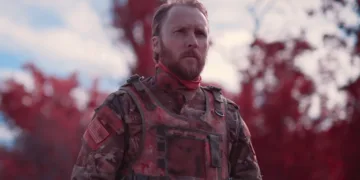
The viewer shares that instability. Trauma is not explained from a safe distance. It is felt as confusion, repetition, and interruption. The visual design strengthens that approach. Scenes set in Afghanistan are washed in magenta, a striking choice that marks shifts in Slinger’s mental state with immediate clarity.
The gun becomes the film’s central image. An early prologue shows a young Slinger cleaning a weapon under his father’s supervision. The scene gives his bond with firearms a long history and roots it in childhood training. Later, in the present, the camera watches him repeatedly take apart and reassemble his rifle. The action has the feel of ritual. It offers a kind of order that civilian life fails to provide. Davidman understands the dramatic value of repetition here. Each motion speaks to habit, memory, and a need for control.
The pacing follows that same careful design. The film moves at a steady, deliberate speed and avoids the choppy rhythm common to current action cinema. Long, attentive shots replace visual frenzy. That patience lets tension accumulate through atmosphere, silence, and implication. Many of the film’s strongest passages rely on what remains unspoken. Davidman trusts stillness, and for much of the running time, that trust pays off.
The Shift from Persona to Politics
As the story moves forward, it widens from one man’s suffering to the culture of violence around him. Slinger’s pain begins to sit inside a national frame, and the script points to the annual figure of 43,000 gun-related deaths in America. A sharp turn involving Auggie redirects the story and forces the characters to face the deadly consequences of their training in a direct way.
Davidman also draws attention to language in his treatment of self-harm. The script states that a person dies by suicide, refusing phrasing that casts the act as criminal behavior. That choice matters. It presents suicide as a human tragedy involving a victim.
Then the film changes again. In its final five minutes, the character study gives way to a documentary mode. Davidman turns the biblical image of swords into plowshares into something literal, showing weapons transformed into useful objects. The gesture is clear, earnest, and openly didactic. For most of the film, the tone stays measured and observational.
This late move into advocacy lands with a jolt. The focus shifts away from watching one damaged man and toward making a public argument about safety and violence. The ending leaves the audience with questions about healing, about what kind of repair is possible, and about the depth of trauma a society can carry for years without ever fully facing it.
American Solitaire premiered yesterday, April 17, 2026, for its limited theatrical release. It is currently screening at Cinema Village in New York City and select venues in Los Angeles. This story follows a veteran as he manages the psychological shift back to his hometown following a period of military service. Audiences can see the production in independent theaters throughout the spring season as the release expands into new markets.
Where to Watch American Solitaire (2026) Online
Full Credits
Title: American Solitaire
Distributor: Complexity Pictures
Release date: April 17, 2026
Running time: 95 minutes
Director: Aaron Davidman
Writers: Aaron Davidman
Producers and Executive Producers: Aaron Davidman, Lisa Bruce, David Oyelowo, Dylan Kussman, Maris Meyerson, Dan Cohn
Cast: Joshua Close, Joanne Kelly, Gilbert Owuor, Jamir Vega, Hudson Brooks, Lorinda Hawkins Smith
Director of Photography (Cinematographer): Hana Kitasei
Editors: Mikhail Aranyshev
Composer: Ronit Kirchman
The Review
American Solitaire
Alexander Slinger’s return to civilian life provides a sobering look at the persistence of internal war. Joshua Close anchors the film with a performance of heavy silence and physical tension. While the shift into a documentary-style finale feels abrupt, the preceding character study remains a grounded exploration of trauma. The film succeeds as a meditation on the fractured identity of a soldier. It offers a clear perspective on the difficulty of finding peace in a familiar yet distant environment.
PROS
- A restrained and authentic lead performance by Joshua Close.
- Effective use of a fragmented narrative to mirror psychological trauma.
- Specific visual language through color shifts that signal mental changes.
- A grounded portrayal of veteran support systems and generational cycles.
CONS
- The abrupt transition to a political message in the final act.
- Slow pacing in certain segments that might hinder engagement.
- Heavy reliance on internal thought occasionally reduces the narrative momentum.