























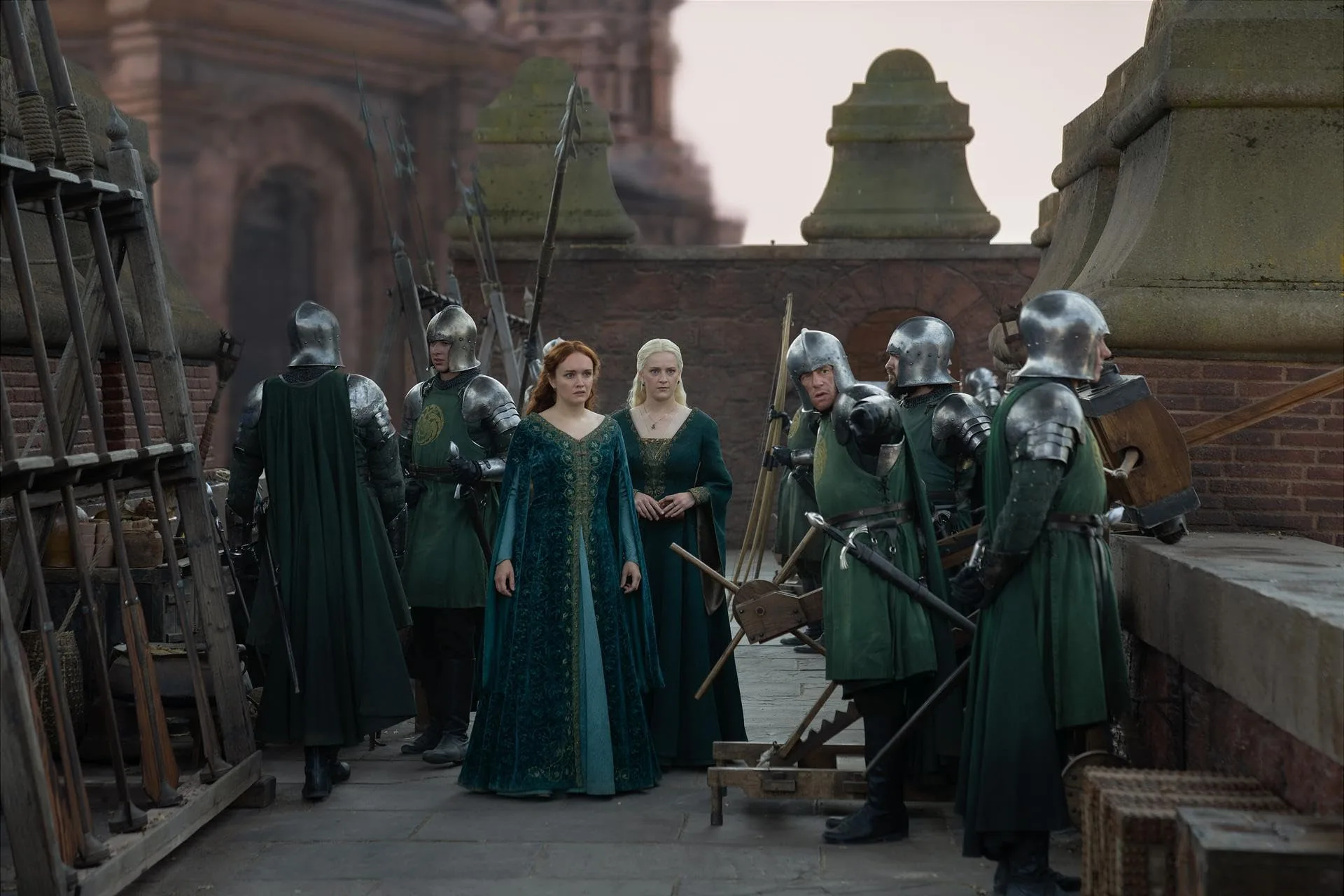

Power arrives in this episode before anyone has had time to clean the blood from the previous one. That sounds like the natural grammar of Westeros, I suppose, but House of the Dragon Season 3 Episode 2 makes the sequence feel almost indecently fast: Jace returns to Dragonstone as a corpse, Rhaenyra breaks, Daemon turns grief into political motion, and by the end she is seated on the Iron Throne with Otto Hightower’s blood at her feet. A queen has won. A mother has not survived intact.
The episode understands that contradiction better than it understands some of its mechanics. Its strongest scenes are built around the sickly intimacy between grief and legitimacy. Baela brings Jace’s body home from the Gullet, and Emma D’Arcy plays Rhaenyra’s first response as a collapse that cannot decide which emotion has the right to speak first. She is furious with her son for disobeying her. She is annihilated by the sight of him. She seems to want to strike him, then cannot bear to touch him with anything except grief. That small hesitation does what a full speech could not.
Then Daemon enters with the most dangerous gift a grieving ruler can receive: meaning. He reminds Rhaenyra of the Song of Ice and Fire, of the Targaryen dream that turns family ambition into cosmic duty. This is the Targaryen sickness in its most elegant form. Call it prophetic laundering, the process by which private violence comes out looking like public destiny. It is useful. It is also insane. Westeros has a habit of allowing rulers to baptize desire in the language of fate, then acting shocked when everyone gets burned.
D’Arcy carries the hour because Rhaenyra is no longer allowed to be one thing. In the chamber with Jace, she is exposed. At council, she is sharpened by humiliation. In King’s Landing, she is awed by the throne and visibly repelled by what it costs to reach it. The performance refuses the clean myth of female empowerment that the episode occasionally seems tempted to offer. Rhaenyra does not take power like a symbol. She takes it like a wound learning how to stand.
The City Opens Too Easily
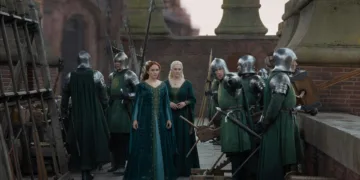
The Fall of King’s Landing should feel impossible until it happens. Here it feels spectacular, then oddly convenient. The sight of Syrax, Caraxes, Vermithor, and Silverwing descending on the capital gives the episode the scale House of the Dragon has often promised from a distance. Dragons over rooftops still work on the nervous system. The show knows this. It lets the city look small under them.
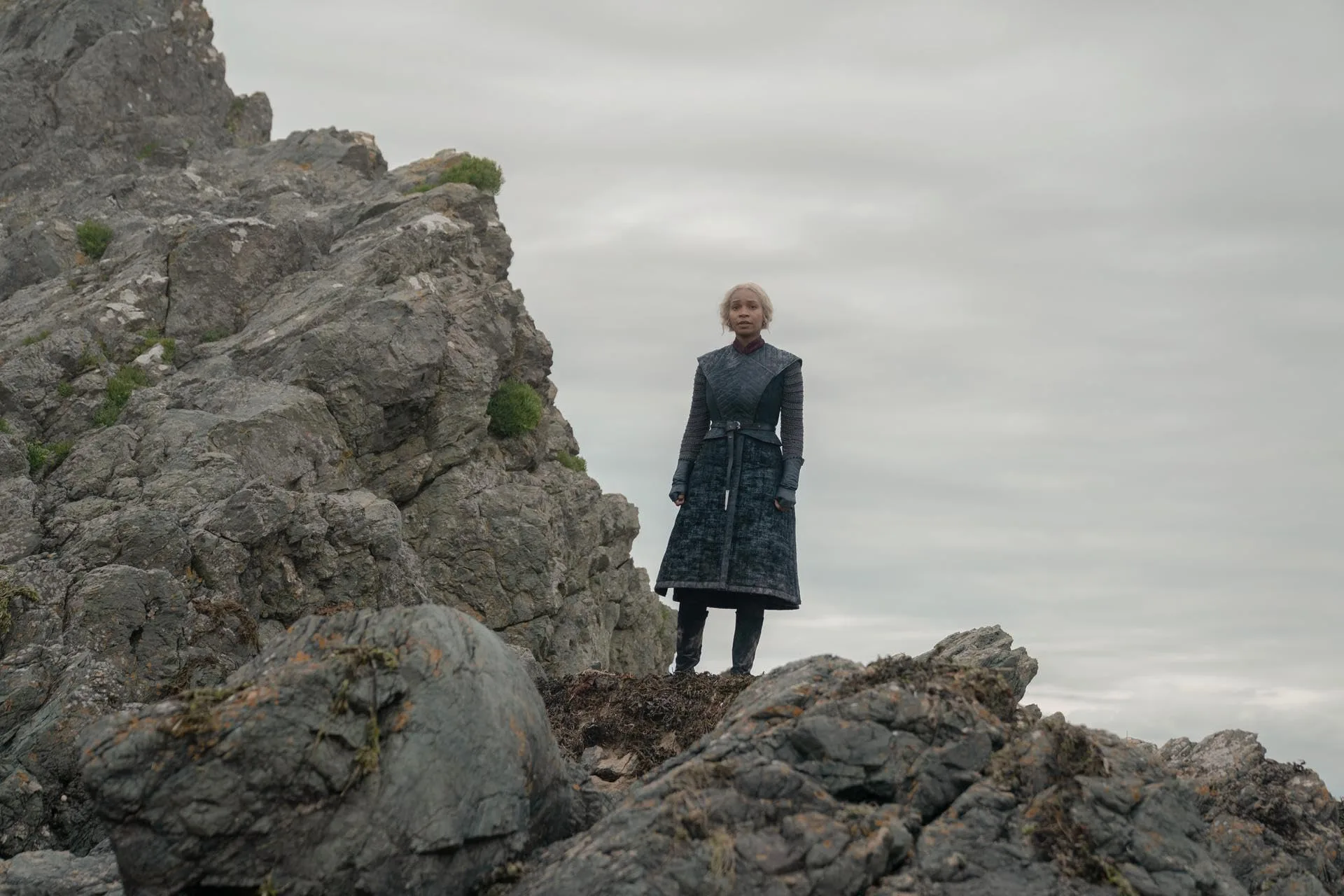
The political machinery beneath that image is less persuasive. Alicent has already prepared the ground by reaching the Gold Cloaks and instructing the scorpion crews to stand down. Aemond is away. Aegon is gone. The Red Keep’s resistance behaves as if it has read the scene outline and knows when to step aside. Daemon’s old loyalty among the Gold Cloaks is a clever callback, especially when Luthor Largent shifts the room in Rhaenyra’s favor, but the whole operation has the faint smell of a locked door opening before anyone has found the key.
This matters because the episode wants Rhaenyra’s victory to feel morally heavy. It sometimes does. Her execution of Otto Hightower is the hour’s strangest image, and maybe its most revealing one. There is physical truth in how badly she performs it. Rhaenyra is not trained for clean beheadings. She hacks, struggles, and turns punishment into labor. Rhys Ifans gives Otto enough brittle dignity in defeat that his death feels like the closing of an old system, one made of paperwork, inheritance, misogyny, and very nice collars.
The problem is the staging of the act. Westerosi power has rarely required kings to swing the sword themselves. A ruler commands death. That is the horror of monarchy: the distance between order and blood. By making Rhaenyra do the killing with her own hands, the episode seems to chase mythic severity and lands somewhere closer to public self-harm. She arrives at the throne crying, sticky with the evidence of a killing she did not need to perform personally. Maybe that is the point. Maybe the throne is not accepting her as much as swallowing her.
That reading is stronger than the scene’s logic. Sometimes interpretation has to do emergency repair on plot. It is an old critic’s disease.
Harrenhal Changes Owners
Aemond’s capture of Harrenhal is the episode’s cleanest argument for terror. Vhagar appears over the Riverlands like weather with intent, and the soldiers’ panic gives the sequence its pulse before the fire begins. Aemond does not need much dialogue here. Ewan Mitchell has learned how to make stillness look like cruelty waiting for permission.
The assault itself has a hard, efficient brutality. Aemond cuts through the garrison, reaches Ser Simon Strong, and refuses the bloodless surrender that Simon once offered Daemon. That echo is important. Daemon accepted usefulness. Aemond demands submission as theater. When Simon’s sons attack after their father’s death, the fight gives Aemond the rare chance to be frightening without Vhagar doing the philosophical heavy lifting. He is a warrior, not merely a boy standing beside an apocalypse.
Simon Strong’s death hurts because the show made him valuable by refusing to overstate him. Simon Russell Beale gave Harrenhal a dry, humane intelligence during Season 2, which made the cursed castle feel inhabited by someone who had developed manners as a defense mechanism. His final scene turns that civility into a liability. He believes surrender should mean something. Aemond teaches him that meaning has left the building.
Then Alys Rivers re-enters the board. Her earlier request to Daemon, that Rhaenyra grant her Harrenhal, is absurd on the surface. Harrenhal is not a cottage with bad drainage. It is a political seat with cursed architecture and strategic value. Daemon laughs because the request deserves laughter. Yet the scene also tells us what Alys wants, or what she wants Daemon to think she wants. By the time Aemond collapses into her care, the castle has become a test of appetite. Daemon would not pay her price. Aemond may.
This is where the episode’s off-screen choices weaken its own war. The Fishfeed, one of the Dance’s bloodiest land battles, is reduced to aftermath and celebration. Daemon drinking with Oscar Tully, Roddy the Ruin, Black Aly, and the Winter Wolves has energy, but the absence of the battle leaves a strange moral gap. The name should carry the horror of bodies feeding fish. Here it plays closer to a campfire story told after a successful raid. The war loses some of its mud.
Exiles, Heirs, and Loose Dragons
Aegon and Larys remain the episode’s most unlikely comic duet, which is another way of saying the show has finally found a use for humiliation that does not feel cheap. Their escape after the Triarchy attack has the rude blessing of accident. Aegon, broken in body and stripped of royal theater, is somehow funnier because every movement appears to insult him. Tom Glynn-Carney makes pain petty, regal, and pathetic at once. That is not easy. Matthew Needham’s Larys answers him with the calm of a man who treats catastrophe as a scheduling problem.
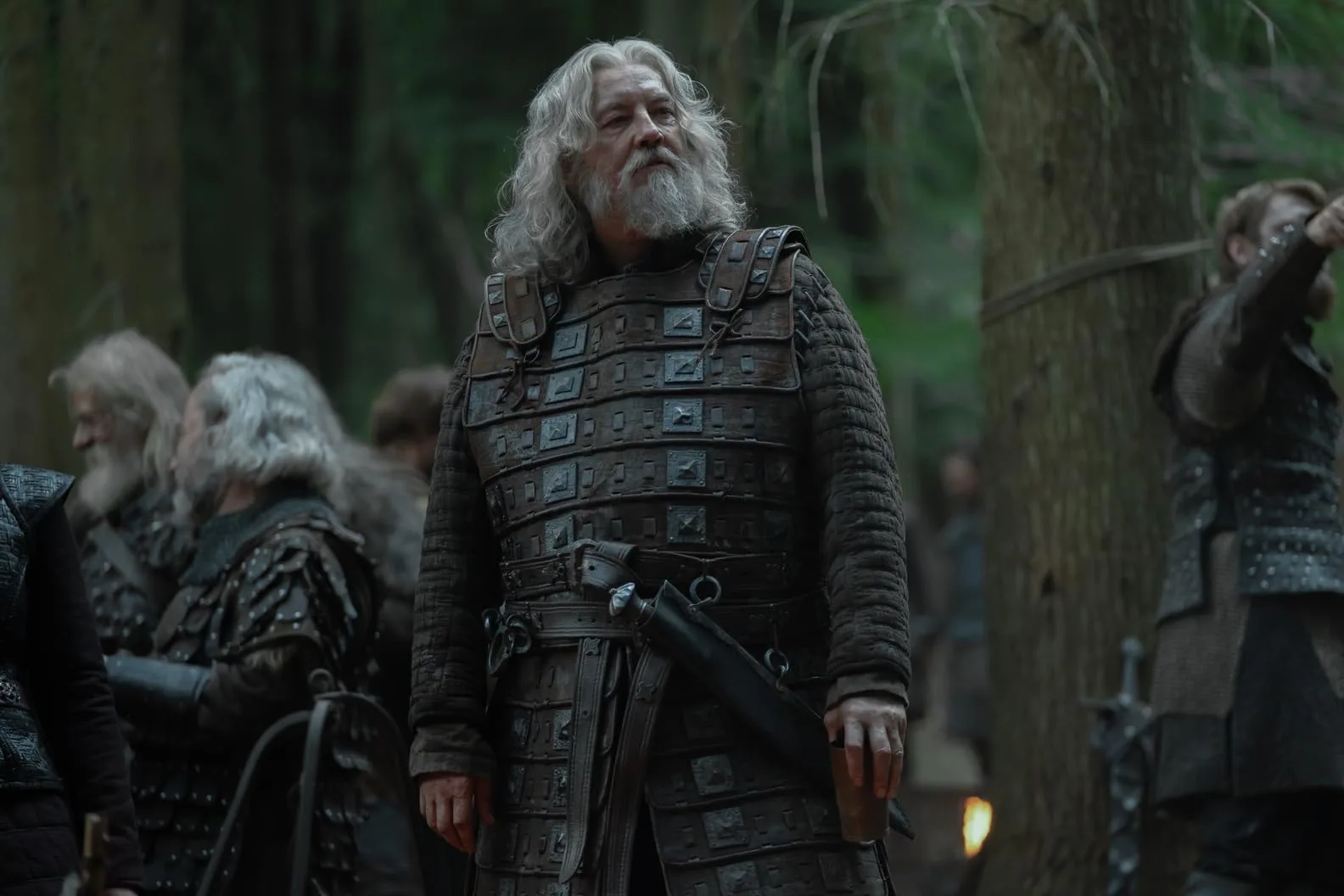
Their decision to head toward Rook’s Rest is loaded with old injury. Aegon is not only running from Rhaenyra. He is moving toward the place where his body and kingship were ruined. Sunfyre hangs over this choice like a golden question the show has been refusing to answer directly. If Aegon finds the dragon alive, his exile becomes something sharper than survival. If he does not, he becomes a king made entirely of grievance. Either version is dangerous.
Rhaena’s thread in the Vale gives the hour a different kind of instability. She arrives before Lady Jeyne Arryn seeking sanctuary after Sheepstealer’s chaos at the Gullet helped lead to Jace’s death. The scene works because Jeyne’s anger is practical, not melodramatic. Rhaena abandoned her duty to take the children to Pentos, claimed the wild dragon, and returned with disaster behind her. Lady Jeyne cannot embrace her without making herself part of the disaster. She also wants a dragon in the Vale. Principle and self-interest sit across from each other in the cold air, pretending not to know one another.
The Velaryon material is softer and, for that reason, welcome. Alyn, Addam, and Baela searching for Corlys gives the episode a pocket of familial feeling that is not poisoned by immediate succession math. Corlys surviving the Gullet, then offering to legitimize Alyn and Addam, turns loss into a small act of repair. Steve Toussaint plays him as a man who has discovered that treasure sinks faster than regret. Baela and Alyn’s brief warmth also hints at future complications without pinning a sign to the wall.
Alicent and the Shortcut Problem
Alicent’s story is where the episode most visibly loses faith in its own intelligence. Her attempt to prepare King’s Landing for Rhaenyra has a sturdy dramatic shape: a city under threat, an insider trying to open the gates, a plan fraying under pressure. Olivia Cooke gives Alicent the nervous momentum of someone who has chosen treason and is now learning that treason involves errands. She moves through the Gold Cloaks, the battlements, and the Red Keep with the frantic focus of a woman trying to save Helaena and Jaehaera from the fire she helped feed.
Then the episode gives her the Jasper Wylde scene, and the whole structure curdles.
The attempted assault is not shocking in a useful way. It is shocking in the way a lazy shortcut is shocking: it cuts through character, motive, and consequence to force a result the plot needed anyway. Jasper has functioned largely as a council presence, yet here he becomes a sudden embodiment of sexual threat so the story can get him to the dungeon and later into Daemon’s reach. Alicent is again made to absorb male violence so the machinery can move. There is a grim poverty in that choice.
This is especially frustrating because Alicent’s final position in the throne room already contains enough agony. She has betrayed her own side to save what remains of her family. She has failed to escape. She enters with Helaena and sees Otto’s body bleeding below Rhaenyra’s new authority. Cooke does not need the earlier violation to make Alicent look destroyed. Her face at the sight of her father’s corpse does the work. The episode added ugliness where tragedy was already waiting.
The dialogue has a similar bluntness in smaller doses. Too many lines state what the scene should imply. Rhaena asking Jeyne if she wants a dragon, Baela reducing Corlys to “stern but gentle,” Daemon’s little verbal jabs at Ulf, Rhaenyra announcing her business with Otto: none ruins the episode alone. Together, they thin the texture of a world that depends on language as much as bloodline. Westeros should sound like a place where even an insult has a family history. Here, too often, people speak like they are trying to finish the scene.
And yet, the final image works. Annoyingly, magnificently, it works. Rhaenyra sits above the room, wet-eyed and blood-adjacent, trying to look like history has chosen her. Alicent stands below, forced to read her father’s death as both justice and betrayal. The childhood friendship that the show keeps trying to preserve has no place in that pool of blood. Let it die there. Some ghosts are useful only when they stop asking for dialogue.
House of the Dragon Season 3, Episode 2, titled “Queen’s Landing,” premiered on June 28, 2026, and is available to stream on HBO and Max. The epic fantasy drama series serves as a prequel to Game of Thrones and chronicles the brutal internal succession war within House Targaryen. In this particular episode, the narrative explores the devastating emotional fallout from the Battle of the Gullet as Queen Rhaenyra Targaryen rallies her forces and makes a massive, game-changing move to capture the Iron Throne.
Where to Watch House of the Dragon Season 3 Episode 2 Online






Full Credits
Title: House of the Dragon Season 3 Episode 2 (Queen’s Landing)
Distributor: HBO, Max
Release date: June 28, 2026
Rating: TV-MA
Running time: 62 minutes
Director: Clare Kilner
Writers: Sara Hess, Ryan Condal, George R. R. Martin
Producers and Executive Producers: Ryan Condal, George R. R. Martin, Sara Hess, Alan Taylor, Melissa Bernstein, Kevin de la Noy, Loni Peristere
Cast: Matt Smith, Emma D’Arcy, Olivia Cooke, Steve Toussaint, Fabien Frankel, Matthew Needham, Sonoya Mizuno, Tom Glynn-Carney, Ewan Mitchell, Harry Collett, Phia Saban, Bethany Antonia, Jefferson Hall, Abubakar Salim, Clinton Liberty, Phoebe Campbell, Kurt Egyiawan, Freddie Fox, Gayle Rankin, Kieran Bew, Tom Bennett
Director of Photography (Cinematographer): Alejandro Martínez, Fabian Wagner, PJ Dillon
Editors: Tim Porter, Crispin Green, Jinx Godfrey, Frances Parker, Selina MacArthur
Composer: Ramin Djawadi
The Review
House of the Dragon Season 3 Episode 2 (Queen's Landing)
House of the Dragon Season 3 Episode 2 is the hour where grief becomes statecraft, then statecraft becomes spectacle with a suspiciously clean floor plan. Rhaenyra’s ascent has real tragic force because Emma D’Arcy plays victory like an infected wound, and Aemond’s Harrenhal sequence gives the war its sharpest menace. Yet the episode keeps sabotaging itself with blunt dialogue, rushed turns, and a miserable Alicent subplot that mistakes degradation for drama. A throne is taken. Narrative discipline, less so.
PROS
- Emma D’Arcy’s grief-struck performance
- Vhagar’s assault on Harrenhal
- Rhaenyra finally taking action
- Aegon and Larys’ bleak comic rhythm
- Strong final throne-room reversal
CONS
- Alicent assault scene feels cheap
- King’s Landing falls too easily
- Dialogue often sounds too plain
- Fishfeed skipped off-screen
- Forced tension around allies