












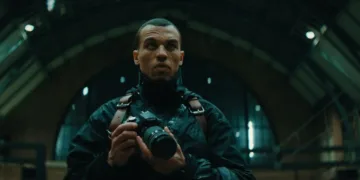












Eduardo arrives in Guadalajara dressed for a university entrance exam, yet his attention keeps drifting toward a different kind of admission. He is 18, away from his small town in Jalisco, and newly able to pursue the queer life he has so far encountered through a phone screen. Rafael Ruiz Espejo builds The Last First Time around that collision between an official test and a private one.
Alejandro Quintana plays Eduardo with a nervous physical precision. His sensible shirt, guarded posture, and constant checking of his phone suggest a boy still carrying home on his body. His mother never appears, but her repeated messages and calls exert pressure from a distance. The city offers anonymity, possibility, and the dangerous thrill of having nobody nearby who can order him back.
The film’s compressed day-and-night structure gives Eduardo little time to process anything. Each encounter arrives before the previous one has settled, producing the breathless logic of an 18-year-old determined to fit several years of freedom into a few hours.
A Birthday Party Before Sex
Mario first appears as everything Eduardo wants to become. Played by Carlos E. López Cervantes, he is confident in his gaze, casual in his attraction, and comfortable enough to invite Eduardo home shortly after their encounter near the exam. Eduardo expects a hookup. Mario’s family has other plans.
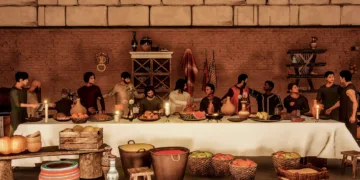
The surprise birthday party is the film’s most revealing sequence because it turns an anticipated sexual encounter into a social test. Mario’s relatives welcome Eduardo without treating his presence as suspicious. Mario does not conceal him or manufacture an excuse. For Eduardo, acceptance this ordinary is almost harder to handle than desire.
A playful cake-smearing exchange captures the difference between the two young men. Mario moves easily through affection and embarrassment, while Eduardo stiffens under the attention. Quintana lets the discomfort register through his shoulders and hesitant responses. The scene requires no speech explaining Eduardo’s home life. His mother’s cold messages have already supplied the missing atmosphere.
Mario becomes both a real companion and a projection. Eduardo sees sexual confidence, family acceptance, and urban freedom collected in one person. His attraction is sincere, yet it also carries the weight of everything he believes Guadalajara can give him. That imbalance lends tenderness to their connection without pretending that a few shared hours constitute a settled romance.
Tequila, Poppers, and Half a Tattoo
Once Eduardo joins Mario and his friends, the film shifts into a loose chain of escalating firsts. Tequila leads to a gay club, poppers, sex, an unfinished tattoo, vomit on a shirt, and a phone that suffers the indignity of being urinated on. Ruiz Espejo keeps the events funny, erotic, and uneasy in roughly equal measure.
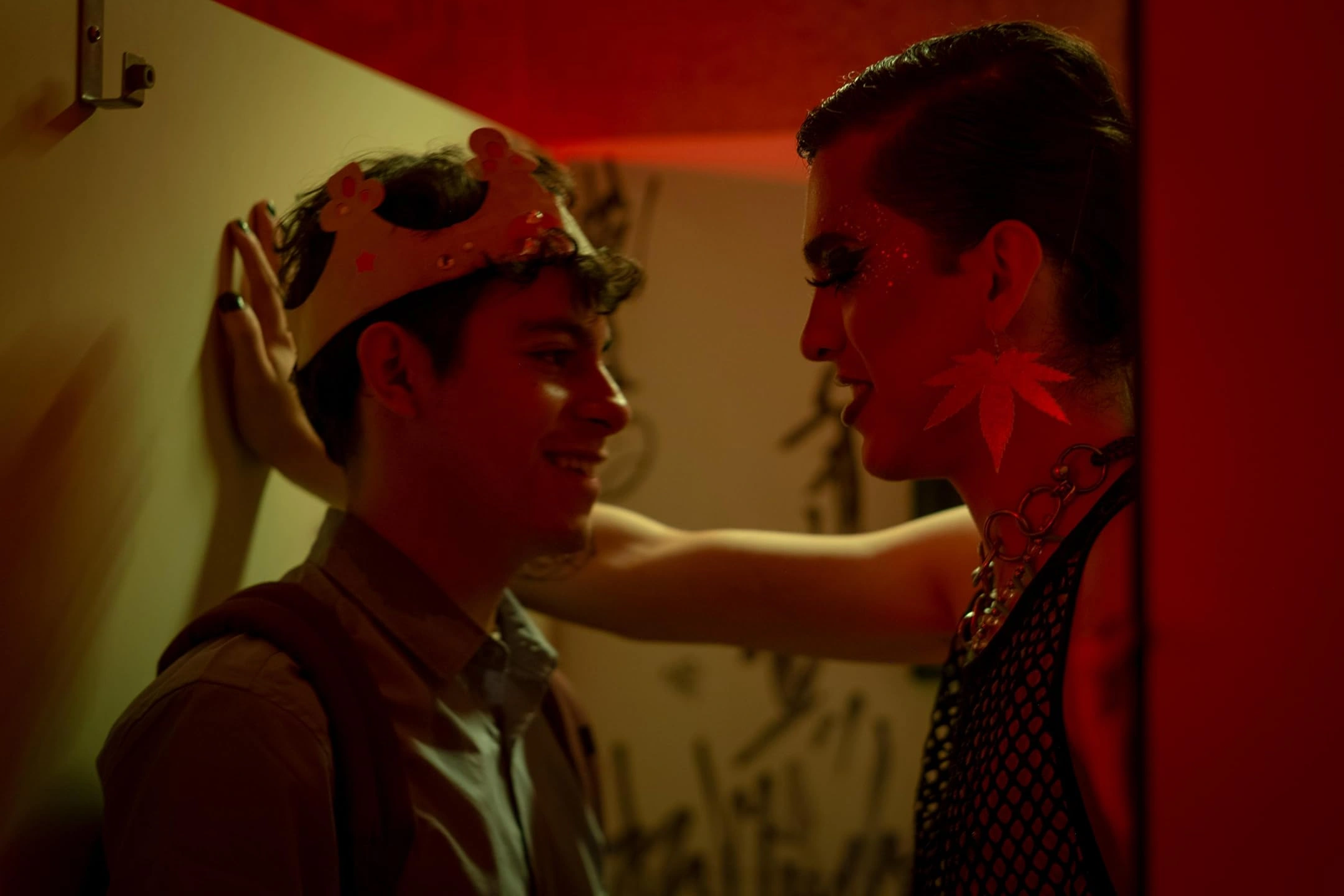
The sexual scenes are frank because sex is the language Eduardo has chosen for his freedom. The camera does not treat his desire as a problem waiting for punishment. It pays equal attention to the awkwardness surrounding intimacy: the glances before contact, the pauses between bodies, and Eduardo’s attempts to imitate the ease he sees in everyone around him.
That directness matters. Queer coming-of-age stories have often been shaped around discovery followed by danger, shame, or rejection. Here, pleasure receives space of its own. Risk remains present, especially during Eduardo’s encounter with an older man whose attention carries a predatory edge, but the night is not converted into a morality lesson.
I kept noticing how little dialogue the film needs once the group enters the city’s nightlife. Eduardo watches faces, rooms, and gestures with an intensity that makes him seem aware of the night becoming a memory while it is still happening. Sparse dialogue places extra weight on body language, and Quintana meets that demand. His posture loosens around Mario, then grows increasingly erratic as alcohol and exhaustion take over. Excitement never fully erases fear.
The episodic structure has a cost. Mario’s friends remain lightly sketched, and Mario himself sometimes functions as the doorway into Eduardo’s awakening rather than a fully explored character. The film has chosen immediacy over depth, and its supporting cast carries the mark of that choice.
The Bus Home
The return trip mirrors Eduardo’s arrival without restoring him to the same emotional position. He is exhausted, embarrassed, sexually experienced, and newly aware of a life that exists beyond his mother’s messages. The entrance exam may decide where he studies, but the night has already altered his sense of what adulthood might contain.
Ruiz Espejo resists treating sexual experience as an instant personality transplant. Eduardo has crossed a threshold, yet he has not become Mario. His family situation remains unresolved, his academic future is uncertain, and his confidence may look different once Guadalajara is behind him.
The unfinished tattoo is the film’s cleanest expression of that state. Eduardo has begun marking himself through choices made away from home, but the image is incomplete. So is he.
This Mexican coming-of-age drama was released on May 28, 2026, and is available through select international film distributors and festival screenings. The story follows an eighteen-year-old boy from a small town who travels to Guadalajara for a university exam and experiences a transformative journey of love and self-discovery.
Full Credits
Title: The Last First Time
Distributor: Piano Distribución, NQV Media
Release date: May 28, 2026
Running time: 75 minutes
Director: Rafael Ruiz Espejo
Writers: Rafael Ruiz Espejo
Producers and Executive Producers: Rafael Ruiz Espejo, Luna Martínez Andrade, Pável Estrella, Simon Savory
Cast: Alejandro Quintana, Carlos E. López Cervantes, Pabel Castañeda, Jaime Bernache, Cote Medeles
Director of Photography (Cinematographer): Bruno Herrera
Editors: Nancy Cruz, Luna Marán
Composer: Alejandro Camarena
The Review
The Last First Time
The Last First Time captures queer adolescence through one unruly day in Guadalajara, where an entrance exam gives way to Mario’s birthday party, a nightclub, sex, tequila, and one regrettably soaked phone. Alejandro Quintana makes Eduardo’s impulsiveness feel painfully credible, shifting from guarded posture to reckless confidence without losing the fear beneath it. Rafael Ruiz Espejo’s narrow timeframe limits the supporting characters, yet its frank intimacy and refusal to punish pleasure give this familiar coming-of-age shape a distinct emotional charge.
PROS
- Alejandro Quintana’s layered performance
- Frank, purposeful sexual intimacy
- Warm birthday-party sequence
- Sharp small-town and city contrast
- Specific portrait of queer desire
CONS
- Mario remains lightly developed
- Supporting friends lack definition
- Familiar coming-of-age framework
- Limited dramatic tension