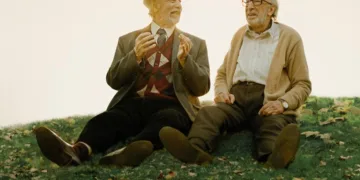






















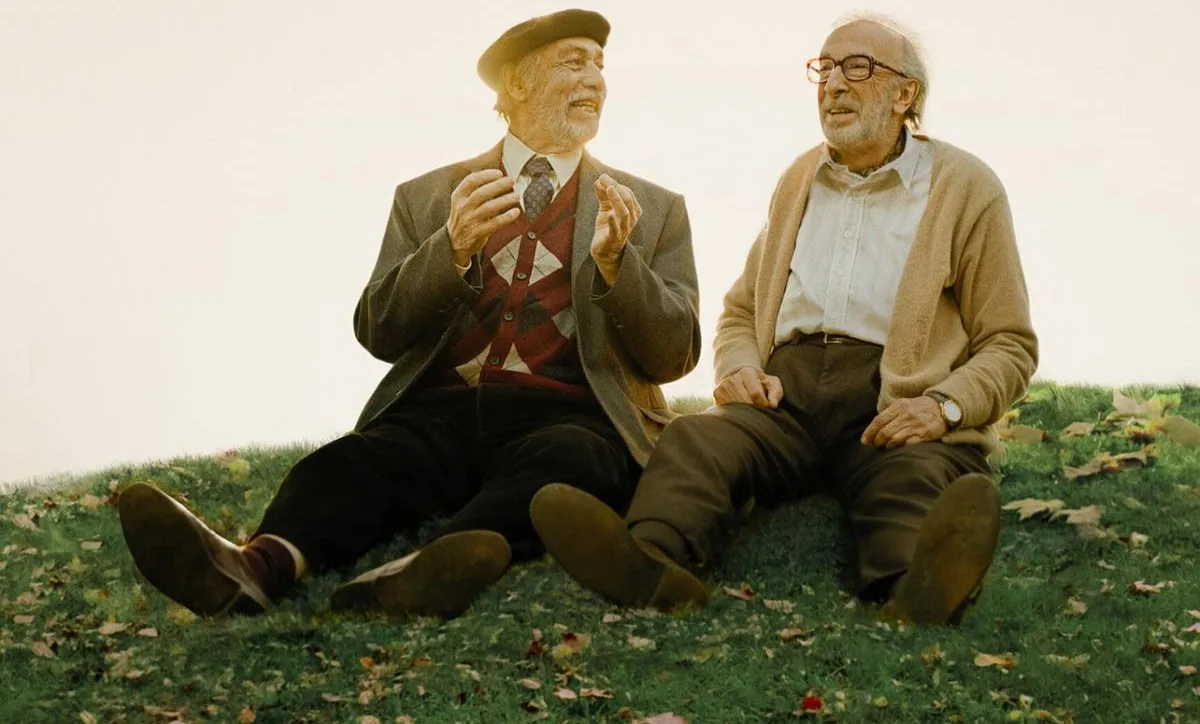

Time has narrowed Antonio Cardozo’s vision until the world appears to him through something like a straw, yet every morning he still raises a newspaper before his face. The ritual matters. Perhaps the words do too, but the gesture carries a quieter desperation: a man continuing to perform the life he remembers having. Then León Schwartz arrives and refuses to allow silence.
Juan José Campanella adapts Herb Gardner’s I’m Not Rappaport through the Argentine stage production he previously directed, relocating this friendship to Parque Lezama. Luis Brandoni’s León claims to have been a spy, a lawyer, a dead man for six minutes, and enough other things to fill several lives.
Eduardo Blanco’s Antonio, a building superintendent facing forced retirement, would prefer to sit peacefully and distrust every syllable. Two elderly men. One bench. An entire war over how to remain alive when the world has quietly begun speaking about you in the past tense.
Bickering as a Love Language
Brandoni treats each of León’s lies as a temporary country and immediately declares himself president. Watch the speed with which he inhabits the lawyer persona when Antonio’s employment is threatened. His posture firms, his vocabulary changes, and threats of legal action arrive with such conviction that truth becomes irrelevant for a few minutes. León does not need his stories to be factual. He needs them to work. The film keeps returning to this distinction.
When Antonio explains his failing peripheral vision, León answers, “Why do we need sight when we have vision?” It is an absurd line, almost offensively ready for embroidery on a cushion. Brandoni makes it hurt. León has constructed his existence around precisely that principle, replacing the limits of reality with whatever tale allows him to keep moving.
Antonio moves in the opposite direction. He accepts his routines, boasts about his grandchildren, and tries to avoid unnecessary conflict. Blanco gives him a heavy physicality, though his gravelly voice and enlarged gestures sometimes turn restraint into visible performance.
Antonio can feel composed from the outside rather than discovered from within. Still, Blanco finds sharp little reactions whenever León starts another impossible story. A glance lingers. The mouth tightens. Antonio knows he is being lied to and listens anyway.
Their insults slowly become a private language. Antonio raises his fists. León exhausts every available particle of oxygen. They accuse each other of cowardice, stupidity, and being exceptionally accomplished sons of bitches. Campanella rarely asks them to announce affection because their friendship exists in the fact that both keep returning to the same bench. There are forms of loneliness that look remarkably like routine.
Fighting Old Wars
León’s daughter Clarita believes her father is losing his ability to care for himself. Her fear is reasonable. He wanders through the park, invents identities, lives alone, and inserts himself into dangerous situations with the confidence of a much younger man who also happens to be an idiot. León hears something else. He hears the first draft of his disappearance.
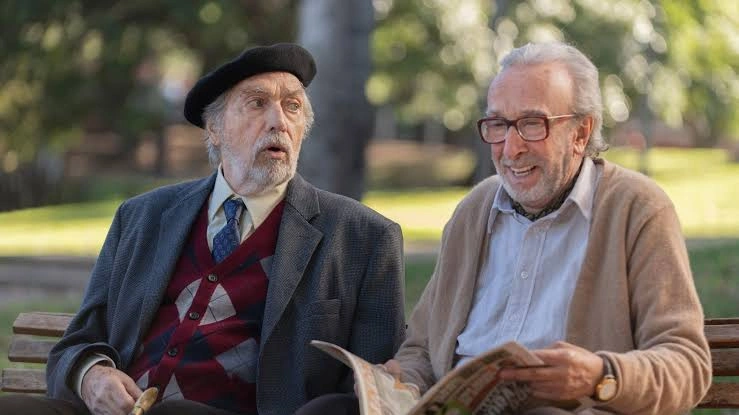
Their argument exposes the film’s darkest idea. Clarita tells him he is still “fighting old wars,” referring to the political battles that shaped his life as a communist militant. León responds by mocking her comfortable existence, her condos, and children sitting in front of Netflix. The specific politics matter, but the wound underneath them is older. Clarita thinks history has moved forward. León suspects history has merely stopped asking for him.
Antonio faces the same erasure through employment. His deteriorating sight gives the building owner a practical reason to remove him as superintendent, yet the conversation around his retirement carries the soft cruelty of decisions presented as kindness. Nobody needs to call him useless. The paperwork can imply it.
Campanella places the men at opposite ends of this fear. Antonio tries to become smaller, hoping compliance will protect the portion of life he still possesses. León expands. He talks louder, invents greater histories, threatens lawsuits, confronts muggers, and involves himself in Laurita’s trouble with a violent drug dealer.
Some of these encounters feel imposed on the central relationship. The mugger and drug-related threat enter like mechanisms designed to force two seated men into motion. Yet León’s recklessness has thematic force. He would rather make the wrong decision himself than have the correct decision made on his behalf. What is dignity after a certain age? Apparently, it may include the right to make a complete mess of things.
The Theatre Never Quite Leaves
Campanella refuses to disguise the bones of the stage production. Parque Lezama remains the dominant space. Antonio’s building stays largely outside the frame, and León’s family conflict returns to the bench rather than pulling the film toward domestic locations. This creates an odd tension between intimacy and confinement.
Close-ups give Brandoni opportunities the theatre could never offer. During León’s stories, his face occasionally betrays a fraction of hesitation before the next invention arrives. Campanella catches these pauses without exposing the truth behind them. Is León remembering, fabricating, or standing somewhere between both? The camera gets closer and leaves the mystery intact.
The same proximity helps Antonio. His best moments come when Blanco reduces the volume and lets Antonio absorb León’s words before answering. A tiny delay can say that Antonio has recognized the lie, considered objecting, and chosen companionship instead.
Campanella’s timing keeps many of the long verbal exchanges alive, especially when León’s rapid inventions crash against Antonio’s irritated disbelief. Yet two hours place enormous pressure on this rhythm. Bench conversations begin to repeat their shape, and several monologues remain rooted in theatrical duration. The film occasionally seems to wait for applause that no cinema audience has been instructed to provide.
The score causes another problem. Sentiment is already present in Antonio’s failing eyes, León’s arguments with Clarita, and the knowledge that both men are measuring a shrinking future. Music sometimes presses against these moments until sadness becomes an instruction.
Still, the bench persists. Morning becomes evening. Stories accumulate, insults soften, and two men who claim to find each other unbearable return once again. Maybe León is lying about nearly everything. Antonio keeps showing up to hear him.
The Argentine comedy-drama Strangers in the Park (originally titled Parque Lezama) premiered globally on March 6, 2026, and is available to stream exclusively on Netflix. Adapted from Herb Gardner’s classic play I’m Not Rappaport, this feature film is accessible to viewers worldwide on the platform with an active subscription. The heartwarming narrative centers on a former communist militant and an easygoing, “live and let live” companion who strike up an unlikely friendship on a Buenos Aires park bench, sharing their rich life stories, navigating the trials of aging, and defending their space with humor and resilience.
Where to Watch Strangers in the Park (2026) Online


Full Credits
Title: Strangers in the Park
Distributor: Netflix
Release date: March 6, 2026
Running time: 115 minutes
Director: Juan José Campanella
Writers: Juan José Campanella, Eduardo Blanco, Luis Brandoni
Producers and Executive Producers: Juan José Campanella, Muriel Cabeza, Telefe, 100 Bares Production Team
Cast: Eduardo Blanco, Luis Brandoni, Verónica Pelaccini, Agustín Aristarán, Manuela Menéndez, Matías Alarcón
Director of Photography (Cinematographer): Félix Monti
Editors: Juan José Campanella
Composer: Emilio Kauderer
The Review
Strangers in the Park
Strangers in the Park finds its melancholy in two old men refusing to disappear quietly. Luis Brandoni gives León's lies the pulse of a man terrified of becoming invisible, while Eduardo Blanco's broader mannerisms sometimes strain Antonio's quieter sorrow. The park bench can feel like a prison during the film's repetitive stretches, yet Campanella keeps finding small human tremors in the arguments, insults, and reluctant acts of loyalty. Growing old is inevitable. Being treated as already absent is another matter.
PROS
- Brandoni's restless, layered performance
- Rich verbal chemistry between the leads
- Tender treatment of aging and loneliness
- Sharp clashes over dignity and independence
CONS
- Overextended two-hour runtime
- Blanco's mannerisms can feel exaggerated
- Secondary conflicts feel mechanically inserted
- Sentimental score pushes too hard