


















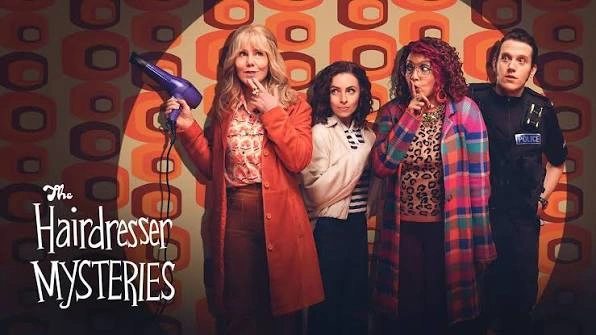

Blossom Vale responds to violent death with the mild alarm usually reserved for a cancelled jumble sale. A body appears beside a stepladder, Lily Petal reaches for a magnifying glass, and the local police seem content to let the new hairdresser handle the awkward questions. Nobody raises their voice. Tea remains available.
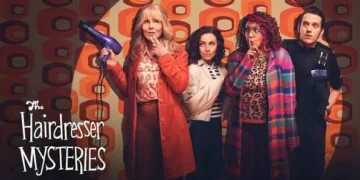
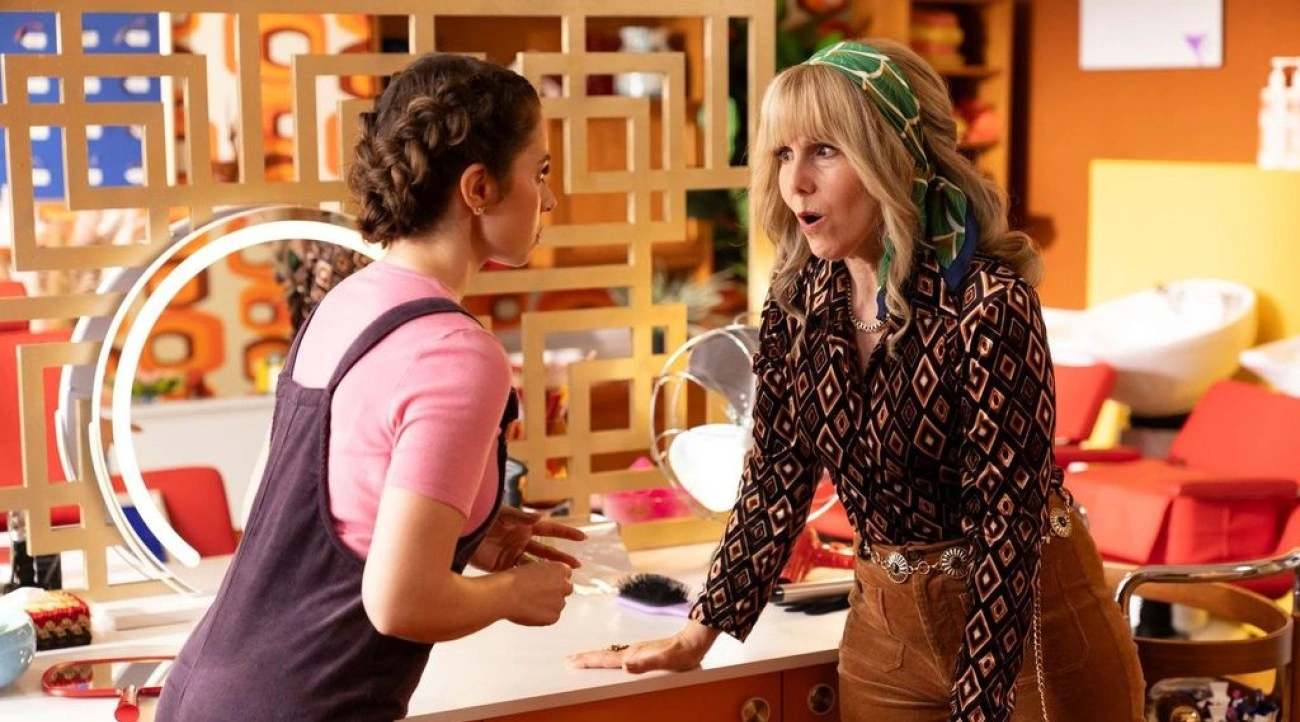
Sally Phillips plays Lily, a former London stylist who has purchased a salon preserved in shades of brown and orange since the 1970s. Her assistant Clary, played by Charlotte Jordan, calls it a time capsule. Lily sees home. She has corduroy flares, flowing headscarves and a vague history of helping people “sort things out,” which is cosy-crime language for knowing how to corner a killer before closing time.
The six-part BBC series replaces forensic procedure with gossip gathered beneath hooded dryers. Hairdressers hear secrets, after all. Blossom Vale simply has a higher corpse-to-perm ratio than most towns.
Four Sugars, One Murder
The opening case, “Storm in a Teacup,” concerns a troublesome local woman found dead beside a stepladder. The title is literal. A missing teacup becomes a major clue, and Lily spends much of the episode wandering through nearby businesses, questioning people who appear delighted to be suspected.
That structure repeats across the series. A murder provides the excuse for Lily and Clary to visit eccentric villagers, inspect a curious object and listen to several improbable alibis. One corpse turns up in a belfry. An influencer is hurled from a minstrels’ gallery. Another investigation is linked to a gym. The clues are rarely arranged into a puzzle that viewers can solve alongside Lily. Answers arrive because the episode has entered its final stretch and a singalong needs setting up.
This creates a peculiar rhythm. Death, chat, shop visit, mild accusation, confession, pop song. Dramatic escalation has been replaced by a loyalty card.
The killers fit the same gentle design. They tend to confess with regret, accepting exposure as if Lily has pointed out an unfortunate split end. Menace never gets through the village gates. Even the bludgeonings feel socially embarrassed by what they have done.
Phillips Holds the Curl
Phillips understands the precise performance this material requires. She never plays Lily as someone aware of the joke. When Clary asks if she has solved crimes before, Phillips narrows her eyes, pauses and offers a teasing answer about helping to “sort things out.” The delivery gives Lily a history without forcing the script to supply one.
Her straight face matters most during the programme’s wildest collisions. Lily and Clary discuss a brutal attack while dancing to “Chirpy Chirpy Cheep Cheep.” Phillips treats both activities with equal concentration. A lesser performance would wink at the camera. Phillips keeps the spell intact.
Jordan gives Clary a useful trace of ordinary human behaviour. Her reaction to the salon’s ancient décor grounds the opening scenes, and her practical questions stop Lily’s cheerful certainty from filling every exchange. The pairing resembles a detective partnership built from hairspray and sensible shoes.
The supporting cast are handed names that sound drafted during a particularly competitive village fête. There is celebrity weatherman Jonty Starr, electrician Parky and Mrs Crudd. Guy Henry appears as an antiques dealer equipped with a giant false moustache and eyebrows working their own shift. His twitchy movements turn every line into a tiny emergency.
These are sketches rather than people, but the actors commit so thoroughly that resistance begins to seem impolite. Guy Henry’s moustache may have solved the case before Lily did.
Welcome to Valhalla With Chips!
Blossom Vale’s design appears to have been assembled from every object left behind after a 1970s themed party. Loud wallpaper, cheap wigs, iced buns and patterned fabrics crowd the frame. The salon has enough brown furniture to qualify as protected woodland.
The period styling rarely convinces as a lived-in world. It works better as comic pressure. Every room pushes the same visual joke until realism gives up and joins the cast for tea.
Nothing captures that method better than Valhalla With Chips!, a Viking-themed takeaway staffed by enormous men in horned helmets and breastplates. Battered sausages arrive in cardboard longships. Nobody comments on the arrangement. The show understands that explaining the joke would weaken it, so the chip shop simply exists, waiting for Ofsted or Odin.
The dialogue operates on similar principles. “Sorry I’m late, I was worming my whippets,” someone announces. Police discover a body in a belfry and respond with “Bloomin’ ’eck!” Each episode closes with a cast singalong to a seventies staple such as “We Are Family” or “I Love to Boogie.” Murder has happened, but T. Rex is playing, so chin up.
The mysteries lack tension, the plotting needs sharper clues, and the production design often resembles fancy dress. Yet the series commits to its cheerful nonsense with rare nerve. It places a whoopee cushion beneath the cosy-crime format and waits. The sound is ridiculous. You still laugh.
This British crime drama premiered on July 17, 2026, and is available to stream on BBC iPlayer. The series follows Lily Petal, an upmarket hairstylist who leaves London for a small town, where her keen intuition and knack for uncovering village secrets turn her into an unlikely amateur detective.
Full Credits
Title: The Hairdresser Mysteries
Distributor: BBC One, BBC iPlayer
Release date: July 17, 2026
Running time: 44 minutes per episode
Director: Paul Gibson, Jermain Julien, Tracey Larcombe
Writers: Jim Cartwright, Mark Catley, David Semple
Producers and Executive Producers: Will Trotter, Oliver Kent, Herbert L. Kloiber, James Copp, Gráinne O’Boyle
Cast: Sally Phillips, Charlotte Jordan, Charlotte Hope, Adrian Hood, Elisabeth Dermot Walsh, Sunetra Sarker, Ben Castle-Gibb, Clive Rowe, Guy Henry, Wendi Peters
Editors: Fiona Starogardzki
Composer: Debbie Wiseman
The Review
The Hairdresser Mysteries
The Hairdresser Mysteries treats murder as a minor interruption between hair appointments, Viking-themed chips, and communal renditions of seventies pop songs. Sally Phillips anchors the chaos by playing Lily’s detective enthusiasm with complete sincerity, while Charlotte Jordan supplies the occasional flicker of common sense. The mysteries are thin, the period styling often resembles fancy dress, and suspense has apparently left Blossom Vale on the last bus. Still, few crime dramas would dare greet a belfry corpse with “Bloomin’ ’eck!” This salon needs stronger plots. Keep the moustache.
PROS
- Sally Phillips’s straight-faced charm
- Fearless comic absurdity
- Charlotte Jordan’s grounded presence
- Memorable village eccentrics
- Cheerful seventies soundtrack
CONS
- Barely developed mysteries
- Little genuine suspense
- Unconvincing period styling
- Caricatures instead of characters
- Resolutions arrive too easily