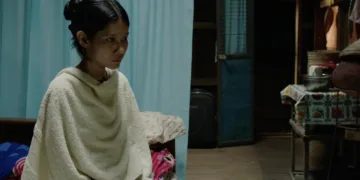

























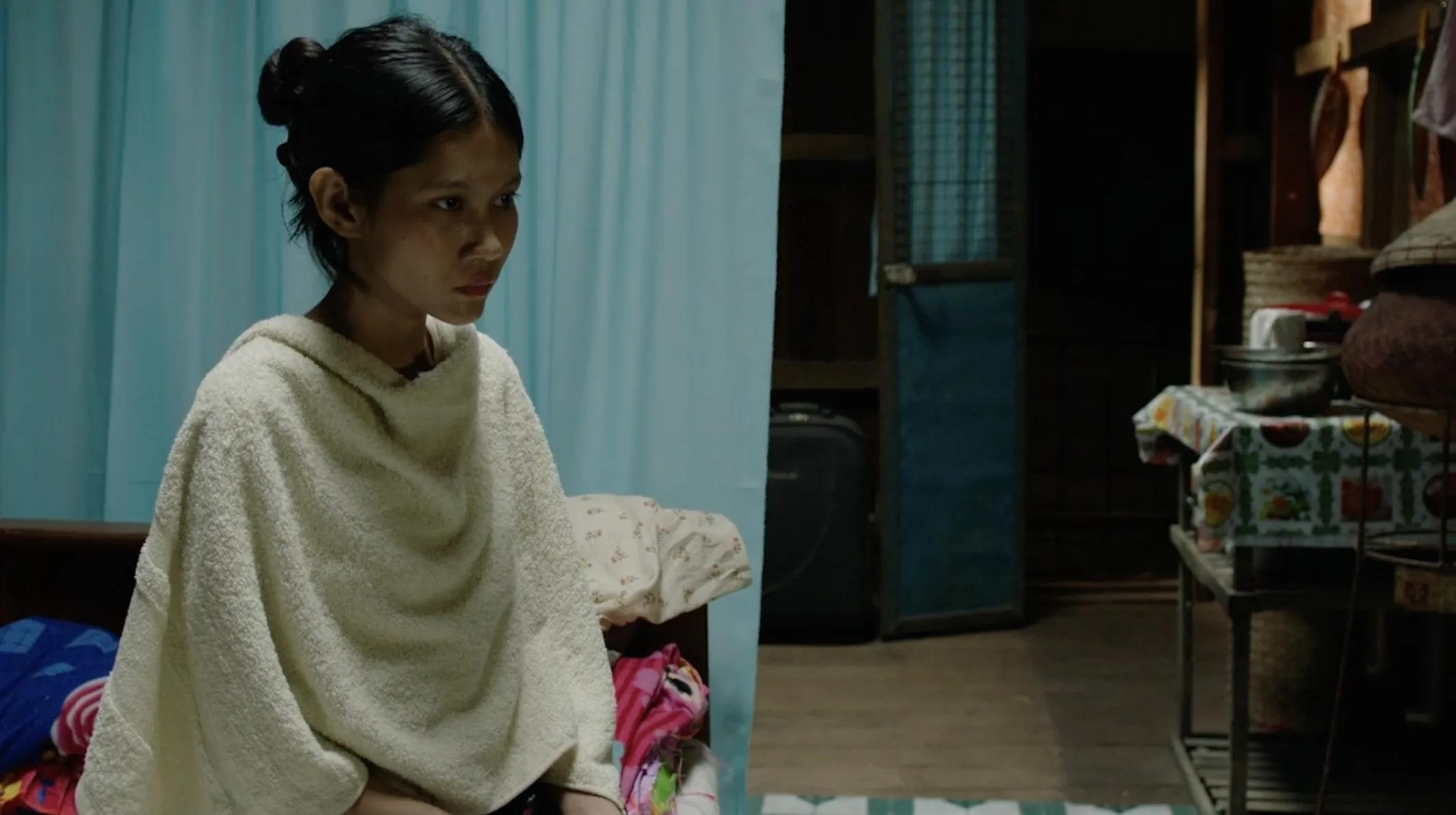

The factory allows San Kyi to leave her sewing machine only after permission has been granted. Her mother applies a similar rule to the rest of her life. Between them, workplace and family reduce existence to obedience, wages, and the possibility of an arranged marriage. Even the body becomes borrowed property.
Aung Phyoe’s feature debut places this quiet suffocation inside industrial Yangon, where San Kyi works beside rows of women beneath the metallic roar of machinery. She has moved from the countryside with her mother and grandmother, yet part of her remains among the mango trees of her village. Those memories appear in faded, dreamlike passages, less like recollection than an interior country she visits when the present becomes too narrow. Then Theint lies for her.
When a supervisor reprimands San Kyi for an unauthorized bathroom break, the new employee claims that permission had been requested. It is a tiny rebellion, delivered with a wink. San Kyi’s gratitude floods her face. Nandar Myat Aung plays the moment without dialogue, letting a slight widening of the eyes reveal how starved this woman has become for uncomplicated kindness.
The performance grows from such restrained reactions. San Kyi lowers her gaze around authority, folds inward beside her mother, and watches Theint with a concentration that gradually becomes impossible to mistake. She seems fragile, yet the fragility contains stubbornness. Her refusal to sign a workers’ petition comes from fear rather than indifference. After a sewing accident injures her, that fear begins to loosen. Pain teaches what argument could not.
The Shape of Attachment
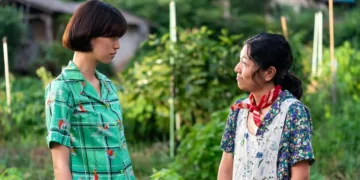
San Kyi and Theint begin with shared meals and factory breaks. Soon they walk hand in hand, sleep beside each other, and wear nearly matching blouses. At the riverside, Theint photographs their shadows touching across the moving water. Their bodies remain separate. Their silhouettes have already merged.
For San Kyi, each gesture accumulates meaning. Paying for dinner when Theint lacks money feels like care. Lending her cash feels like trust. Imagining work abroad together feels like an escape plan. Theint may experience the same moments as affection, convenience, play, or some unstable mixture of all three. The film leaves her motives uncertain without turning her into a puzzle that can be neatly solved.
Nandar Myint Lwin gives Theint a harder rhythm. She smiles easily, disappears without warning, borrows money, and returns with news of a husband. Later, with that husband working in Malaysia to avoid military service, she moves close to San Kyi again. The intimacy resumes, carrying the discomfort of a debt neither woman can name correctly.
Money matters because affection here has material weight. San Kyi does not possess enough freedom to love without calculation. Every meal has a price. Every loan removes another piece from the future she has been saving toward. Theint’s need may be genuine, yet need can wound as deeply as deceit when one person mistakes dependence for devotion.
Their kiss finally gives physical form to what San Kyi has been carrying. It also exposes the distance between them. When Theint rejects a romantic future, San Kyi retreats into the language of friendship and sisterhood. She is willing to rename desire if the new name keeps Theint near. The plea hurts because it asks memory to reverse itself, as though the body can forget what it has learned.
Mangoes Beyond the City
Thaiddhi’s cinematography watches this relationship through still surfaces. One woman studies a mirror while the other brushes her hair. Light from a passing train moves across a bedroom wall. Their clothing begins to echo in soft pastel shades. The film does not announce intimacy. It waits for objects, colors, and pauses to absorb it.
The absence of a guiding score makes silence feel exposed. Factory noise presses against the women during the day. At night, quieter rooms offer no protection. A held breath becomes audible. A glance lasts long enough to become dangerous.
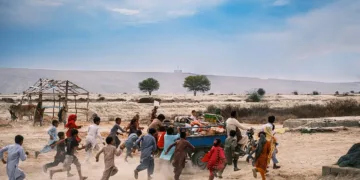
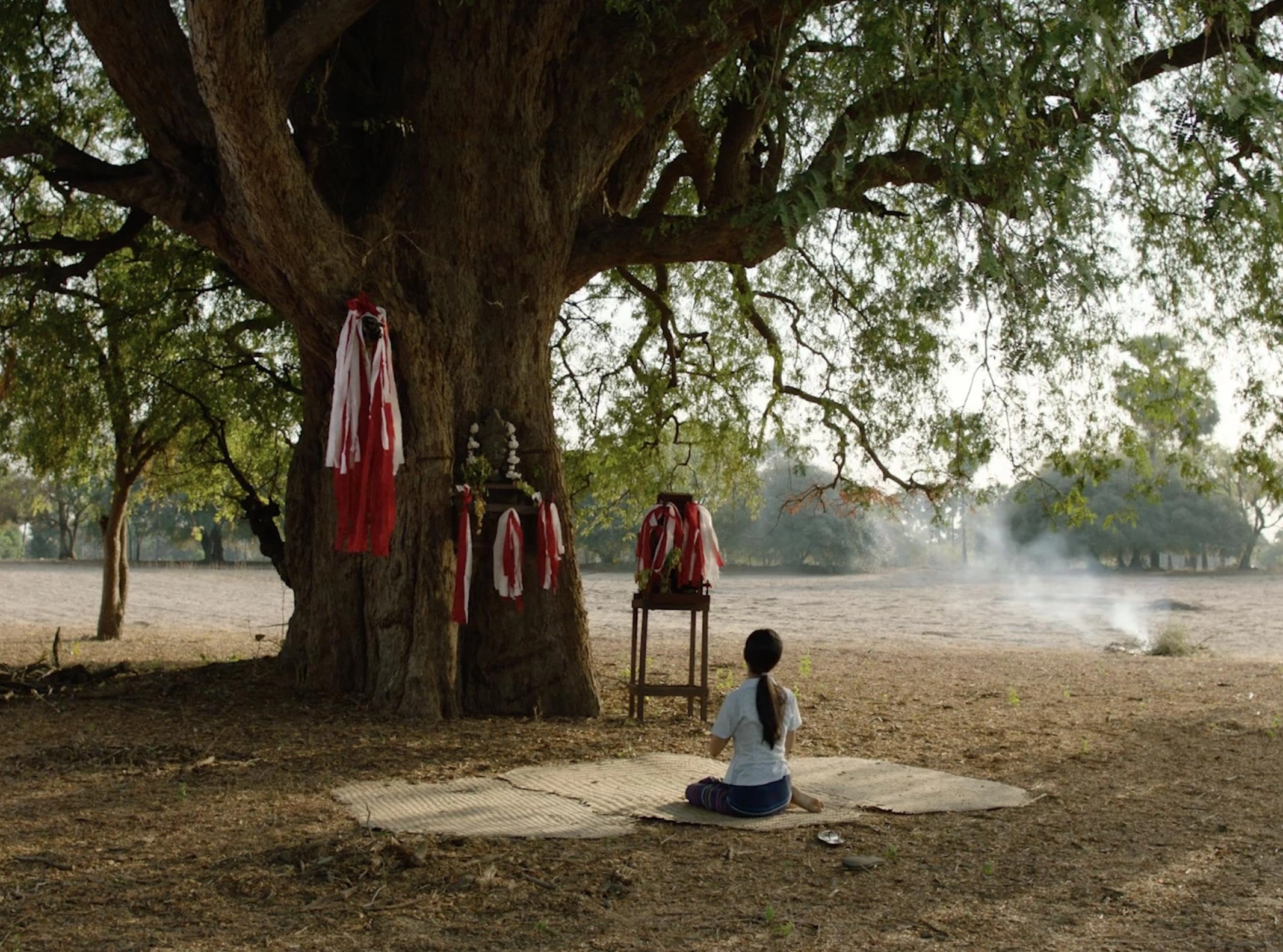
The rural passages provide a different texture. Mangoes hang from branches with the abundance missing from San Kyi’s urban life. Traditional spirit dances permit her a brief physical release, a body moving without supervision. Yet the village exists partly as fantasy. San Kyi imagines return as purity because the city has taught her to associate survival with compromise.
Phyoe occasionally strains this visual language. Flooded rooms, snails, water, and ripening fruit carry erotic meaning with less subtlety than the performances. The symbols arrive already interpreted. The quieter image of two shadows on the river says far more.
What the World Permits
Same-sex desire remains criminalized in Myanmar, while public hand-holding between women may pass as ordinary friendship. This contradiction gives San Kyi and Theint both concealment and imprisonment. They can touch without being recognized. They cannot speak plainly without risking the life around them.
Men occupy little space in the film, yet patriarchal power remains everywhere. It appears in marriage proposals, labor migration, military conscription, and the mother’s insistence that security must take precedence over longing. The women enforce many of these rules because they have learned the cost of refusing them.
The late confrontations disturb the film’s careful pressure. Shouting and physical violence arrive with a sharpness that the earlier scenes have not prepared. Nandar Myat Aung keeps San Kyi emotionally credible, her voice pinched by feelings she has never been allowed to articulate, but the writing momentarily mistakes volume for revelation.
The film regains its stillness near the end. Nothing has been resolved because resolution belongs to people with choices. San Kyi remains caught between the factory and the mango trees, between the person she loves and the life that love cannot provide. Somewhere inside her, fruit continues to ripen. The world arrives with an empty basket.
The film premiered at the Karlovy Vary International Film Festival on July 9, 2026, where it won the Crystal Globe. Set in Yangon, Myanmar, the story follows two young female garment factory workers who form a deep, unspoken bond while navigating the exhausting pressures of their jobs and the social restrictions of a conservative society.
Where to Watch Fruit Gathering (2026) Online
Full Credits
Title: Fruit Gathering (Thit-thee Khu)
Distributor: D1 Film (International Sales), Third Floor Film Production
Release date: July 9, 2026
Running time: 97 minutes
Director: Aung Phyoe
Writers: Aung Phyoe
Producers and Executive Producers: Thu Thu Shein, Thaiddhi, Vít Janeček, Michal Mocňák, Claire Marquet
Cast: Nandar Myat Aung, Nandar Myint Lwin, Thida Soe Khant, Tin Tin Ei, Min Nyo
Director of Photography (Cinematographer): Thaiddhi
Editors: Emily Swe
The Review
Fruit Gathering
Fruit Gathering finds its deepest ache in San Kyi’s inability to separate love from rescue. Every borrowed coin, shared bed, and clasped hand becomes evidence of a future that may exist only inside her. Nandar Myat Aung gives that hope a fragile physical presence, while Thaiddhi’s quiet images let longing settle across factory floors, bedroom walls, and mango orchards. The late violence bruises the film’s carefully sustained restraint, yet its final sadness remains intact: desire ripens in a world determined to harvest something else.
PROS
- Nandar Myat Aung’s restrained performance
- Tender, observant visual language
- Rich social and cultural detail
- Painfully ambiguous central relationship
CONS
- Abrupt late melodrama
- Heavy-handed symbolic flourishes
- Theint remains slightly underwritten