




























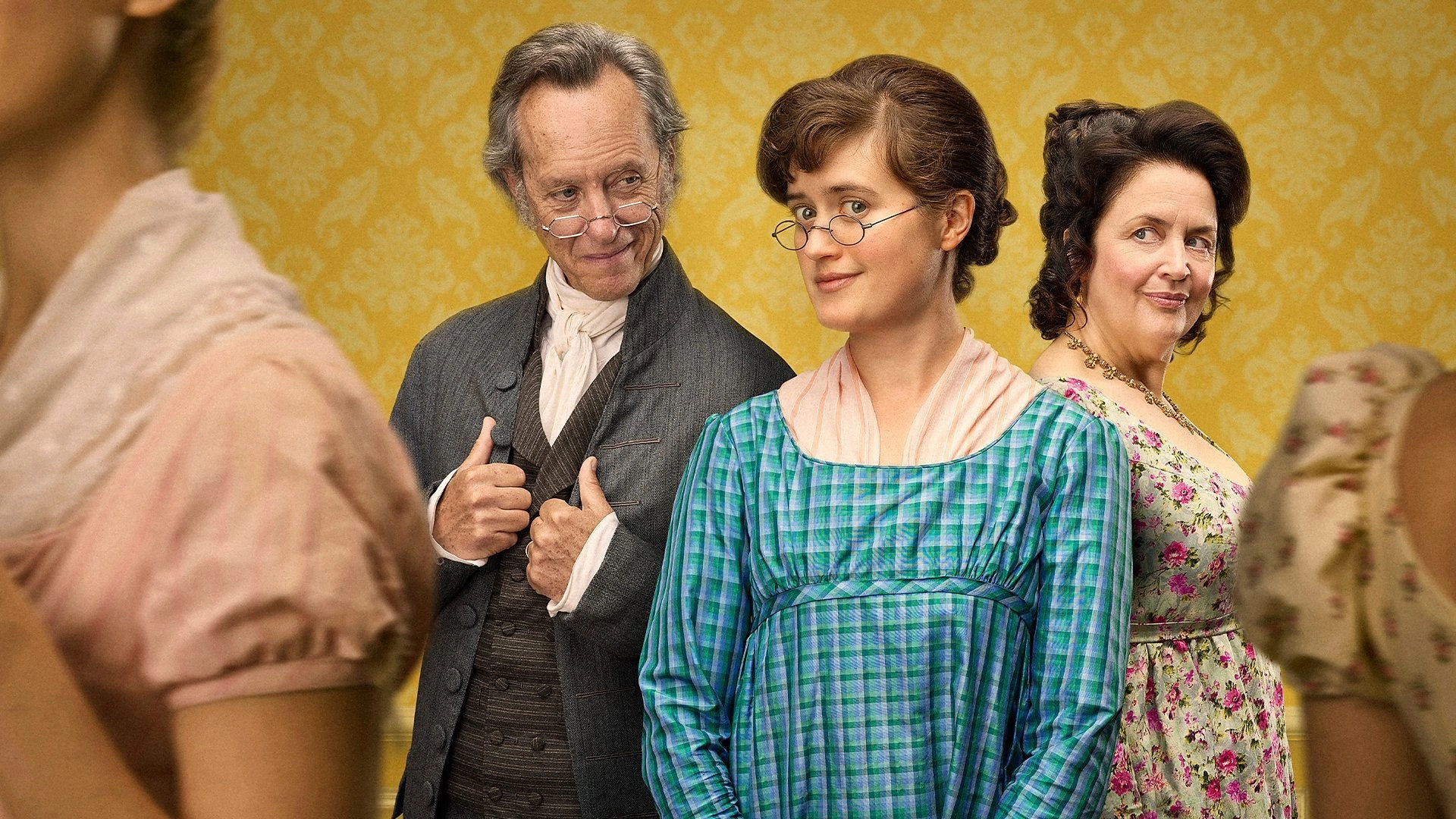

Mary Bennet stands at the piano, her fingers moving with a mechanical precision that lacks the effortless grace of her older sisters. In Meryton, a woman is defined by her utility in the marriage market, and Mary has been labeled a defective product.
She possesses a ruddy complexion and a preference for heavy books, traits her family treats with the same gravity as a contagious disease. This ten-part adaptation of the Janice Hadlow novel refuses to look away from the quiet misery of the middle child. It presents a world where the search for a husband is a grueling competition. Mary lives as a social outcast within her own family, a ghost in a house full of forceful personalities.
Her story begins in the familiar halls of Longbourne during the events of Pride and Prejudice, with the perspective shifted to reveal the harshness of the Bennet domestic life. While her sisters receive praise, Mary receives silence or sharp corrections. The series follows her transition from a timid girl hidden behind memorized facts to a woman seeking her own place in a society that never expected her to find one.
A Sideways View of Meryton
The series utilizes the existing Pride and Prejudice timeline while shifting narrative weight to the forgotten sister. The familiar beats of Mr. Bingley and Mr. Darcy’s arrival appear, filtered through Mary’s internal sense of inadequacy. We see the family dynamic as a series of small, sharp exclusions.
One specific moment captures this perfectly. Mrs. Bennet lists the family’s accomplishments to impress Mr. Bingley. She praises Jane’s beauty, Elizabeth’s wit, and the spirit of the younger girls. Mary is left off the list entirely. She stands in the room, physically present but treated as a void. This absence of acknowledgment lands as a sharper wound than an outright insult.
The portrayal of Elizabeth Bennet offers a startling contrast to traditional interpretations. In this version, Elizabeth is seen from the outside. She appears cold or dismissive. Her quick wit, usually a source of charm, feels like a weapon Mary cannot wield. This creates a specific atmospheric pressure. Mary is forced to find her identity in a house where the older sisters represent the only acceptable standards of success. Their shadow is long and dark.
The production shows major events from the periphery. Mary’s perspective on the Netherfield ball or the arrival of Mr. Collins provides a painful look at events usually treated with humor. We see the exhaustion of the social climber. We see the anxiety of the woman who knows she is ranked last in the marriage market.
This reframing turns a romantic comedy of manners into a study of social survival. It strips away the glamor of the ballroom to reveal the cold calculations beneath the silk. The familiar story becomes background noise to Mary’s internal crisis.
The narrative structure emphasizes the repetitive nature of her isolation. Each social gathering is a new opportunity for her to be ignored. The arrival of Mr. Collins carries no humor here. For Mary, it represents a terrifyingly practical chance for security.
She watches her sisters move through social waters with ease while she struggles to stay afloat. The series captures the specific claustrophobia of being the one person in a room who does not understand the unwritten rules of engagement. This creates a grounded reality that feels truer than the typical romanticized version of the Regency era.
The Physicality of Invisibility
Ella Bruccoleri delivers a performance defined by subtle physical acting. She conveys Mary’s pain and growth through posture and voice. In the early episodes, she makes herself small. She hunches her shoulders as if trying to vanish into the wallpaper. Her eyes are often cast down.
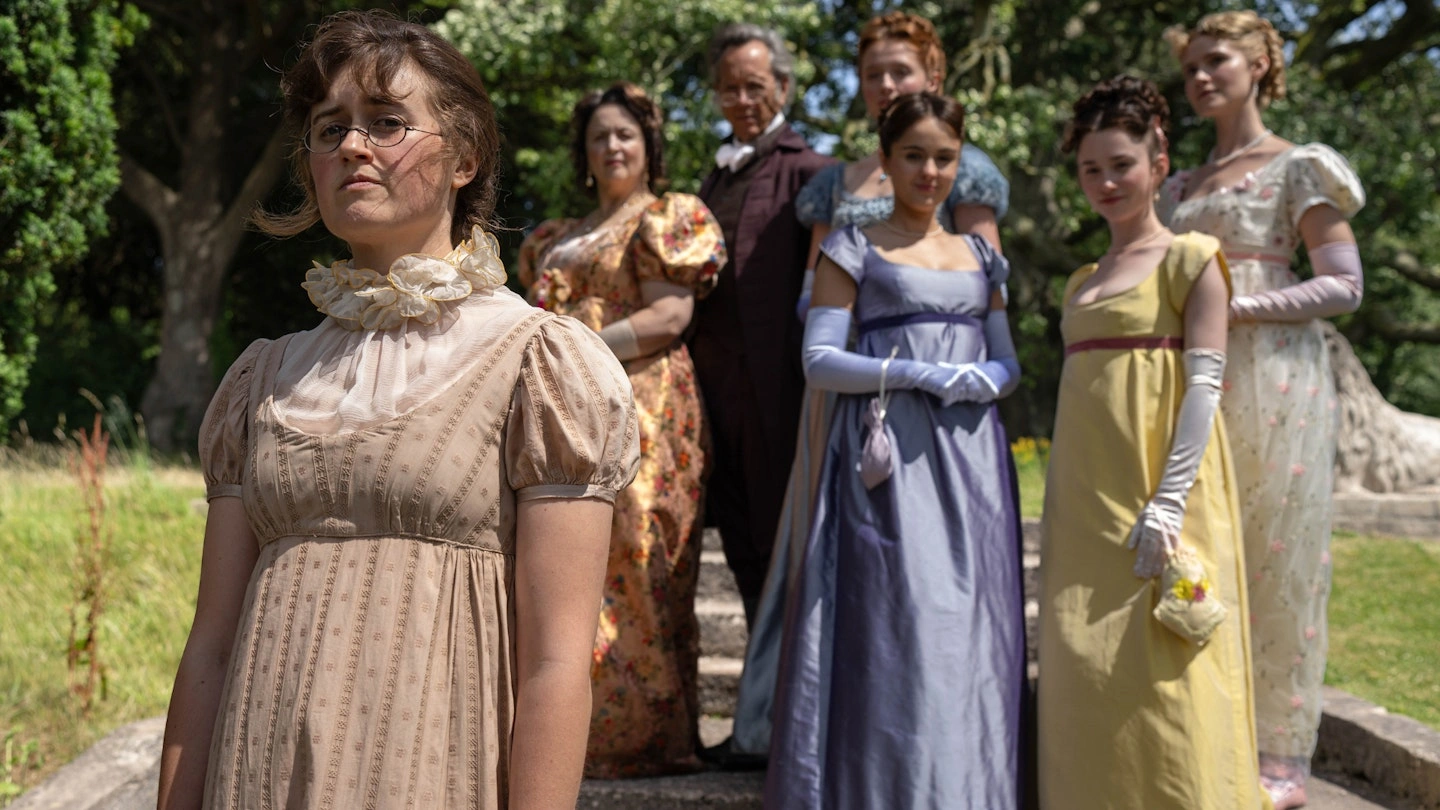
She avoids the judgmental gaze of her mother. As Mary begins to step out of her shell, her movements become more deliberate. The change is slow and realistic. She does not suddenly become graceful. She simply begins to stand her ground.
The series rejects the cliché of a sudden beauty transformation. There is no moment where the glasses come off to reveal a hidden model. Mary’s use of spectacles remains a constant part of her character. Her choice of garish fabrics when first given freedom in London highlights her genuine lack of social training.
She lacks an innate sense of style. She has a desire to be seen. This emphasizes her awkwardness over any hidden Hollywood glamor. She looks like a child playing dress-up because she was never allowed to develop her own taste.
For most of her life, intellectualism has been a shield. She retreats into books and the piano to defend herself against a world that judges her for being plain. The series portrays her struggle to believe she is worthy of being seen as a person. This internal conflict drives the narrative forward. Her physicality changes as she moves from Meryton to a more supportive environment.
She begins to take up space in the frame. Her voice gains a steady quality that was absent in the halls of Longbourne. This is a study of a woman unlearning the low self-esteem her family forced upon her. The camera lingers on her face, capturing the micro-expressions of a person discovering her own value for the first time. It is a quiet, internal revolution.
Bruccoleri uses her voice to trace this transition. At the start, she speaks in clipped, defensive sentences. She recites facts to prove she has a right to be in the conversation. Later, her speech patterns grow more fluid. She expresses her own opinions, having shed the habit of quoting books. This vocal shift mirrors her physical opening. The series treats her intellectual curiosity as a double-edged sword. It isolates her in Meryton, yet it eventually becomes the key to her freedom in London. We see her moving from a state of performance to a state of being.
The Cruelty of the Domestic Sphere
The antagonistic forces in Mary’s early life are often found within her own walls. Ruth Jones provides a portrayal of Mrs. Bennet that moves away from comic relief. Here, the character acts as a source of genuine cruelty. She is Mary’s most vocal critic.
The script highlights specific slights that feel visceral. Before the Netherfield ball, Mary is forced to take the last bath in cold, dirty water. It is a small detail that speaks volumes about her standing in the home. Her mother views her as a burden, a failure of the family brand.
The social pressures of the Regency period keep her trapped in a harsh ultimatum. We see the failed attempts to secure a proposal from Mr. Collins. Mary considers him for practical, heartbreaking reasons. She knows her options are limited.
She is a smart soul in a house full of people who only wish to climb the social ladder. Richard E. Grant plays Mr. Bennet with a quiet support that feels ineffective. He likes Mary, yet he fails to protect her from her mother’s disdain. He retreats into his library, leaving Mary to face the brunt of the domestic hostility alone. This passivity is its own kind of betrayal.
The brief encounter with Mr. Sparrow, an optician, serves a vital narrative purpose. This subplot shows that Mary is capable of attracting interest based on her intelligence. Mr. Sparrow appreciates her mind. He finds her habit of correcting his grammar charming. Mrs. Bennet quickly suppresses this connection.
She views a man in trade as a threat to the family’s social standing. This moment reinforces the idea that Mary’s worth is tied to her family’s status. It shows the tragedy of a woman who finds a spark of connection only to have it extinguished by the demands of polite society.
The scene at the ball where Mary is forced to sit out for the sake of her sisters’ reputations is particularly galling. It illustrates the systemic way she is sacrificed for the benefit of the group. The series does not shy away from the unfairness of this arrangement. It presents the Bennet household as a site of constant negotiation and compromise.
The Expanding Horizon
In the second half of the series, the setting shifts to London. This change allows Mary to find a life outside her family’s expectations. The influence of the Gardiners proves transformative. Indira Varma and Richard Coyle provide a warmth that Mary has never known. Their home is the first place where she is treated as an individual of value. They encourage her to speak her mind and pursue her interests.
London opens up her world in ways Meryton could not. She meets people who share her intellectual curiosity. She realizes that her supposed oddness is actually a strength in different social circles. The introduction of characters like Mr. Hayward and Mr. Ryder offers new romantic possibilities.
These relationships differ from the transactional nature of the matches at Longbourne. They are built on shared ideas and mutual respect. Dónal Finn and Laurie Davidson deliver performances that stand apart from the shallow suitors of her youth. They interact with Mary as an equal.
The shift to the Lake District facilitates a change in her spirit. Mary realizes that she does not need to live to accommodate others. She finds her voice in the silence of the landscape. The pacing of these later episodes reflects her internal unfurling. The story moves away from the cramped drawing rooms of her youth toward a broader future. It is a slow process.
She learns that the narrative of being unloveable was a lie told by people who did not understand her. She finally gets the chance to define herself on her own terms. The visual style shifts as she moves through these new environments. The lighting becomes warmer. The framing becomes more open.
This expansion concerns the growth of her inner world. She begins to trust her own judgment. She stops looking for approval from people who are incapable of giving it. The series captures the relief of finally being seen. It shows that Mary’s value was always there, hidden under the weight of her family’s expectations.
By the time she reaches the Lake District, she is no longer the other Bennet sister. She is a woman in her own right. The narrative concludes by giving her the flowers she was denied for so long. It is a satisfying end to a story about the power of self-worth.
The Other Bennet Sister premiered on BBC One and BBC iPlayer on March 15, 2026, offering a fresh, character-driven perspective on the world of Jane Austen’s Pride and Prejudice. This ten-part period drama, which is currently available for streaming on BBC iPlayer in the UK and BritBox in the United States and Canada, centers on the overlooked middle sister, Mary Bennet. The series follows her journey from the social isolation of her family home at Longbourne to a new life of self-discovery in London and the Lake District. As of late April 2026, the series has completed its initial broadcast run and remains a popular choice for fans of literary adaptations seeking a more grounded and empathetic look at Regency-era social dynamics.
Where to Watch The Other Bennet Sister Online



Full Credits
Title: The Other Bennet Sister
Distributor: BBC One, BBC iPlayer, BritBox, Sony Pictures Television
Release date: March 15, 2026
Rating: TV-PG
Running time: 30 minutes
Director: Jennifer Sheridan, Asim Abbasi
Writers: Sarah Quintrell, Maddie Dai
Producers and Executive Producers: John Pocock, Janice Hadlow, Sarah Quintrell, Dan McCulloch, Kate Crowther, Becca Kinder, Jane Tranter, Rebecca Ferguson, Jess O’Riordan, Robert Schildhouse, Stephen Nye, Ryan Rasmussen
Cast: Ella Bruccoleri, Ruth Jones, Richard E. Grant, Richard Coyle, Indira Varma, Dónal Finn, Laurie Davidson, Varada Sethu, Aaron Gill, Maddie Close, Poppy Gilbert, Molly Wright, Grace Hogg-Robinson, Tanya Reynolds, Anna Fenton-Garvey, Ryan Sampson, Lucinda Dryzek, Lucy Briers
Director of Photography (Cinematographer): Luke Bryant, Simona Susnea
Editors: Sara Jones, Rebecca Trotman, Lucy Harris, Emily Lawrence
Composer: Anne Chmelewsky
The Review
The Other Bennet Sister
The series provides a sharp examination of the emotional cost of being an outsider within one's own family. It reframes a beloved story by focusing on internal growth instead of social triumphs. While the early episodes dwell heavily on Mary's misery, the eventual shift to London offers a rewarding payoff. Ella Bruccoleri anchors the narrative with a performance that feels painful and triumphant. This is a quiet, thoughtful reimagining of the Austen world that rewards patience.
PROS
- Ella Bruccoleri's grounded and nuanced performance.
- A fresh, realistic perspective on the Pride and Prejudice timeline.
- Strong supporting performances from Indira Varma and Richard E. Grant.
- Avoids the typical beauty makeover tropes.
CONS
- The early episodes occasionally overemphasize Mary’s social struggles.
- Mrs. Bennet's cruelty can feel repetitive in the first two installments.
- The slow pacing might deter viewers seeking a high-energy period drama.