






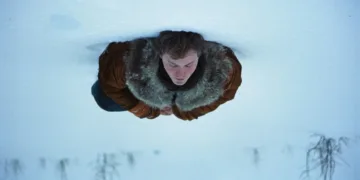




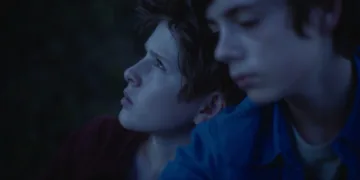
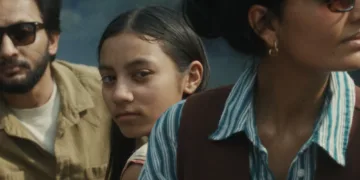





Peace has arrived in Inadelso Cossa’s childhood village, yet the nights remain crowded. Footsteps pass outside doors. Voices call from places where nobody stands. His grandfather speaks in dreams. Someone knocks, and when the door opens, the darkness offers nothing back.
The Nights Still Smell of Gunpowder treats Mozambique’s 1977 to 1992 civil war as an event that has ended only according to calendars. Cossa returns to his village searching for family history, particularly the circumstances surrounding his grandfather Inácio’s death, and finds himself among people whose recollections have been torn, rearranged, or sealed away.
Archival footage briefly supplies images of labor, children, armed men, bodies, smoke. Then history loses its straight line. Cossa does not reconstruct the war as a political chronology. He listens for what remains after chronology fails.
What the Body Remembers
Cossa’s grandmother can still summon Inácio, but the facts surrounding him shift beneath her. At one point, illness appears to have killed him. Later, prompted by her grandson, she recalls a landmine and the suggestion that he died alongside another wife. Her testimony folds back on itself, and Cossa leaves the contradictions exposed.
There is something painful in the way the film begins to second-guess her. She looks into the camera during one staged action and is asked to repeat it. We see the takes. Documentary purity has already left the room, assuming it was ever there.
Yet her uncertainty may be the most honest material Cossa records. War fractures memory, then old age arrives to damage the surviving pieces. Dates disappear. Causes exchange places. A dead husband’s presence survives with greater clarity than the circumstances of his death. Macuacua remembers differently.
He picks up a tree branch shaped vaguely like a rifle and resumes a soldier’s movements. The transformation is immediate and horribly casual. His hands know where the weapon should sit. His body settles into a patrol rhythm learned decades earlier. The branch is wood, the war is over, and his muscles disagree.
Macuacua now lives in poverty with Zalina. They bicker, dance, quarrel over rhythm. He jokingly threatens to beat her when she fails to clap correctly, a moment whose humor curdles because violence already shadows his past. Zalina remembers the long absence when he left for battle and the uncertainty of his return. Domestic life has resumed around the old wound. A ceasefire can stop a gun. Muscle memory is less cooperative.
Listening to the Dark
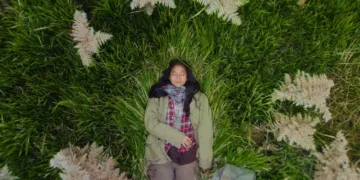
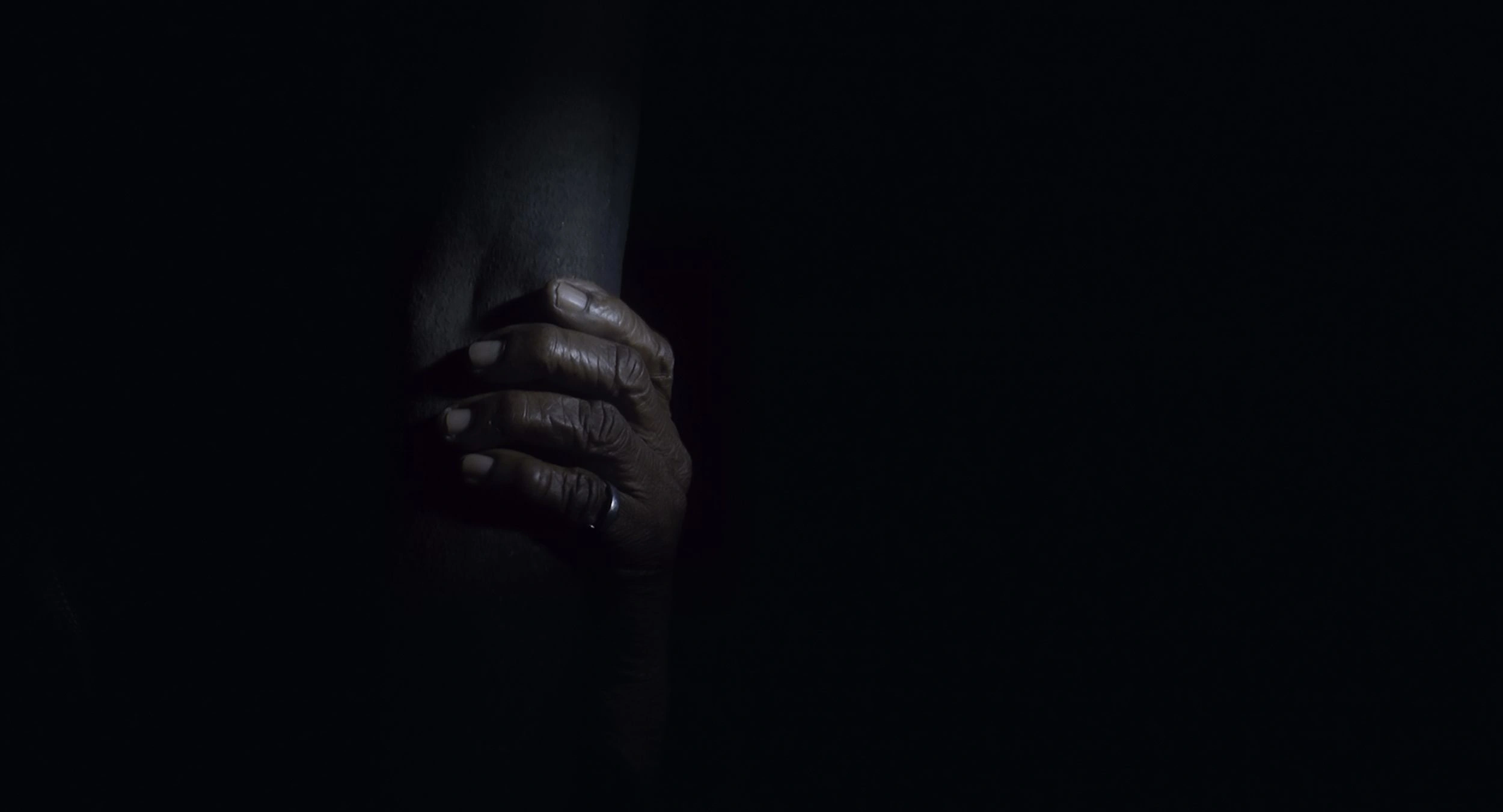
Cossa and cinematographer Rui Tenreiro repeatedly bury the village in blackness. Faces occupy small circles of light. Sheds dissolve into shadow. Fields stretch beyond the camera’s ability to see. Bright light rarely feels comforting here; it cuts into darkness and reveals how much remains invisible.
The visual method makes historical uncertainty physical. Cossa can illuminate a face, record a voice, photograph an old picture placed against the earth. He still cannot see the entire past. Sound carries the same problem. Moises Langa moves through the landscape with a directional microphone raised above him, searching for something hidden among crickets and distant voices. He speaks of hearing the dead answer from their graves. The claim sits somewhere between supernatural encounter, psychological rupture, and an artist becoming consumed by the act of listening.
Cossa offers his own nightmares in response. He hears his grandfather, strangers, knocks, footsteps. The filmmaker is no neutral investigator arriving with a camera to organize other people’s trauma. He is infected by the same history he is trying to record.
This makes the film’s quietness unusually oppressive. Testimonies describe massacres, mutilation, kidnappings, landmines, and relatives who vanished. Around those words, the rural night remains calm. Crickets continue. Grass moves. Darkness rests over the village with almost indecent serenity.
The archival material carries a different texture: degraded images of bodies working, children playing, soldiers moving, smoke rising. Cossa places these fragments beside highly controlled digital compositions and openly staged exchanges. Memory is never allowed the dignity of pretending to be untouched evidence.
The method has a cost. With so little explanation of FRELIMO, RENAMO, or the political forces behind the civil war, viewers unfamiliar with Mozambican history can become unmoored. Repeated nocturnal tableaux sometimes drift past their point of hypnosis into exhaustion. Still, confusion here has a strange thematic honesty. Cossa is searching through broken recollections. A perfectly mapped road would feel suspicious.
Living Beside the War
One of the film’s most unsettling facts requires no spectral voices. Civilians marked by wartime atrocities and former fighters now live within the same community. Elisa recalls being taken hostage by RENAMO rebels. Macuacua carries the physical memory of soldiering. They inhabit a shared present where accusation, punishment, and confession are largely absent. Some survivors speak of fighters following orders, men sent into violence without understanding what they were fighting for. Cossa’s grandmother speaks of living together in harmony. Harmony is a difficult word after landmines.
Cossa does not turn these people into symbols of noble forgiveness. The rifle reappears in Macuacua’s hands even when it is only a branch. Zalina still carries the waiting. Cossa still wakes to voices. His grandmother’s memories break apart as he tries to preserve them.
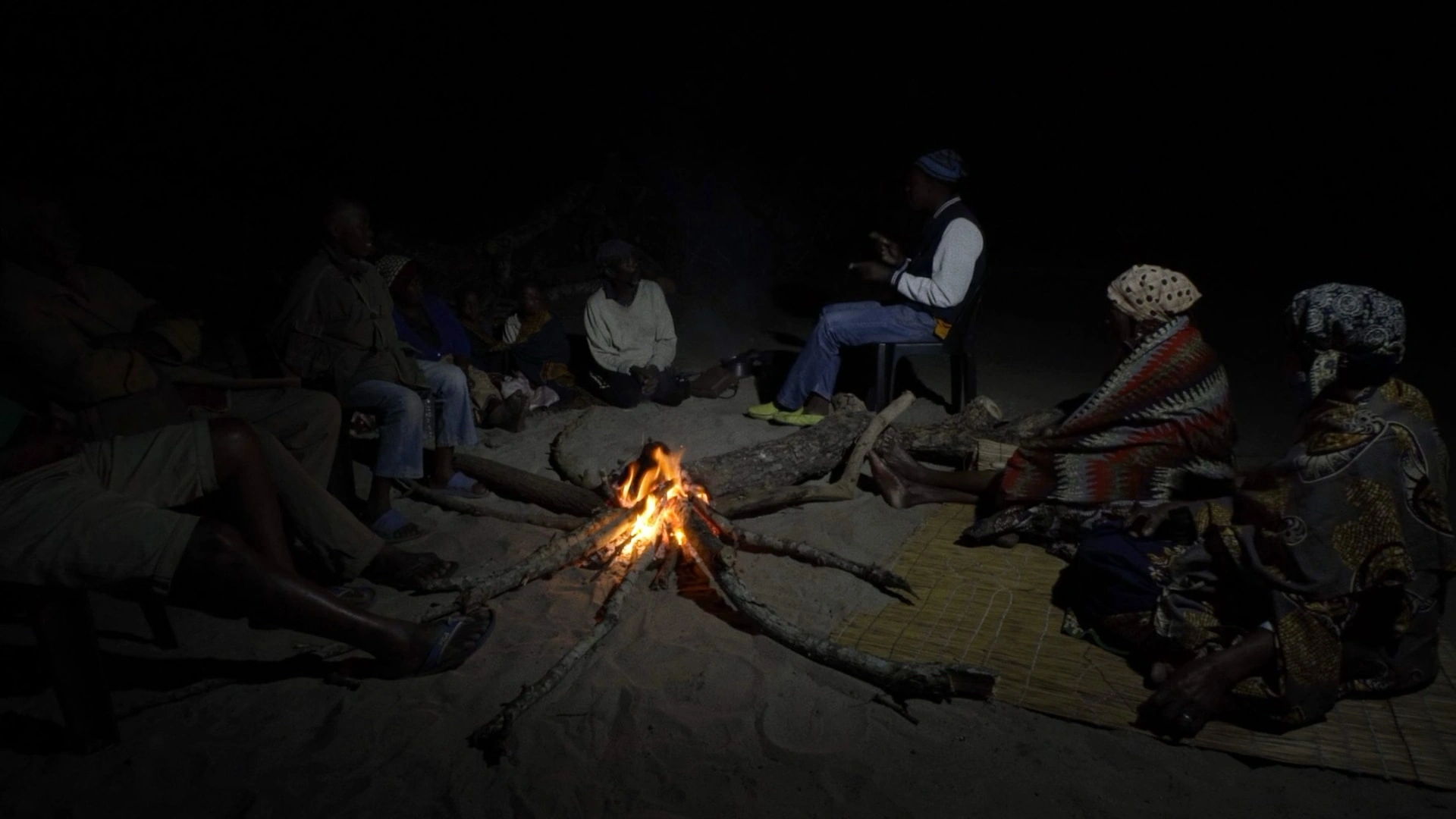
Near the end, elderly villagers and children gather around a fire and tell stories. The scene is quiet, almost fragile. Pain passes into language, then language passes toward a generation that did not experience the war directly. Elsewhere, a child runs through an open field with arms extended while an older woman watches in stillness. The child can run. The ghosts, for now, keep pace.
The experimental documentary The Nights Still Smell of Gunpowder (originally titled As Noites Ainda Cheiram a Pólvora) made its global premiere at the Berlin International Film Festival on February 17, 2024. This international co-production has been traveling through major global independent documentary festivals and special art house exhibitions, where it can be seen via selected cinematic showcases and platform events. The deeply personal narrative follows a filmmaker returning to his grandparents’ remote village in Mozambique to confront his fragmented childhood memories and the lingering, unhealed psychological trauma left behind by the country’s brutal civil war.
Full Credits
Title: The Nights Still Smell of Gunpowder
Distributor: Syndicado Film Sales, 16mmFILMES, Berlin Film Festival Forum
Release date: February 17, 2024
Running time: 93 minutes
Director: Inadelso Cossa
Writers: Inadelso Cossa
Producers and Executive Producers: Inadelso Cossa, Émilie Dudognon, Thomas Kaske, Manuel António Câmara, Elisa Fernanda Pirir, Frank Hoeve
Cast: Inadelso Cossa, Maria Estevão, Moises Langa, Macuacua, Zalina
Director of Photography (Cinematographer): Inadelso Cossa
Editors: Inadelso Cossa, Tomás Baltazar
Composer: Moises Langa
The Review
The Nights Still Smell of Gunpowder
The Nights Still Smell of Gunpowder moves through memory as if walking across land that may still contain mines. Inadelso Cossa finds his deepest images in a branch becoming a rifle, a microphone searching the dark, and an old woman's recollection collapsing mid-sentence. Its refusal to explain Mozambique's civil war can leave the viewer unmoored, and the slow repetitions sometimes dull the trance. Still, the film understands something terrible about survival: peace can arrive while the body continues fighting a war nobody else can see.
PROS
- Haunting nocturnal cinematography
- Extraordinary use of sound
- Macuacua's rifle reenactment
- Unsettling treatment of memory
- Powerful fireside storytelling
CONS
- Sparse historical context
- Occasionally meandering rhythm
- Repetition weakens some passages
- Staged moments may distance viewers