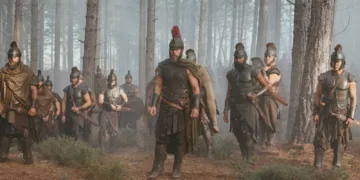



















Christopher Nolan’s “The Odyssey” cleared its first public hurdle this week, and the verdict from those who saw it early leans overwhelmingly toward triumph. Social media reactions lifted their embargo Monday, drawing responses from journalists who attended the film’s London premiere and press screenings, and the consensus painted Nolan’s adaptation of Homer’s epic as among the most ambitious work of his career.
One awards writer described the film as feeling like Nolan’s own version of “Hamilton,” pointing to a multicultural, generational cast anchored by Matt Damon’s Odysseus and Tom Holland’s Telemachus. Another reviewer called it an astonishing achievement, singling out battle sequences and the performances of Damon, Anne Hathaway, Robert Pattinson and Lupita Nyong’o as some of the best of their careers.
Not every response was uncomplicated praise. One critic called the film clunky in stretches while still crediting a strong final act, and another noted the movie functions almost as a companion piece to “Oppenheimer,” Nolan’s last film, in its meditation on a man undone by his own choices.
The reactions arrive after months of preemptive controversy. When trailers surfaced in May, commentators mocked the cast’s uniformly American accents, with one publication joking the film sounded more like it was set in Ohio than ancient Greece.
The casting of Nyong’o as Helen of Troy, Elliot Page in an unconfirmed role and rapper Travis Scott as a bard drew criticism from some corners of social media, including amplification from Tesla and X owner Elon Musk, who suggested the choices were about winning Oscars rather than serving the story. Nolan has defended the decisions publicly, comparing his approach to speculative worldbuilding and noting he cast Scott to draw a line between oral poetry and rap traditions.
None of that controversy appears to have dampened the reception among those who’ve now seen the finished film. Full reviews remain under embargo until July 15, two days ahead of the movie’s July 17 theatrical release, when a wider swath of critics and audiences will get to judge whether the finished three-hour epic lives up to its early word of mouth.