



























Puerto Rico in Esta Isla seems to remember through water. Bebo’s parents disappeared at sea. Charlie fishes because the sea remains one of the few things that can still be worked and sold. Later, grief is carried into crystal-blue water among motorboats, and the image feels almost indecent beside the pain it contains. Cristian Carretero and Lorraine Jones return to one contradiction: a place can be beautiful enough to worship and still fail the people who belong to it.
Bebo (Zion Ortiz) has learned this lesson without language for it. He and his older brother Charlie (Xavier Antonio Morales) haul nets onto a boat, then watch the restaurant buying their catch pay them less. Charlie moves drugs because honest labor cannot hold his family together, while their grandmother Aida (Georgina Borri) refuses his cash beneath a Puerto Rican flag and dreams of the boys’ dead mother.
The film does not treat poverty as atmosphere. Bebo’s sick horse needs penicillin, and that necessity takes him to Moreno (Audicio Robles), a local gangster who puts weed in his hands. A horse, an antibiotic, a bad door opening. Ruin often enters quietly.
Two Young People Running
Bebo meets Lola (Fabiola Victoria Brown) while selling drugs at a club. She comes from manicured lawns, pool parties, and the hilltop home of a wealthy American stepfather. Her friends consume the same drugs that can get Bebo killed for distributing them. The directors place the two lives beside each other and let the distance show.
Ortiz and Brown are strongest when Bebo and Lola have no useful words. Their attraction is built from glances, uncertain closeness, and the belief that another person might be an exit. Ortiz carries Bebo with a slightly folded posture, as though he expects another demand. Brown gives Lola a restless stillness. At the pool, she looks less free than bored by the shape of her cage.
Charlie’s conflict with Moreno pushes the story toward familiar crime-film machinery. His murder, followed by Bebo’s failed revenge, sends Bebo and Lola into the mountains. The death works too efficiently as an engine, especially after Charlie’s nocturnal land-crab hunt and family obligations have made him feel so lived-in. Then the red Corolla breaks down. The chase loosens its grip.
Work in the Mountains
Cora (Teófilo Torres) finds Bebo and Lola and brings them into seasonal labor on a plantain farm. Here, Esta Isla begins breathing differently. Hands carry crops. Chickens move through the yard. Cora smokes his bees and carves a wooden Santa Barbara. Meals stretch into conversations about Puerto Rico, the Dominican Republic, and the idea that Caribbean people remain one Antillean family.
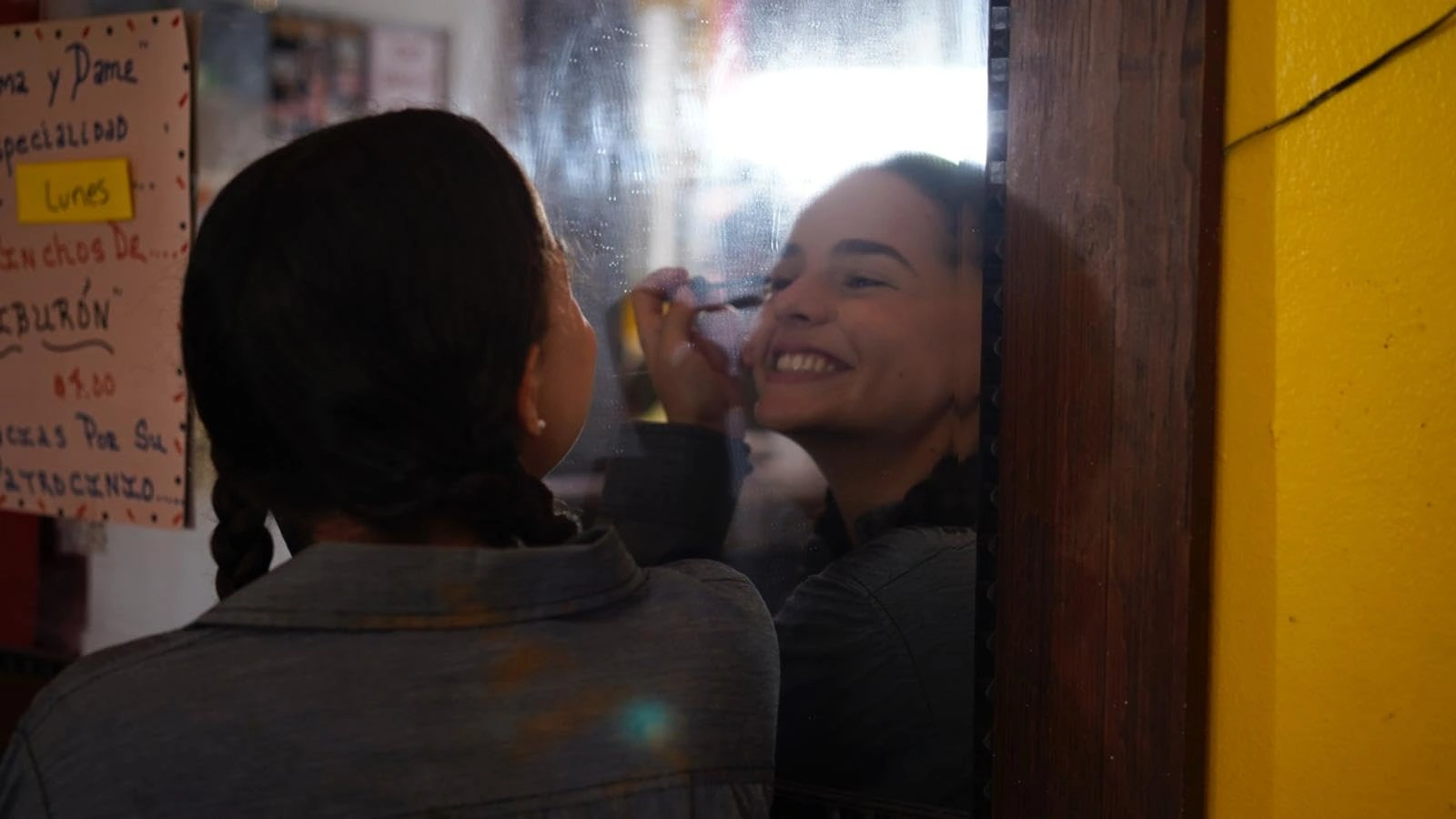
The camera waits for labor to establish its own rhythm. Farming is never polished into rustic fantasy. Bebo and Lola sweat, tire, and discover that escape contains work too. Their romance changes under that pressure. The club allowed them to project desire onto each other. The farm asks them to stand beside one another in daylight. Brown and Ortiz drain the dreamy charge from their early scenes, replacing it with pauses and small irritations. They are frightened and beginning to understand that they barely know each other.
Lola’s family history enters through Cora. Her father served in Iraq, returned psychologically damaged, and had ties to Puerto Rican independence activism. Cora knew him. The mountains that first offer hiding become a place where Lola collides with a past obscured by her affluent life and American stepfather.
The screenplay sometimes reaches for too many histories at once. Minimum wages, migration, military service, lost communal farming, trafficking, colonial power, class, and Caribbean solidarity pass through these conversations. Some remain briefly touched. Charlie suffers most from this compression. A film so interested in Bebo’s attachment to place could have spent longer with the brother who taught him how to survive there.
Memory Under Natural Light
Cedric Cheung-Lau’s cinematography refuses the postcard. Beaches, sea caves, rainforest, and farmland are photographed largely in natural light, yet the images do not ask to be admired from a safe distance. Bodies belong inside these spaces. Mud sticks. Night obscures. Sunlight exposes fatigue.
The directors let sound and image drift slightly apart, creating the sensation of memory arriving before explanation. This becomes especially powerful in the late flashback to Bebo and Charlie beside a bonfire. Charlie says he wants to live forever in that memory. The line is simple, almost childish. It hurts because memory cannot shelter anyone. It can only preserve the shape of what has been lost.
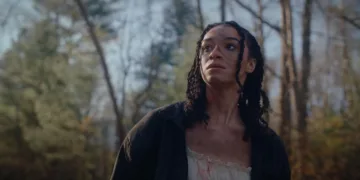
Lola’s roadside scene works through a similar delay. She walks alone beside the highway. A voice asks if she is all right before the driver appears. The camera stays on Lola’s tense face until an older woman offers her a ride and her body softens. No attack comes. Fear remains present anyway.
At the cliff in the final act, Bebo and Lola face the future without the neat spiritual rebirth films often grant young fugitives. Their ordeal has not made them suddenly wise, and love has not erased the forces pressing against them. Bebo’s hesitation belongs to his body before it becomes a decision. Behind him sit Charlie, the fishing boat, the horse, and the water that took his parents. The sea is still there. It always is.
The Puerto Rican coming-of-age drama Esta Isla (internationally titled This Island) made its official theatrical debut on March 19, 2026, in Puerto Rico before opening in selected United States indie theaters, including the Village East by Angelika in New York City, on March 20, 2026. Film enthusiasts can check local arthouse listings or independent film distribution platforms for contemporary regional screenings. The story centers on a pair of hard-up beachside siblings who get mixed up in dangerous criminal activities with local drug dealers, forcing one of them to escape into the island’s isolated mountains alongside a wealthy young woman seeking her own path away from home.
Full Credits
Title: Esta Isla
Distributor: Wiesner Distribution, Experimento Lúdico, Habanero Film Sales
Release date: March 19, 2026 (Puerto Rico), March 20, 2026 (United States)
Running time: 114 minutes
Director: Lorraine Jones Molina, Cristian Carretero
Writers: Cristian Carretero, Lorraine Jones Molina, Kisha Tikina Burgos
Producers and Executive Producers: Lorraine Jones, Cristian Carretero, Rafael Carretero, Annabelle Mullen, Valerie Steinberg, Frankie Cueto
Cast: Zion Ortíz, Fabiola Brown, Xavier Morales, Teófilo Torres, Audicio Robles, Georgina Borri, Omar Iloy, Sean Ortiz, Jeniffe Fret, Bryan Minaya
Director of Photography (Cinematographer): Cedric Cheung-Lau
Editors: Cristian Carretero, Andrei Nemcik, Ismael Cubero
Composer: Alain Emile
The Review
Esta Isla
Esta Isla lets Puerto Rico appear as beauty under pressure, a place where the sea feeds families, swallows parents, carries funerals, and remembers everyone who tried to leave. Cristian Carretero and Lorraine Jones sometimes burden Bebo and Lola with too many political and historical threads, leaving parts of their bond thin. Yet Cedric Cheung-Lau's natural-light images, the farm's patient rhythms, and Zion Ortiz and Fabiola Victoria Brown's guarded performances give the film a bruised, lingering life. Escape remains uncertain. Belonging hurts just as much.
PROS
- Haunting natural-light cinematography
- Patient observational direction
- Strong Ortiz and Brown performances
- Rich Puerto Rican cultural detail
- Powerful use of memory and landscape
CONS
- Several themes remain underdeveloped
- Bebo and Charlie need greater depth
- Crime setup can feel contrived
- Romance occasionally turns opaque