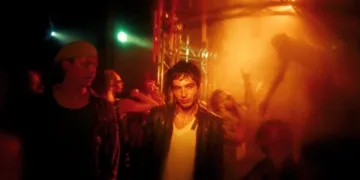

















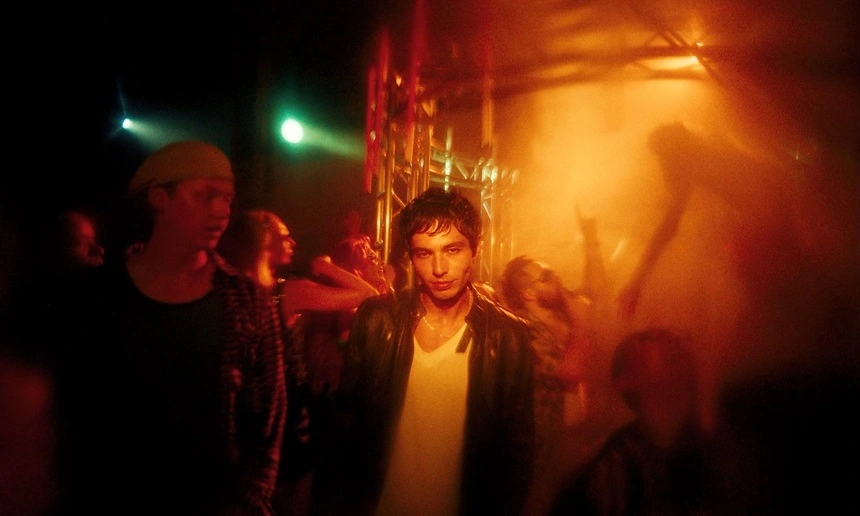

Every time Sayo presses the shutter, the room seems to hold its breath. The flash freezes dancers in New York clubs, stretches movement into slow motion, and briefly turns red darkness into acid yellow and burnt orange. Corrin Evans uses that effect as a visual grammar rather than a decorative trick. Early on, the images preserve pleasure. Later, they record panic.
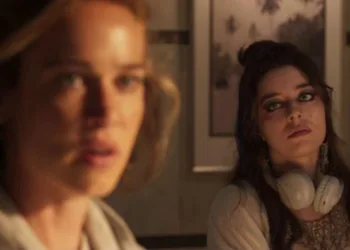
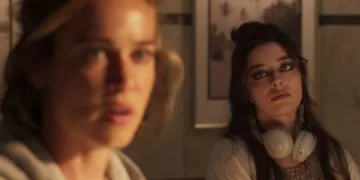
Set during the summer of 1998, Corpus centers on Sayo (Jeff Wahlberg), a nightlife photographer who sells drugs to keep himself afloat. His routine shifts when Vince Marlowe (Brodie Townsend), an old friend and occasional lover, returns to the city with a rising acting career and an invitation to spend a weekend upstate. Their rowdy friend Ross (Michael Vlamis) comes along, expecting a crowded party. The destination is an isolated mansion occupied by photographer Billie (Lily Cowles), her partner Cata (Ching Valdes-Aran), and Wren (Nuha Jes Izman), a model introduced one year earlier during a disturbing shoot.
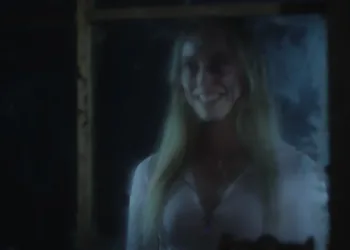
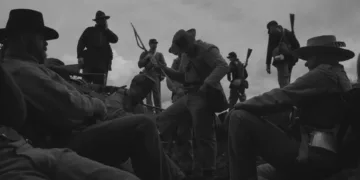
That prologue establishes Evans’s sharpest instinct. Billie, heard from behind the camera, pressures an inexperienced Wren to appear “edgy” beside an unexpected naked man wearing a pointed mask. The scene stays on Wren’s discomfort long enough for professional ambition to become a trap.
New York After Midnight
The film’s first act has the texture of something recovered from a late-1990s shoebox. Handwritten titles, rock music, magazine covers, cigarettes, and crowded dance floors establish the period without turning it into costume-pageantry. Sayo’s photographs matter because nobody around him is holding a phone. His subjects lose themselves without preparing an image for an audience.
Evans and cinematographer Charlie Cole make the club sequence easy to read when the lighting is murky. Each camera flash separates a face from the crowd, giving Sayo’s viewpoint a rhythm of observation and interruption. It is also how Vince enters the film. Sayo first sees him on a magazine cover and pushes it aside. Then Vince crosses the dance floor with his eyes fixed on Sayo’s lens, fully aware that he is being watched.
Wahlberg plays Sayo with guarded softness. He wants Vince near him, then recoils whenever their intimacy becomes possible. Townsend gives Vince a magnetic confidence that keeps slipping into control. He flirts, withdraws, and sells the mansion visit as both a reunion and a career connection. Ross warns Sayo that Vince looks after himself, and the repeated advances and rejections give that warning weight.
The problem is repetition. Several exchanges between Sayo and Vince make the same emotional point after the audience has already understood it. Their chemistry survives the delay, but the screenplay keeps photographing the wound from the same angle.
Old Money, Raw Meat
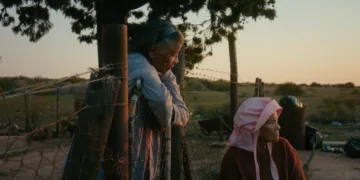
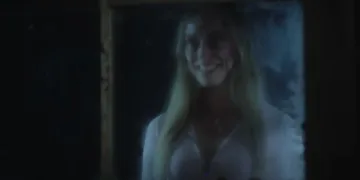
The mansion trades the club’s crowded freedom for faded control. Marble statues, peeling surfaces, shadowed hallways, and relic-like objects suggest wealth that has outlived its owners’ need to explain themselves. Wren greets the men covered in blood and carrying a dead chicken. The pointed mask from the opening shoot sits inside like a trophy. Ross still treats the weekend as a good time waiting to happen. Horror characters have ignored subtler warnings.
The promised party turns out to be a St. John’s Eve gathering. During dinner, raw meat is served to guests who cannot eat it, Wren recites a Latin prayer, and the women feed one another while the camera circles the table. A circular camera move can make a stable room feel unsteady because the viewer loses a fixed position. Here, it turns the meal into an initiation before the men realize they are participants.
Alcohol, drugs, folk songs, dancing, and nighttime swimming push familiar party behavior toward ritual. Billie and Cata control the pace, while Wren’s feral presence shows what may happen after resistance gives way. Evans’s experience as an intimacy coordinator can be felt in how bodies are framed. Touch carries information about power, uncertainty, and consent. Nudity never floats free of the scene’s emotional pressure.
A Slow Burn That Nearly Stalls
The middle stretch asks for patience and occasionally spends too much of it. Sayo and Vince circle their attraction through long conversations and false starts, while Ross dismisses enough warning signs to make self-preservation look unfashionable. The mansion remains visually alive, but the plot sometimes appears reluctant to leave the doorway.
Still, the delay connects to the film’s central question: why do people remain where they already feel unsafe? Sayo stays because he wants Vince and believes Billie can help his photography career. Wren stayed during the opening shoot because leaving could mark her as difficult. Both accept immediate discomfort as the admission price for a desired future.
Sayo’s dream of tearing part of Vince’s face away turns longing into physical consumption. The image is blunt, strange, and effective. Desire in Corpus carries an appetite to possess, reshape, and absorb another person. Once the film turns violent, Evans changes her visual method. The chase fractures space, camera flashes replace continuous visibility, and Sayo’s artistic tool becomes his only way to understand what is pursuing him.
The ritual’s rules remain hazy, and the emotional logic between Sayo and Vince gets knotted during the final movement. Evans is far surer when telling the story through light, bodies, and movement. One last flash can explain what several pages of dialogue cannot.
Corpus is a psychological horror thriller film that premiered at the Fantasia International Film Festival on July 26, 2026. Set in the late 1990s, the film follows a nightlife photographer and drug dealer who travels with friends to an isolated villa, only to encounter three mysterious women with a terrifying agenda. Viewers can watch the film through upcoming festival screenings and independent cinema circuits.
Full Credits
Title: Corpus
Distributor: Fantasia International Film Festival
Release date: July 26, 2026
Running time: 102 minutes
Director: Corrin Evans
Writers: Corrin Evans, Lily Cowles
Producers and Executive Producers: Lily Cowles, Corrin Evans, Alix Taylor
Cast: Jeff Wahlberg, Brodie Townsend, Michael Vlamis, Lily Cowles, Nuha Jes Izman, Ching Valdes-Aran
Director of Photography (Cinematographer): Charlie Cole
Editors: Corrin Evans
The Review
Corpus
Corpus loses momentum when its erotic tension circles the same emotional conflict, yet Corrin Evans’s command of image, sound, and physical space keeps the film from going still. Sayo’s camera flashes turn club pleasure into fragmented panic, while the St. John’s Eve dinner shifts ordinary hospitality toward ritual without spelling out every rule. The mythology remains hazy, and Vince’s emotional games last too long, but the film’s strongest sequences reveal a director who understands how framing can change attraction into fear.
PROS
- Striking late-1990s atmosphere
- Expressive flash-photography motif
- Charged physical performances
- Disturbing ritual imagery
- Assured visual direction
CONS
- Sluggish middle section
- Repetitive romantic conflict
- Murky ritual mythology
- Questionable character decisions