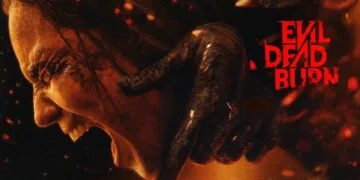










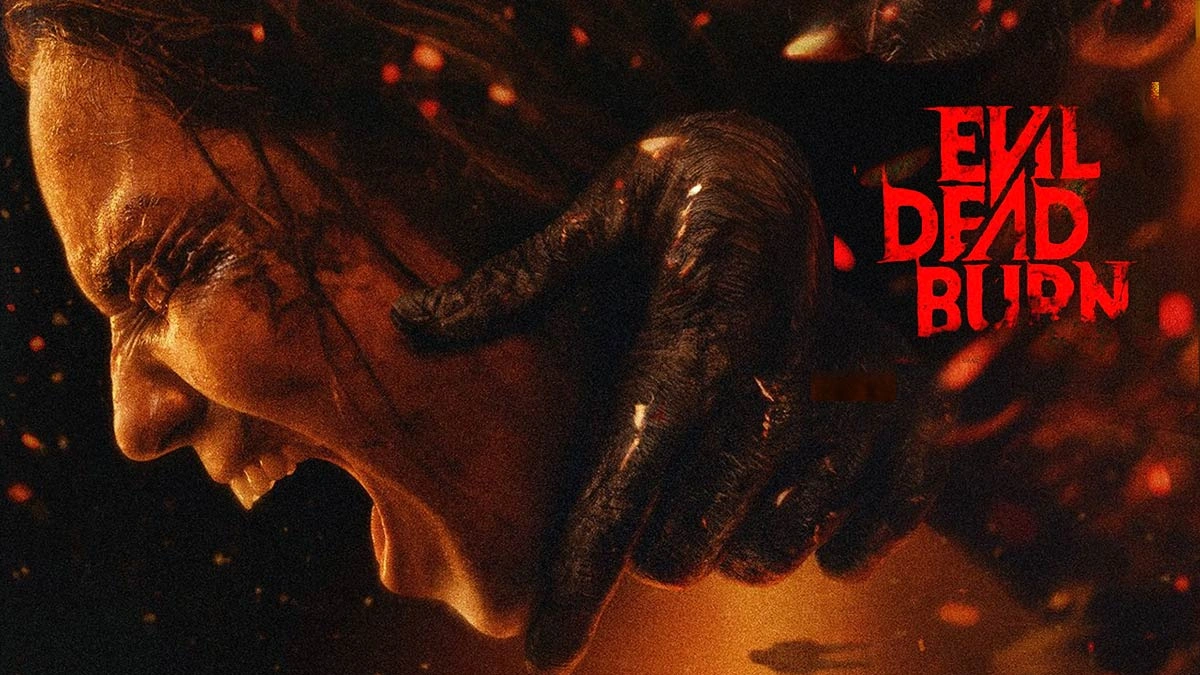

The sixth Evil Dead film arrives speaking with a noticeably different accent. Sébastien Vaniček, the French director behind Infested, inherits one of American horror’s most elastic franchises and strips away much of its carnival instinct. Sam Raimi built this series from rural panic, slapstick cruelty, and visual invention that could turn a severed hand into a comedy partner. Vaniček prefers winter, grief, resentment, and violence that lands with a cold metallic thud.
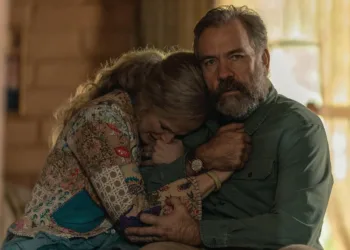
Evil Dead Burn continues the harsher line established by 2013’s Evil Dead and 2023’s Evil Dead Rise. Alice, played by Souheila Yacoub, loses her husband Will after his drunken drive intersects with a Deadite attack tied to the lakeside aftermath of Rise. After the funeral, she joins Will’s parents Susan and Edgar, his brother Joseph, Joseph’s girlfriend Thya, and grandmother Polly at a deteriorating woodland home.
Will was angry and violent. Alice is relieved in ways his family cannot tolerate. Susan treats blood ties as moral law. Edgar grips knives with nervous intensity. The Deadites enter a family that has already learned how to hurt one another.
Family as a Closed Border
Alice’s conflict with the Price family plays like a cultural collision inside one household. She is French, pink-haired, emotionally unreadable to her in-laws, and unwilling to perform widowhood according to their expectations. Her purple sneakers at the memorial and visible distance from the family turn grief into a test she has apparently failed.
Susan’s line, “Without family, you’re nothing,” sounds like unity and functions as exclusion. Alice’s marriage to Will granted her conditional entry into this clan; his death makes her foreign again. Horror has long used families as fortresses against outsiders. Burn twists that structure by making the outsider the person who knows the dead man best.
The problem is that Vaniček and co-writer Florent Bernard hurry through the evidence. At Joseph’s birthday celebration, Will and Alice exchange passive-aggressive blows until his temper breaks through the surface. We understand that their restaurant, marriage, and plans for children have become pressure points.
What the film needs is another private scene showing the logic of Will’s control. Alice later carries the dramatic weight of an abused woman resisting a family determined to canonize her husband, yet the screenplay gives Yacoub fragments and asks her to build a history from them.
She nearly manages it. Watch the tension in her shoulders around Susan, or the way her breathing changes once family arguments become physical danger. During long stretches of screaming, crawling, and fighting, she never resets into the polished competence of a conventional final girl. Exhaustion accumulates. Panic leaves residue.
The Deadites attack Alice using the emotional pressure already circulating through the house. Possessed relatives repeat accusations and resentments the family could barely voice at the funeral. Vaniček approaches the family less as a sacred unit under siege and closer to a social institution that reproduces violence across generations. Edgar’s agitation and Joseph’s latent anger suggest Will inherited his temper. He inherited a grammar.
Malice Replaces Mischief
Every era of Evil Dead has translated the Deadites into a different cinematic language. Raimi’s first film treated them as primal intruders. Evil Dead II gave them cartoon insolence. Army of Darkness carried the series into fantasy comedy. Fede Álvarez returned to bodily punishment in 2013, while Lee Cronin made Evil Dead Rise a vertical siege movie inside an apartment building.
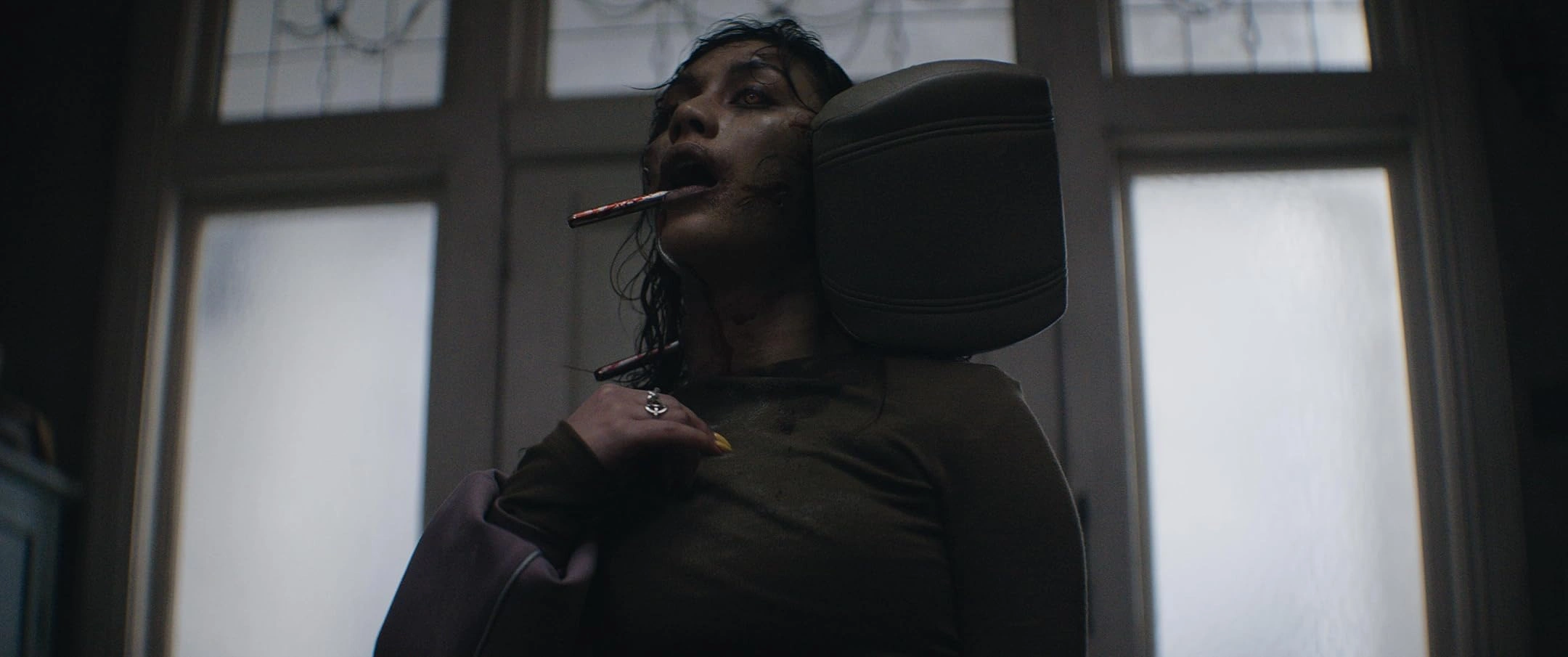
Vaniček comes from French genre cinema, where bodily extremity has often carried a harsher philosophical charge. Burn does not simply imitate the New French Extremity, yet its fixation on flesh as a site of emotional damage sits closer to that lineage than Raimi’s splatstick. The body here is evidence.
The lakeside attack makes the difference clear. Rain turns the Deadite into a slick, writhing shape. Fishing line, bait, mud, wet wood, and skin occupy the same tactile register. Later, charred flesh melts against heat, fingers disappear inside a closing car door, and a face is crushed with a dishwasher door. Raimi often made the camera seem drunk on movement. Vaniček makes the frame fascinated by texture. This severity brings a cost. The Deadites have lost much of their grin.
Their low voices and spider-like bodies place them closer to contemporary possession horror, while the Necronomicon, Kandarian Dagger, Professor Raymond Knowby, and Cult of the Wise Men give them a fresh objective. Yet the mythology arrives in clumps. Alice and the others spend too long without understanding what the demons want or how they can be stopped.
The physical rules are hazy too. One possessed character shoots themselves in the face three times and continues moving. Another pulls a large object from the neck and carries on. The apparent solution is catastrophic head damage delivered through whichever power tool happens to be nearby. A weed whacker appears. A jackhammer follows. The chainsaw, that sacred object of American splatter iconography, is absent.
Raimi’s chainsaw became a comic emblem of mastery, an absurd prosthetic attached to Ash’s heroic identity. Vaniček’s tools stay heavy, ugly, and industrial. They do not crown a hero. They reduce a body.
The Architecture of Pain
Vaniček is strongest when space determines violence. Infested turned apartment corridors into choke points, and Burn applies the same instinct to a rural property that should feel open. Rooms narrow under pressure. Outdoor areas remain enclosed by winter, trees, and darkness.
The car fight is the film’s finest set piece because every injury emerges from the geography of the vehicle. Fingers are amputated by a door. A crushed sunroof reduces the available space. Seat belts become strangling devices. Headrests become impaling weapons. Each object has a position, each body has limited movement, and Vaniček escalates the attack by changing who controls those few available inches.
Compare that with some house attacks, where anticipation of another grotesque injury begins to flatten the effect. Scissors carve into a head. A fountain pen enters an ear. A corkscrew finds a throat. Grilling skewers are repurposed. Hot wax is swallowed. The practical work is extraordinary, especially the exposed tissue, melting skin, and wounds that seem to possess weight rather than digital cleanliness. After a while, the film behaves like an international catalogue of household misery.
The difference between gore and fear becomes harder to ignore. Álvarez’s 2013 film used sustained brutality to create hopeless momentum. Cronin frequently built anticipation around architecture, especially doors, corridors, and the elevator. Vaniček often slows down before impact, using music swells, extended takes, and stretches of near-contemplative violence. A possessed victim repeatedly firing a gun into their own head acquires a mournful rhythm that is grotesque without feeling disposable. Then another scene arrives with a nastier implement and the spell weakens.
A long tracking shot following a character crawling through an extended fight shows Vaniček at his best. The camera keeps the distance to safety visible. Threats remain positioned within the frame. Vulnerability comes from duration rather than surprise. Vaniček understands that terror can be measured in metres.
At 110 minutes, repeated slow preparations create an odd pacing problem. A film packed with amputations and supernatural attacks should feel ferocious. Burn sometimes feels heavy. Its rhythm leans toward European art-horror while its content keeps demanding grindhouse escalation. For several scenes the traditions coexist. Elsewhere, one waits politely for the next skull to collapse.
Grief in the Machine
Yacoub holds the tonal experiment together because Alice never becomes comfortable inside either side of it. She is too raw for action-horror triumph and too physically engaged for detached art-horror suffering. When she fights, the movement looks improvised by panic. When she cries, it feels connected to exhaustion rather than a screenplay cue. Her fury toward Will survives his death, giving the Deadites an opening to weaponize love, guilt, and social obligation without pretending she secretly wants him back.
Erroll Shand takes Edgar in the opposite direction. His knife fixation and coffin-ripping behavior establish instability before possession magnifies it. After he shoots himself repeatedly in the face and keeps moving, his body becomes a grotesque parody of patriarchal endurance, a man who can destroy himself publicly and still demand that everyone else deal with the consequences.
Tandi Wright’s Susan is colder. Her devotion to family unity becomes predatory once Alice’s status as outsider hardens into accusation. Maude Davey’s Polly presents a trickier case. The recurring jokes about her dementia and accusations of theft aim for cruel absurdity, yet they sit badly beside a film asking viewers to take domestic trauma seriously. Evil Dead has always laughed at bodily indignity. Vaniček’s darker moral register makes that old freedom harder to access.
The late rush toward the Cult of the Wise Men and the Deadites’ objective exposes the same split. Lore is delivered quickly, then the film races into power-tool destruction with a strangely mechanical, almost Terminator-like shape. Alice has barely had time to understand the supernatural rules before survival becomes a matter of aiming industrial force at a head and holding on. No chainsaw rises in comic triumph. A jackhammer meets flesh with no wink in the frame, and Yacoub’s exhausted face is left to supply the human response the mythology hurried past.
This supernatural horror film debuts in theaters on July 10, 2026, meaning audiences can watch it exclusively on the big screen during its initial release. The story follows a grieving widow who visits her late husband’s family at their secluded home, only for the gathering to turn into a terrifying struggle for survival as the individuals transform into demonic entities.
Where to Watch Evil Dead Burn (2026) Online





Full Credits
Title: Evil Dead Burn
Distributor: Warner Bros. Pictures, Sony Pictures Releasing International
Release date: July 10, 2026
Rating: R
Running time: 109 minutes
Director: Sébastien Vaniček
Writers: Sébastien Vaniček, Florent Bernard
Producers and Executive Producers: Rob Tapert, Sam Raimi, Bruce Campbell, Lee Cronin, Romel Adam
Cast: Souheila Yacoub, Hunter Doohan, Luciane Buchanan, Tandi Wright, Erroll Shand, Maude Davey, George Pullar
Director of Photography (Cinematographer): Philip Lozano
Editors: Maxime Caro
Composer: Double Danger
The Review
Evil Dead Burn
Sébastien Vaniček brings a distinctly French severity to Evil Dead Burn, trading Sam Raimi's carnival cruelty for something colder, slower, and obsessed with inherited violence. The car fight and tactile practical effects show a director with formidable command of bodies and space, yet the screenplay gives Alice's trauma too little room before demanding emotional weight from it. The result is a fascinating cultural mutation of Evil Dead, even when the franchise's grin disappears beneath the blood.
PROS
- Ferocious practical effects
- Superb car fight choreography
- Claustrophobic camera work
- Souheila Yacoub's physical performance
- Distinctive tonal identity
CONS
- Thin abuse backstory
- Murky Deadite rules
- Uneven pacing
- Gore becomes numbing
- Humor often misfires