


























![Kingdom Hearts Collection [I-III] Review](https://gazettely.com/wp-content/uploads/2026/10/Kingdom-Hearts-Collection-I-III-1-360x180.webp "Kingdom Hearts Collection [I-III] Review: KHII Holds Steady as Newer Entries Fluctuate 40")

Six episodes give Faithless enough room to complicate Marianne and Isabelle, and enough time to expose the one weakness an adultery drama cannot afford: its central affair is hard to believe. Sara Johnsen’s adaptation of Ingmar Bergman’s screenplay returns to material Liv Ullmann filmed in 2000, with Tomas Alfredson directing this Swedish television version. The story moves between Stockholm in 1977 and the present.
In the earlier timeline, recently divorced filmmaker David Howard (Gustav Lindh) returns from London and reconnects with his oldest friend, musician Markus Vogler (August Wittgenstein). David soon becomes close to Markus’s wife, actress Marianne (Frida Gustavsson), and the friendship drifts into an affair with consequences lasting decades.
The present-day scenes reunite an elderly David (Jesper Christensen) with Marianne, now played by Lena Endre. Endre’s casting carries unusual weight since she played Marianne in Ullmann’s film. Her presence creates a continuity the rest of the adaptation cannot manufacture through dialogue or production design.
Streaming television has developed a fondness for treating extra runtime as an automatic form of depth. Faithless makes a stronger case than many six-hour adaptations, particularly through Marianne and her daughter Isabelle, yet every added conversation also puts the affair itself under closer inspection. The closer the series looks, the less heat it finds.
An Affair That Has to Sell Itself
David enters the Vogler household from a position of extraordinary trust. Markus is his oldest friend, welcomes him after his divorce, and allows him to move through the family’s life without much suspicion. David stays close to Marianne and their daughter Isabelle (Poppy Klintenberg Hardy), who develops her own emotionally charged attachment to him. The story has already loaded the gun before David and Marianne touch each other.
Johnsen initially builds their attraction through artistic conversation. Marianne reads David’s screenplay and criticizes his simplistic understanding of female desire. She recommends Susanna, a novel centred on a sexually liberated woman, and David eventually adapts it for the screen with Marianne in the lead role. The arrangement gives their relationship a credible intellectual foundation. Marianne sees weaknesses in David’s writing that he cannot see himself, while David begins turning her ideas into his work.
Their drive through Stockholm should deepen that connection. They discuss the difference between eroticism and pornography while Marianne ferries David to a production meeting. Later, she looks around his elegant new apartment and recommends painting it “pale, pale blue.” These are intimate exchanges disguised as ordinary errands. The series clearly understands the mechanics of an emotional affair.
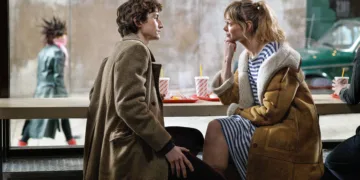
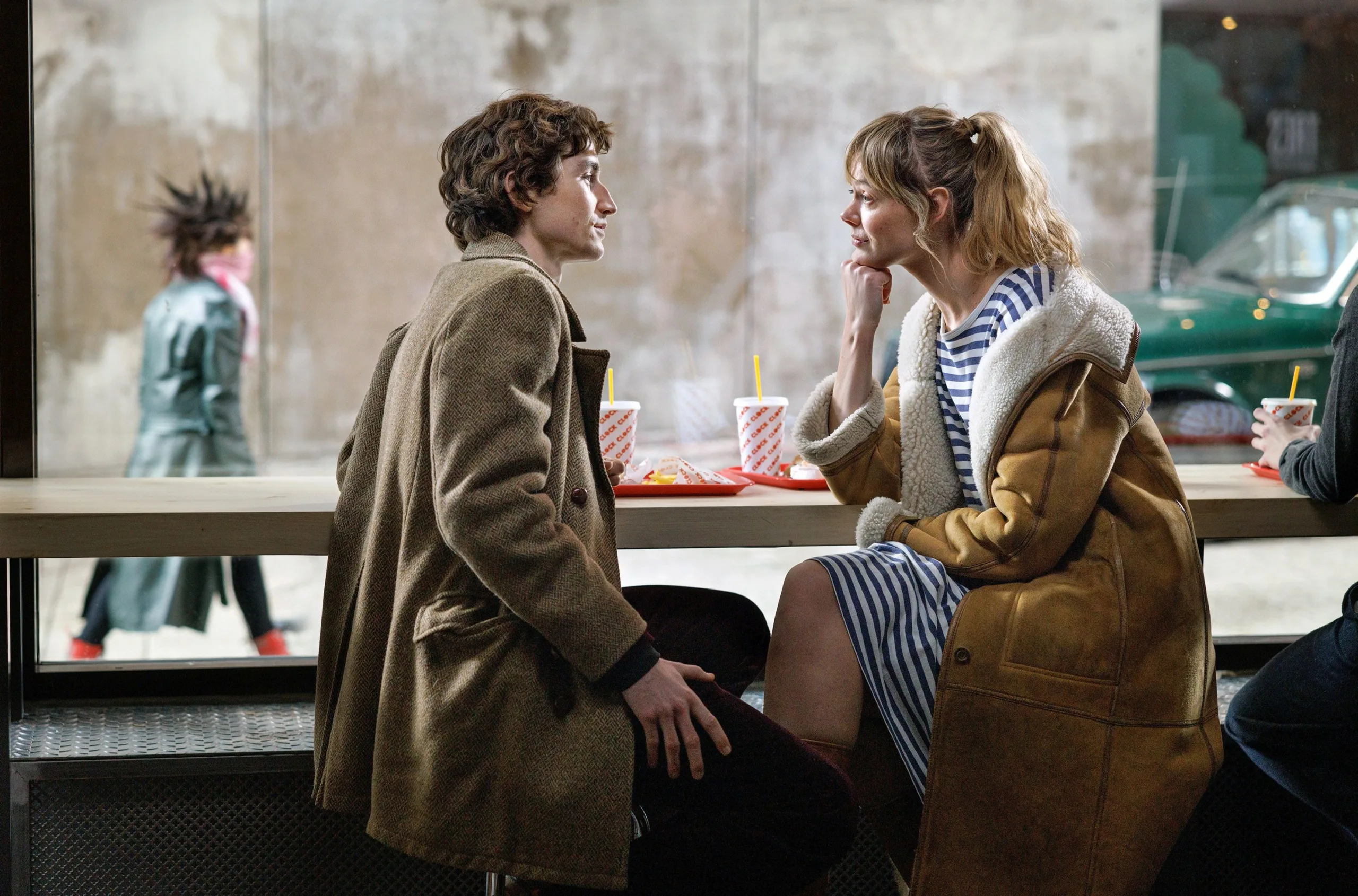
Then it asks the actors to turn emotional intimacy into overwhelming desire. At dinner with Markus, David shifts from weeping about his failed marriage to commenting on Marianne’s “delicious” blackcurrants. It is a strange scene, partly because the flirtation arrives before Lindh and Gustavsson have established the current running beneath it. Their fast-food stop works better. Their knees overlap beneath the counter before they notice their reflections in the window. Both faces harden. They understand what has happened between them before either wants to name it.
That scene gives Alfredson something physical to photograph. Too many later exchanges depend on longing glances that carry little longing. The first kiss is structured as a rupture. David and Marianne have released something they can no longer control. Yet their banter remains mild and their physical chemistry rarely supports the scale of the consequences to come. The series keeps insisting that resistance has become impossible while showing two adults who look perfectly capable of going home.
This problem damages Marianne’s characterization. She tells David that they “didn’t cross the line” before the relationship becomes sexual. By then, they have arranged private time together, discussed desire, admitted attraction, and built a relationship hidden inside her marriage. The line has not merely been crossed. Someone has installed furniture on the other side.
Her repeated fear of what Markus might think carries a similarly adolescent quality. Marianne is a wife, mother, actress, and the person perceptive enough to diagnose David’s view of women. Watching her suddenly behave as if consequences are an unexpected administrative problem creates a split the writing never fully repairs. An adultery tragedy can survive unlikeable people. It cannot easily survive an unconvincing reason for the adultery.
Marianne Steps Outside Bergman’s Frame
Johnsen’s most valuable alteration is the attention paid to Marianne as a person with ideas about sex, acting, and authorship. Bergman’s story has autobiographical roots, and its earlier screen form placed greater control in male hands. This adaptation gives Marianne professional instincts that exist before David turns his camera toward her.
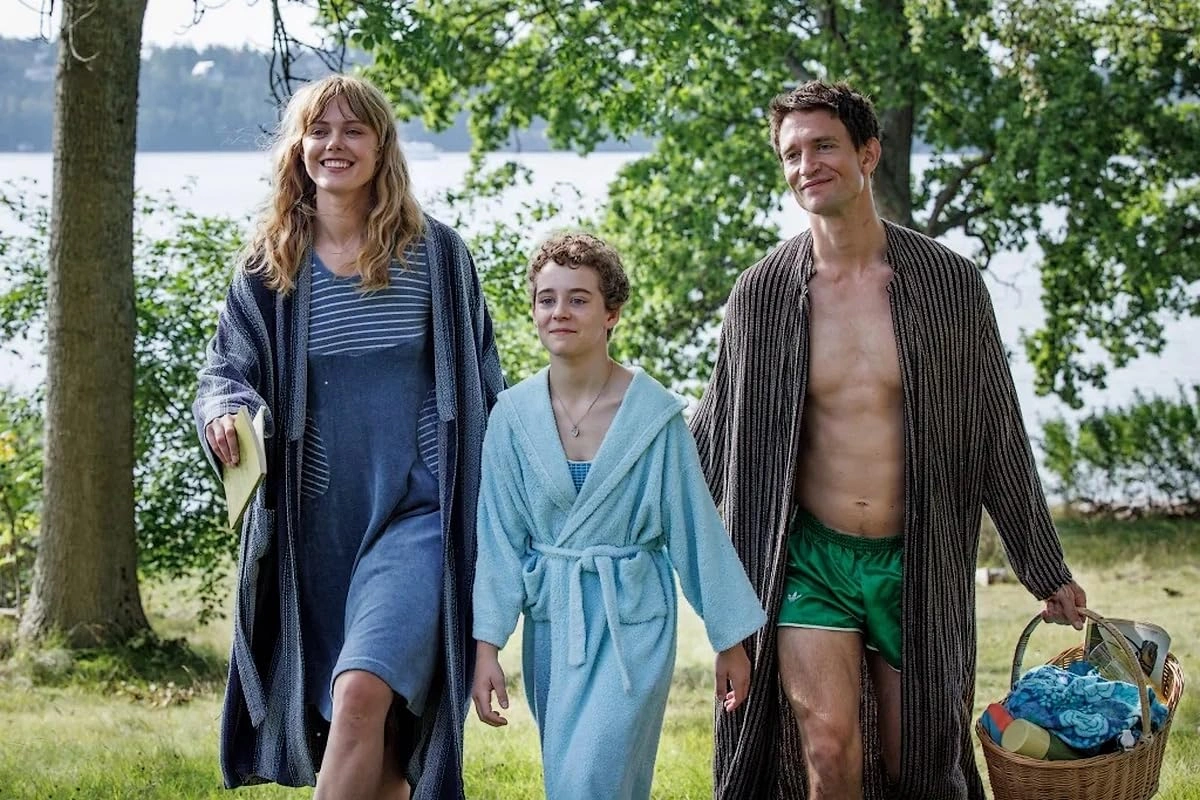
Her criticism of his script is important because she immediately identifies the kind of idealized woman he has written. David believes he understands sexual liberation. Marianne recognizes a male filmmaker describing an idea of female freedom convenient to himself. The irony is that Faithless periodically recreates the fantasy it appears to be examining.
Episode 3 makes that contradiction visible during the filming of Susanna. Marianne performs an erotic scene nude, her face covered by a veil, before an all-male crew. Alfredson’s composition turns her into a body being organized by men. David directs. The crew watches. Marianne’s face, the part most closely associated with individual identity, is hidden.
The image is sharper than the dialogue around it. Marianne introduced David to the book. David translated it into his screenplay. He then casts Marianne as the woman whose sexual freedom he previously failed to understand. Art and private desire have become tangled so thoroughly that separating one from the other would require legal assistance.
Episode 4’s screening of Susanna gives this material its strongest dramatic consequence. Markus sits in an audience and watches the erotic image of his wife projected on screen through his best friend’s artistic gaze. David’s betrayal has gained framing, lighting, and public exhibition. Markus does not need a confession to sense that something private has been moved into the work.
Isabelle’s presence complicates the same dynamic. Her connection to David contains traces of infatuation, and seeing her mother’s sensuality presented through his camera forces several emotions together. Jealousy sits beside confusion and disappointment. Isabelle is old enough to recognize sexual desire, yet still young enough to experience the adults’ behaviour as a collapse of the structure around her.
The adult Isabelle, played by Malin Crépin, becomes significant in the present-day timeline because Faithless refuses to leave the children off-screen while the lovers debate their pain. Her continued presence changes the story’s moral geometry. David and Marianne can discuss what they felt. Isabelle carries evidence of what they did.
Alfredson Builds Rooms Between People
The 1977 material is frequently beautiful enough to explain why Faithless remains easy to watch during its slower stretches. Deep maroon clothing, corduroy suits, smoking on planes, crowded bookshelves, wine, jazz, film sets, and theatre rehearsals create a version of artistic Stockholm where every conversation seems five minutes away from becoming a debate about sex. Alfredson photographs this world with an obsessive interest in separation.
Windows, door frames, and mirrors repeatedly divide the image into sections. Characters sharing a room can occupy visually distinct spaces, with architecture creating barriers before the script acknowledges them. It is a simple compositional principle: where a director places someone inside the frame changes how we read their relationship to everyone around them.
The fast-food reflection is the clearest use of the technique. David and Marianne see themselves together in the window and briefly become spectators of their own behaviour. The recognition is immediate. They have been flirting privately, then the reflection gives them an external view.
Other mirror shots are harder to defend. At one point the camera moves from David toward Marianne’s reflection at an angle visible primarily to the audience. The shot announces significance without clarifying what has been revealed. A recurring visual motif needs development. Repetition alone is interior decoration.
Alfredson is far better when music carries the dramatic information. Hans Ek’s score and Markus’s performances with his jazz band give the character a life outside his role as the betrayed husband. His music belongs to him before David’s affair begins consuming the family story.
The film-festival montage in Episode 4 uses music to track changes between the characters without forcing them into explanatory conversations. Episode 5’s birthday party is stronger still. Looks pass across the room while editing and music circulate suspicion from one character to another. Alfredson lets knowledge become social before it becomes verbal.
Those scenes expose a strange imbalance in Faithless. The director can communicate a marriage cracking through a glance across a party, yet David and Marianne often need entire conversations to convince us they want each other.
Five Hours of Damage
The present-day timeline removes the protections surrounding the younger characters. There are no stylish apartments to inspect, erotic books to debate, or film productions capable of turning selfishness into artistic seriousness. Elderly David and Marianne have to sit together after desire has lost its glamour.
Jesper Christensen never fully reads as an older version of Gustav Lindh. The gap is partly physical, partly behavioural, and the transition between the two Davids can feel like a change of character rather than age. Lena Endre has the opposite advantage. Her history with Marianne gives the older version a sense of continuation before the series asks her to explain anything.
The return of adult Isabelle changes the ending’s moral temperature. Ullmann’s film was harsher. This adaptation leaves greater room for forgiveness, and Isabelle becomes the figure through whom that possibility enters the story.
There is a risk in softening material built around permanent damage. Bergman’s central insight was brutal because the adults’ pursuit of personal fulfilment did not erase their responsibilities to other people. Markus watching Susanna works because desire has become an act with a witness. Isabelle’s reaction works because children do not experience an affair as an abstract debate about love. The birthday party works because several people can feel a secret changing the room before anyone says the wrong sentence.
Faithless loses force whenever it treats David and Marianne’s attraction as a mysterious power exempt from ordinary scrutiny. The performances do not create that sense of inevitability, so the writing starts doing the lobbying on their behalf.
Five hours give Marianne greater agency and Isabelle greater significance. They also leave David and Marianne with nowhere to hide. Every stolen meeting, reflected glance, rehearsal, and private conversation becomes another piece of evidence placed before the audience. The case for the damage is strong. The case for the desire is much weaker.
The acclaimed television miniseries Faithless made its world debut at the Toronto International Film Festival in September 2024, followed by its broad television broadcast premiere on SVT on January 26, 2025. Audiences interested in watching the production can access it through the SVT Play streaming service or via regional public broadcasters carrying Fremantle’s international distribution catalog. The narrative explores a complex, passionate love triangle spanning multiple decades, focusing on a married couple and their closest companion whose historical infidelity forces deep reckonings forty years down the line.
Full Credits
Title: Faithless
Distributor: SVT, Fremantle International Sales, ARTE
Release date: September 2024 (Toronto International Film Festival), January 26, 2025 (Sweden)
Rating: TV-MA
Running time: 88 minutes per episode
Director: Tomas Alfredson
Writers: Sara Johnsen, Ingmar Bergman
Producers and Executive Producers: Jonas Allen, Peter Bose, Christian Rank, Henriette Marienlund
Cast: Frida Gustavsson, Lena Endre, Gustav Lindh, Jesper Christensen, August Wittgenstein, Poppy Klintenberg Hardy, Malin Crépin, Kicki Bramberg, Annika Hallin, Léonie Vincent
Director of Photography (Cinematographer): Monika Lenczewska
Editors: Dino Jonsäter
Composer: Hans Ek
The Review
Faithless
Faithless gains useful room to give Marianne and Isabelle lives outside David's self-regard, yet the extra hours expose the central weakness with surgical clarity: the affair never feels powerful enough to support the wreckage built around it. Tomas Alfredson finds sharper drama in Markus watching Susanna, the birthday-party glances, and the series' divided frames than in David and Marianne's romance itself. A thoughtful adaptation can survive a structural imbalance. This one spends six episodes placing its full weight on it.
PROS
- Meticulous period design
- Strong visual composition
- Richer Marianne and Isabelle
- Excellent music-led sequences
CONS
- Tepid central chemistry
- Unconvincing affair
- Overextended runtime
- Uneven mirror symbolism