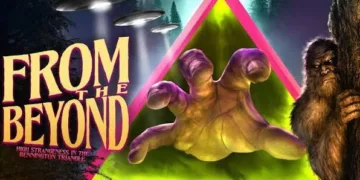









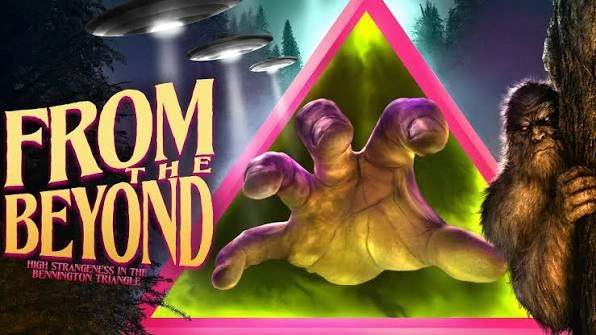
Five disappearances between 1945 and 1950 give Glastenbury Mountain a gravity that no phantom light or Bigfoot story can match. Those cases form the firmest ground beneath From the Beyond: High Strangeness in the Bennington Triangle, yet director Seth Breedlove keeps stepping outward, from documented absence into a wilderness of UFOs, haunted homes, impossible stone formations, and distorted time.
The setting carries enough history before the paranormal material arrives. Glastenbury began as a logging town, briefly attempted to survive as a tourist destination, then became an unincorporated ghost settlement in 1937. Its abandonment gives the film a physical foundation for the mythology. Empty woodland and forgotten infrastructure naturally invite stories, particularly when people have entered the area and failed to return.
Mark Matzke’s measured narration guides the documentary through this mixture of record and legend. His calm delivery helps Breedlove avoid the breathless tone common to paranormal television, where every snapped branch receives its own musical sting. The restraint matters because the subject already risks collapsing under the weight of its claims.
Five Disappearances and a Thousand Explanations
The film’s strongest material concerns the missing people and the 1943 death of hunter Carol Herrick, whose body was reportedly discovered with injuries suggesting he had been crushed. Breedlove recounts these cases without recreating them as cheap horror set pieces. Search efforts, incomplete reports, and unanswered questions retain their human weight.
The investigation grows less focused once it begins cataloguing every strange event associated with the area. Interviewees describe floating orbs, malfunctioning compasses, crying babies heard in empty forests, shadow figures, UFOs, ancient-looking cairns, and cattle apparently killed by electrical force. A large Bigfoot-like creature receives the memorable description of being built like a brick outhouse, phrased rather less politely in the film. Then comes the boulder said to absorb people.
This breadth is entertaining, yet it creates a credibility problem. A missing person case supported by historical records cannot be treated with the same evidentiary weight as a cannibalistic rock. Placing them beside each other gives the documentary range, but it also encourages the wildest folklore to contaminate the stronger material.
Also Read



Breedlove seems aware of this danger. Matzke repeatedly returns to the distance between scarce facts and abundant stories, while the film acknowledges that ordinary explanations can transform through repetition. A failed compass becomes a magnetic anomaly. A distant light becomes an extraterrestrial craft. Several decades later, the account has acquired extra details and a name suitable for a podcast series.
Credibility in the Fog
Author and folklorist Joseph Citro provides much of the historical framework. He coined the term “Bennington Triangle” during a radio interview, drawing from the Bermuda Triangle and Massachusetts’ Bridgewater Triangle. Citro knows Vermont’s stories, understands how they changed, and explains why Glastenbury became a container for unrelated fears.
His presence raises a question the documentary never examines with enough pressure. Citro has written extensively about Vermont monsters and regional folklore, giving him both expertise and a professional interest in keeping these tales alive. That does not make his information false. It does mean his role deserves firmer scrutiny than the film provides.
Breedlove prefers conversation to confrontation. Interviews are allowed to wander, repeat, and settle into natural rhythms. This occasionally slows the documentary, yet it lets witnesses sound like people recalling events rather than performers delivering polished anecdotes. Their pauses and uncertainties often carry greater persuasive force than the claims themselves.
Robert Singley’s account becomes the clearest example. While travelling through the mountain area, he describes distance and time appearing to shift, leaving him unable to exit as expected. The film saves this story until late, giving Singley space to recount it without aggressive editing or visual reconstruction. His restrained delivery creates tension because he appears less interested in proving a paranormal theory than in describing something he still cannot explain.
That method produces effective oral history. It does not produce evidence. Breedlove asks viewers to judge credibility through voice, body language, and accumulated testimony, which is emotionally persuasive and scientifically fragile.
The Mystery Stays on the Mountain
The documentary’s visual language supports its uncertainty. Wide shots of dense woodland make Glastenbury appear inaccessible rather than theatrically sinister. Low light, subdued music, and long views of empty paths create unease without pretending the camera has captured anything supernatural. The mountain’s ordinary appearance becomes part of the effect. Nothing looks wrong, which allows every sound and absence to feel slightly misplaced.
The editing follows a similar principle. Breedlove rarely forces connections between separate phenomena, but the steady stacking of accounts creates its own pattern. One light can be dismissed. One missing stretch of time can be blamed on exhaustion. After several testimonies, the viewer begins searching for links the film cannot prove.
That accumulation is also where the structure becomes loose. Ghost encounters, cryptid sightings, disappearances, and UFO claims could each support a documentary of their own. Packed together, they sometimes resemble a paranormal sampler rather than a sustained investigation into Glastenbury’s history.
Sceptical viewers are unlikely to leave convinced that a supernatural force controls the Bennington Triangle. The film offers too little physical documentation and too few challenging voices for that. It succeeds instead as a portrait of how folklore forms around an isolated place, fed by real tragedy, imperfect records, and the human refusal to leave an unexplained absence empty. Breedlove never solves Glastenbury Mountain. His camera simply watches the tree line, listens to the people who came back, and remembers those who did not.
The paranormal investigative documentary From the Beyond: High Strangeness in the Bennington Triangle launched globally across video-on-demand digital streaming channels on April 28, 2026. Audiences can rent or purchase the independent film online via platforms like Apple TV, Amazon Prime Video, and Google Play, with physical media copies available exclusively through the official Small Town Monsters store. The film explores decades of bizarre, unexplained occurrences centered around Vermont’s Glastenbury Mountain, leaning on firsthand expert interviews and stylized digital animations to inspect localized local lore ranging from historic missing-person cases to alleged cryptid and UFO encounters.
Where to Watch From the Beyond: High Strangeness in the Bennington Triangle (2026) Online





Full Credits
Title: From the Beyond: High Strangeness in the Bennington Triangle
Distributor: Small Town Monsters, Apple TV, Amazon Prime Video, Google Play
Release date: April 28, 2026
Running time: 70 minutes
Director: Seth Breedlove
Writers: Seth Breedlove
Producers and Executive Producers: Courteney Breedlove, Heather Moser, Zac Palmisano
Cast: Joseph Citro, Nick Willard, Paul Dulski, Andy Curtis, Henry Elliott, George Clifford, Paul Bartholomew
Director of Photography (Cinematographer): Courteney Breedlove, Seth Breedlove, Zachary Palmisano, Aleksandar Petakov
Editors: Seth Breedlove, Santino Vitale
Composer: Brandon Dalo
The Review
From the Beyond: High Strangeness in the Bennington Triangle
Seth Breedlove gives Glastenbury Mountain room to remain unknowable, using patient interviews, restrained narration, and shadowed woodland photography instead of manufactured shocks. The documented disappearances carry genuine weight, while the flood of UFOs, cryptids, warped compasses, and man-eating rocks sometimes blurs credible testimony with campfire invention. Robert Singley’s account is especially effective because the film lets his quiet delivery create the tension. This is stronger as an atmospheric record of regional folklore than as a paranormal investigation, but it understands that uncertainty can be its own form of evidence.
PROS
- Patient, atmospheric direction
- Respectful handling of disappearances
- Strong witness testimony
- Effective landscape photography
- Calm, clear narration
CONS
- Evidence remains mostly anecdotal
- Too many competing phenomena
- Outlandish legends weaken credibility
- Limited sceptical examination