













For nearly half an episode, Thunder 3 behaves like a school comedy assembled from the least glamorous corners of adolescence. Pyontaro searches for adult material while hiding from his little sister. Tsubame discusses women’s underwear with the solemnity of a research fellow. The boys receive no Valentine’s chocolate, then watch a handsome transfer student collect the attention they assumed might eventually wander toward them.
The joke is that none of this appears important. Netflix viewers, trained by endless menus to abandon a series before the first act has settled, are being asked to sit through crude humour, rounded character designs, and a toddler calling Pyontaro “Big bwudder.” Patience has become television’s least fashionable subscription feature.
The misdirection works because the episode refuses to hurry its real premise. Pyontaro, Hiroshi, and Tsubame are the “Small 3,” an affectionate insult that describes their height and their place within the school hierarchy. They possess no social capital, romantic prospects, or evident heroic qualities. Their teacher, Doc, lends them a mysterious game disc said to connect with another universe. The explanation sounds like one more eccentric detail in a harmless comedy. Then the disc enters Pyontaro’s TS5 console.
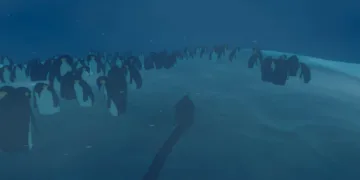
Its realistic landscape holds the family’s attention until the doorbell pulls the boys away. Futaba remains behind, sees a dragonfly emerge through the television, and follows it back through the screen. The opening credits arrive deep into the episode, practically announcing that everything before them was camouflage. It is a sharp piece of television architecture, built around the audience’s confidence that it already knows what kind of show it is watching.
Two Worlds, Unequal Budgets
The parallel Earth treats Futaba as an impossible object. Its people have realistic proportions and inhabit detailed streets beneath alien spacecraft, while she retains the soft geometry of a gag-manga child. A field of screentone follows her body, marking her as a printed character dropped into a supposedly physical world.
This is the premiere’s strongest idea. The art-style collision becomes part of the fiction rather than decorative novelty. Civilians crowd around Futaba because she looks wrong to them. An alien scans her, identifies the toddler as a threat, and responds with missile fire. The escalation is absurd, frightening, and very funny, sometimes within the same shot.
The execution is rougher. The computer-generated civilians move stiffly, while alien machines drift through action scenes with limited weight. Several backgrounds resemble game environments awaiting a final rendering pass. The visual poverty may repel viewers before they grasp its dramatic function, which leaves the series in the awkward position of demanding that audiences distinguish deliberate ugliness from production limits. Streaming platforms usually ask viewers to admire polish. Here, Netflix is distributing an anime whose ugliest material carries part of its argument.
The contrast still registers. Pyontaro’s home world looks cheap in a playful, childlike way. The occupied Earth looks cheap while reaching for realism. Their incompatibility creates the sense that the Small 3 have wandered into another programme, one produced for an older audience with nastier rules.
Futaba Changes the Stakes
Futaba’s disappearance lands because the episode spends time making her irritating. She steals Pyontaro’s clothes, enters his bed, interrupts his private moments, and declares that she plans to marry him. Her speech can become grating, yet Risa Mei’s performance gives those habits the uncontrolled affection of a child who has not learned that love may need personal boundaries.
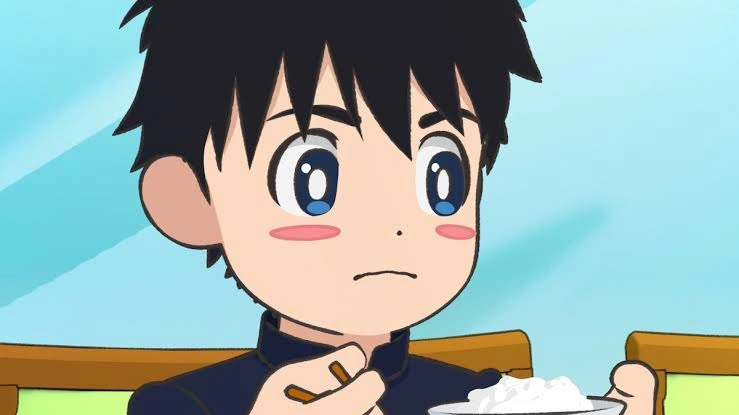
Pyontaro responds with the embarrassed cruelty common to older siblings. He ignores her whenever escape is available. When he returns home, Futaba stops crying immediately, a small reaction that reveals the authority he holds within her world. He barely registers it.
The silence after she enters the television changes him. Pyontaro searches the house, notices leaves drifting from the game world, and understands that the sister he treated as an inconvenience is gone. His panic gives emotional direction to a premiere crowded with tonal experiments.
Abby Trott voices him without polishing away his immaturity. Pyontaro remains rude, distracted, and fascinated by sex, yet his fear for Futaba never feels like a sudden personality replacement. Hiroshi and Tsubame follow him through the screen because their friendship has already been established through small humiliations: shared rejection on Valentine’s Day, aimless conversations, and afternoons spent playing games with Doc. The Small 3 are united by being socially negligible. The rescue gives that insignificance a use.
Heroes Built for the Wrong Reality
Once the boys cross into the occupied Earth, the physical hierarchy reverses. Pyontaro survives a fall that should kill him. Stone crumbles beneath the boys’ hands. Alien weapons designed to terrorise realistic bodies struggle against children constructed according to cartoon physics.
The concept carries a sly social charge. In their own world, the Small 3 are judged by height, popularity, and adolescent status. In this one, the traits marking them as ridiculous make them dangerous. The aliens read Futaba’s body as a threat before she performs any hostile act, turning visual difference into the basis for state violence. Their scanners provide the verdict, their missiles provide the policy. Bureaucracy moves quickly when the target is a toddler.
The episode rushes through these discoveries. Pyontaro learns about his durability during combat, while Hiroshi converts the revelation into hope before the world’s rules have been established. Tatsuomi and the guitar-carrying girl receive introductions without a clear function, creating the sense that the premiere is stocking future episodes while its present crisis accelerates.
Still, the closing image earns its pause. Alien ships fill the sky as Hiroshi suggests that their strange strength may allow them to save Futaba. Three boys who could not attract a Valentine’s gift now face an occupying force. Television loves an underdog. Thunder 3 has found three and changed the laws of matter on their behalf.
The series premiered on July 8, 2026, and is available to stream exclusively on Netflix. The plot follows three childhood friends—Pyontaro, Tsubame, and Hiroshi—who embark on a desperate, imaginative adventure after Pyontaro’s younger sister mysteriously vanishes.
Where to Watch Thunder 3 Online


Full Credits
Title: Thunder 3
Distributor: Netflix, Fuji TV
Release date: July 8, 2026
Director: Hiroyuki Seshita
Writers: Hiroshi Seko
Producers and Executive Producers: UNEND (Animation Production), Thunder 3 Production Committee
Cast: Sayumi Suzushiro, Natsumi Kawaida, Eri Akiyama, Honoka Mitsubachi
The Review
Thunder 3
Thunder 3 treats its premiere like a prank on the streaming economy, spending half an episode impersonating a disposable school comedy before revealing an alien occupation, a kidnapped toddler, and heroes whose cartoon bodies break the physics of a realistic world. The delayed credits and clashing art styles make that deception exhilarating, though stiff CGI and crude adolescent jokes may drive viewers away before the trick lands. Netflix has released an anime that asks for patience from audiences trained to decide within minutes. Bold strategy. Strange show.
PROS
- Audacious mid-episode transformation
- Strong sibling stakes
- Inventive visual collision
- Cleverly delayed opening credits
- Promising rescue premise
CONS
- Stiff, uneven CGI
- Grating juvenile humour
- Compressed final act
- Thin supporting-character setup
- High early dropout risk