

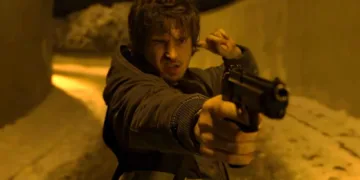




















Martina Buchelová treats emotional immaturity as a shared family condition, then lets the youngest characters take most of the blame. Parents disappear into new relationships, fathers collect debt and younger girlfriends, and one anxious patriarch prepares for social collapse by stealing spoons and planning a bunker. Against this unstable adult world, twenty-year-old Andrej’s alcoholism begins to look less like an isolated defect than the family inheritance nobody bothered to name.
Milovník, Nie Bojovník, released internationally as Lover, Not a Fighter, shapes this idea through a fragmented romantic comedy about Andrej, played by Adam Kubala, and the quieter, sharper Miša, played by Michaela Kostková. Their relationship supplies the emotional thread, but Buchelová keeps cutting away from it, allowing cousins, siblings, grandparents, and disastrous acquaintances to occupy the film’s wandering attention. The structure risks diffusion. It also captures a generation whose days arrive as interruptions rather than chapters.
Emotional Buffering
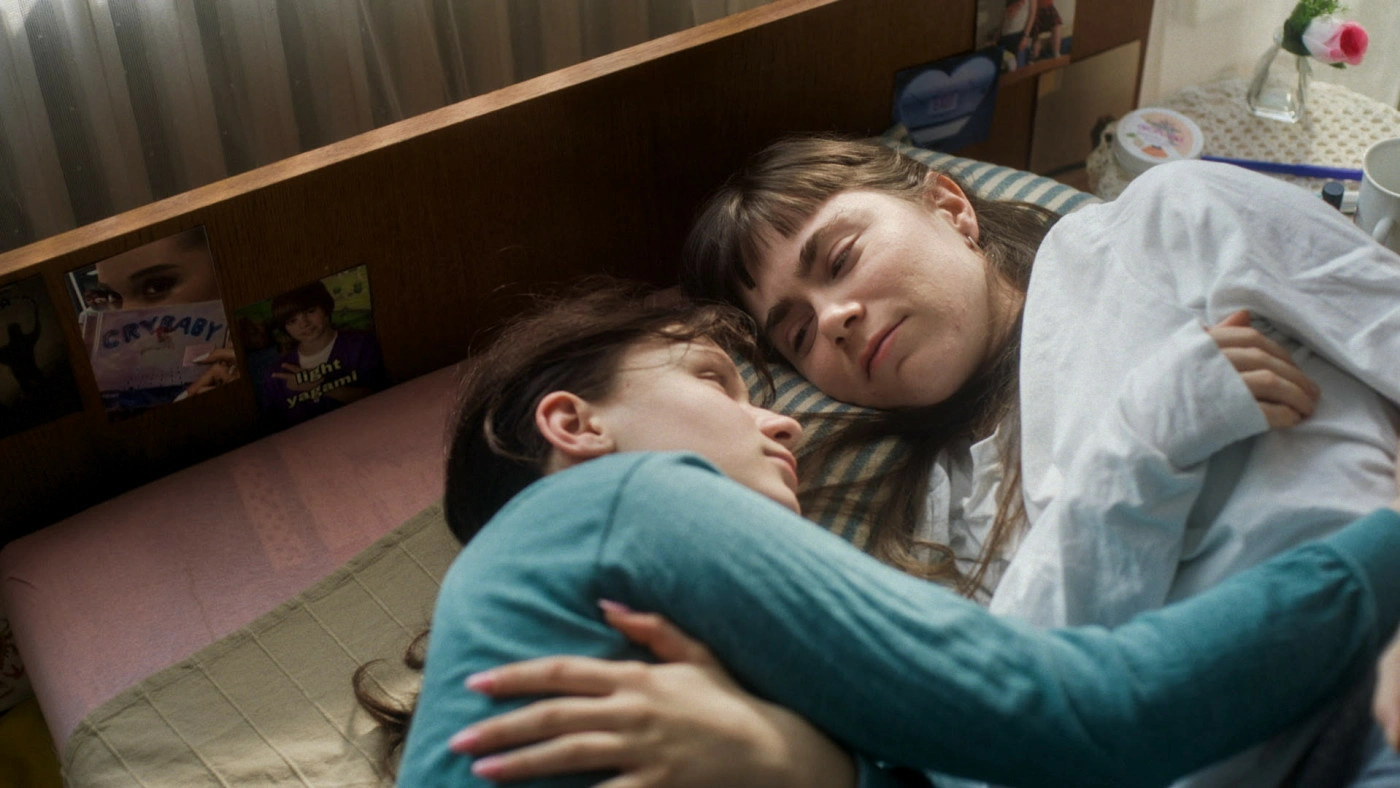
Andrej first meets Miša at a tram stop while drunk enough to turn her attempt at kindness into unpaid emergency care. She helps him, he barely manages himself, and romance must wait for sobriety, chance, and an awkward family dinner. Miša’s father later introduces her to Andrej’s cousin Peťo, believing the sensitive young man might be a suitable match. Miša instead notices Andrej, whose appeal rests somewhere between wounded openness and the warning signs everyone politely ignores.
Their dates appear partly through vertical phone footage, with affection preserved in the visual grammar of private clips. The format matters. Andrej and Miša do not simply experience happiness; they record it, crop it, and carry it around after the relationship breaks. Call this emotional buffering, the state of waiting for life to resume while replaying the last moment when it seemed functional.
Andrej wants intimacy, yet he behaves as though affection should survive every failure of responsibility. Kubala gives that contradiction physical form. His body often seems a beat behind the room, folding into furniture, blankets, and public trees. One morning finds him watching weak television from beneath a duvet while eating preserved cherries from a jar, an image of regression played without easy contempt. His tree-climbing habit offers the reverse impulse: escape by elevation, adulthood by several metres, philosophy courtesy of a sturdy branch.
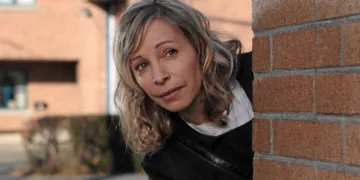
Kostková refuses to let Miša become the patient woman assigned to repair a damaged man. Her reserve carries judgment, disappointment, and curiosity. She sees Andrej’s sadness without confusing it for innocence. When Peťo tells his cousin that sadness has made him stupid, the insult works as compassion because it names pain while leaving responsibility intact.
Everyone Is Improvising
Andrej moves into his grandmother’s home to quit drinking, only to discover that Peťo has chosen the same refuge. Their early hostility resembles a territorial dispute between two men who own nothing. Each views the other as an intruder, largely because each recognizes the same loneliness, failed independence, and social awkwardness staring back.
Jaroslava Pokorná plays the grandmother with an ease that prevents the household from becoming a collection of comic conditions. She feeds, observes, and imposes limits without delivering speeches about lost youth. Her flat becomes a temporary republic for people who cannot govern themselves.
The surrounding adults offer little proof that age solves anything. Andrej’s separated parents are absorbed by new partners. His indebted father dates a much younger woman, entering scenes with the confidence of someone who has mistaken chaos for freedom.
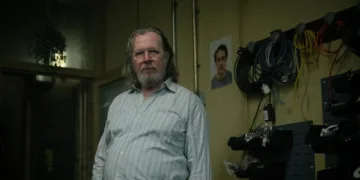
Miša’s father worries that her lack of romantic recovery might reveal something about her sexuality, then channels his own fears into bunker construction. He hoards spoons with the solemnity of a civil defence program. The joke lands because his absurdity grows from real dread: environmental disaster, political instability, economic collapse, the vague suspicion that ordinary life has stopped keeping its promises.
Miša’s younger sister faces a harsher version of that disorder. A sudden episode involving an older man preying on her shifts the film toward genuine danger. The abruptness is unsettling, partly by design and partly from structural carelessness. Buchelová has spent so long teaching us to accept each digression as comic texture that this encounter arrives carrying dramatic weight the surrounding material has not prepared to hold.
Digression as a Way of Life
Buchelová divides the film with elaborate intertitles that explain scenes through ironic excess. Andrej is introduced as someone who no longer waits at tram stops, sits in trees, and lives with his grandmother. Another title announces that his father is in love and broke. The phrasing resembles an overlong message sent by someone unwilling to state a feeling directly.
Some of these captions become precious, yet their fussiness belongs to the characters’ habit of decorating discomfort. Pain receives a joke, a label, a phone clip, or a strange anecdote. Direct expression remains the final option.
The same principle governs the side stories. Andrej imagines a boyband living in his closet. Peťo’s foolish friend arrives and creates havoc. Miša’s father pursues bunker supplies. Several incidents contribute little to the central romance, but they reveal how this group fills time while waiting for identity to solidify. A few scenes remain anecdotes searching for a home. Others create the peculiar intimacy of knowing people through the stories that never appear on their official biographies.
Adam Mach’s handheld camerawork supports this looseness. Close-ups arrive with documentary roughness, while the camera roams through flats, streets, and family gatherings as though catching behaviour before anyone can perform respectability. The shifts between phone images and wider framing separate curated memory from physical life. Inside the phone, Andrej and Miša can appear temporarily complete. Outside it, he still has to answer for what happened after recording stopped.
Sadness Without Fashion
Many films about disaffected youth treat despair as a visual accessory: grey rooms, vacant faces, tasteful alienation. Buchelová is less impressed by misery. Andrej’s sadness makes him ridiculous, selfish, tender, and occasionally cruel. Peťo’s loneliness turns into resentment before it softens into recognition. Miša’s disappointment never grants her moral perfection. Each character remains capable of insight and foolishness within the same conversation.
That refusal to diagnose an entire generation gives the film its generosity. The young characters have grown up online, but Buchelová avoids turning internet habits into an easy villain. The phone camera preserves affection and distance at once. The real disorder comes from families where adults have also postponed responsibility, only with better excuses and larger debts.
The film’s freewheeling structure occasionally confuses accumulation with depth. Still, its strongest moments carry unusual precision: Andrej disappearing into his duvet, Miša choosing him across a badly arranged dinner, two cousins fighting over space in their grandmother’s flat, a father preparing for apocalypse while misunderstanding his daughter. Buchelová finds comedy in people who cannot explain themselves and tenderness in the fact that they keep trying anyway.
This Slovak-Czech tragicomedy premiered at the Karlovy Vary International Film Festival in July 2026, where it received critical acclaim. The story follows a young man named Andrej who seeks to simplify his life by spending the summer at his grandmother’s house, though his plans are derailed when he falls in love and discovers that love often requires a fight.
Full Credits
Title: Milovník, nie bojovník
Distributor: ASFK (Slovakia)
Release date: September 17, 2026 (Slovakia)
Director: Martina Buchelová
Writers: Martina Buchelová
Cast: Adam Kubala, František Beleš, Jaroslav Vojtek, Marián Mitaš
Director of Photography (Cinematographer): Adam Mach
Composer: Adam Matej
The Review
Milovník, Nie Bojovník
Milovník, Nie Bojovník turns romantic failure into a theory of arrested adulthood, then quietly admits that the adults are scarcely less arrested. Martina Buchelová’s fragmented structure sometimes mistakes anecdote for insight, yet its best scenes find tenderness inside embarrassment: Andrej beneath his duvet, Miša recording their fragile happiness, Peťo naming sadness as the source of stupidity. Call it emotional buffering, the state of waiting for life to load while pretending the frozen screen is a choice. Funny, bruised, and unusually generous.
PROS
- Adam Kubala’s physical comedy
- Tender, intelligent central romance
- Expressive phone-video imagery
- Sharp intergenerational observations
CONS
- Uneven comic digressions
- Occasionally precious intertitles
- Abrupt tonal shifts