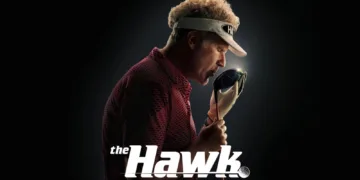




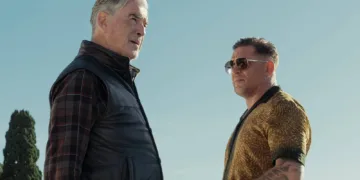


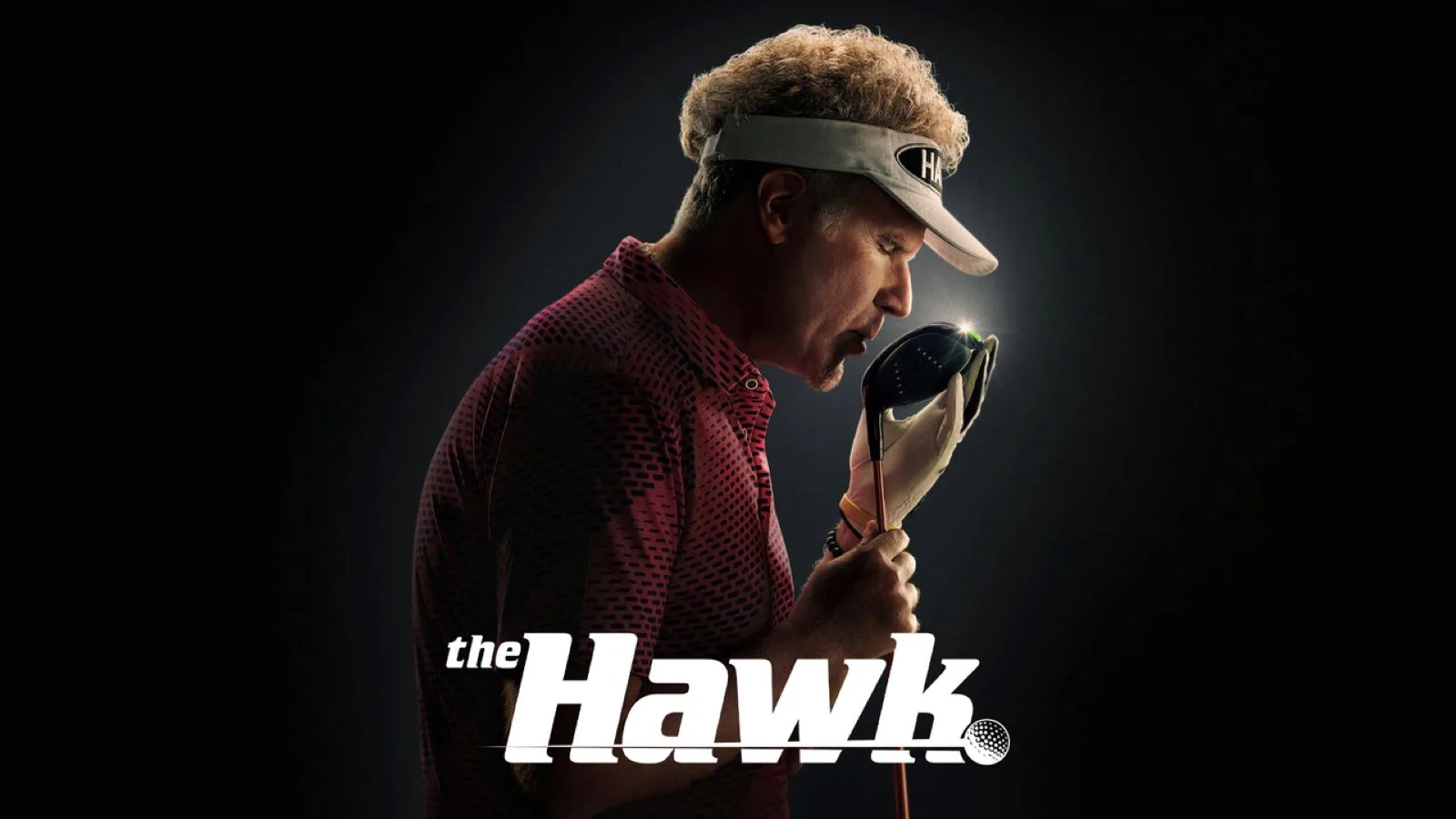

One missing major has organised Lonnie Hawkins’s life for two decades. Ten half-hours give his comeback room to grow older, sadder and more self-aware than Will Ferrell’s theatrical sports comedies usually allowed, but that extra space becomes both The Hawk’s best opportunity and its defining mistake. The series keeps confusing expansion with accumulation. Every new rival, business scheme, cameo and supporting subplot adds material without reliably adding pressure.
Lonnie was once the world’s top-ranked golfer, but a disastrous missed putt denied him the final major required for a Career Grand Slam. Two decades later, he is stranded on a lower-tier circuit, travelling in an enormous tour bus and behaving as though his decline is a temporary administrative error. His body is slowing down, his reputation has curdled into novelty, and his son Lance has become the composed young professional Lonnie can neither fully support nor stop envying.
That is a sturdy comic engine. Lonnie’s attempt to win his way back onto the PGA Tour gives the season a measurable objective, while Lance’s ascent makes each professional setback a personal humiliation. The comeback is not simply about recovering status. Lonnie wants to prove that his son has not replaced him, that his estranged wife Stacy has not outgrown him and that the golfing world still needs the disorder he once brought to it.
Ferrell has played variations on this man before: the loud competitor with the confidence of a champion and the judgment of a concussed mascot. Yet Lonnie is not quite Ricky Bobby with a golf club. He understands more than Ferrell’s earlier sports buffoons did. He knows that his best years may be behind him, recognises that Lance has become the more disciplined athlete and grasps how thoroughly he has damaged his family. His problem is not a total absence of self-knowledge. It is that self-knowledge rarely changes his behaviour.
That distinction gives The Hawk an unexpectedly melancholy undertow. The sudden death of Lonnie’s longtime caddie, Old Henry, confronts him with mortality before the comeback has properly begun. His jealousy of Lance is sharpened by reluctant pride. Even his endless refusal to complete the divorce from Stacy carries something more complicated than simple possessiveness. Lonnie remains attracted to her fury because it is one of the last signs that she is still emotionally engaged with him.
Molly Shannon turns that fury into the series’ most dependable source of propulsion. Stacy’s threats, sales pitches and explosive reactions can be excessive, but Shannon gives each confrontation an escalating shape. She does not merely match Ferrell’s volume; she changes the direction of the scene. Jimmy Tatro takes the opposite approach as Lance, containing the hereditary Hawkins chaos beneath wellness routines and professional restraint. Fortune Feimster’s Sam, an inexperienced caddie hired almost by accident, provides Lonnie with a companion whose eccentricity does not automatically become aggression.
These relationships deepen the comeback because each one tests the same question: can Lonnie pursue relevance without treating everyone around him as equipment? The series is strongest when golf, family resentment and friendship occupy the same dramatic space. Too often, however, it sends those elements into separate stories and assumes that occasional intersections will create a coherent season.
The tournament schedule supplies forward movement, but the narrative keeps wandering away from it. Golden Fisk, Lonnie’s polished professional rival, offers an obvious contrast but rarely becomes more than an image-conscious nuisance. Anton Floyd, a PGA official with a personal grudge, embodies the familiar conflict between country-club respectability and the vulgar outsider without developing it beyond obstruction. Lance’s influencer fiancée, Stacy’s new relationship, Sam’s family history, athlete appearances and various promotional ventures compete for attention without consistently changing Lonnie’s choices.
Not every subplot needs to alter the season’s outcome. Comedy benefits from digression, especially when a character as undisciplined as Lonnie is at its centre. The problem is one of structural load. The Hawk repeatedly pauses its strongest conflicts to begin stories that generate neither sustained comic escalation nor meaningful consequence. Some characters disappear for stretches. Others receive ominous setup followed by thin resolution. Extended detours involving poker, criminal confusion or physical mishaps consume time that could have intensified the rivalry between father and son or complicated Lonnie’s dependence on Sam.
The half-hour episodes keep this from becoming unbearable. Individual scenes can end before their premise completely collapses, and Ferrell remains capable of rescuing weak material through conviction alone. He treats every garish outfit, wounded scream and intimate conversation with a golf ball as though the fate of American comedy depends on it. But short episodes do not automatically produce a tight season. Ten compact chapters can still contain the narrative bulk of a stretched feature.
The looseness also complicates the show’s tonal ambitions. The Hawk wants Lonnie to function as a live-action cartoon, a tragic relic, a selfish father and a plausible underdog. Those versions of him are not incompatible. The series simply struggles to make them influence one another. A crude gag may be followed by a sincere confrontation, but the joke rarely alters the emotional scene and the emotional scene rarely changes the terms of the comedy. The tones coexist more often than they combine.
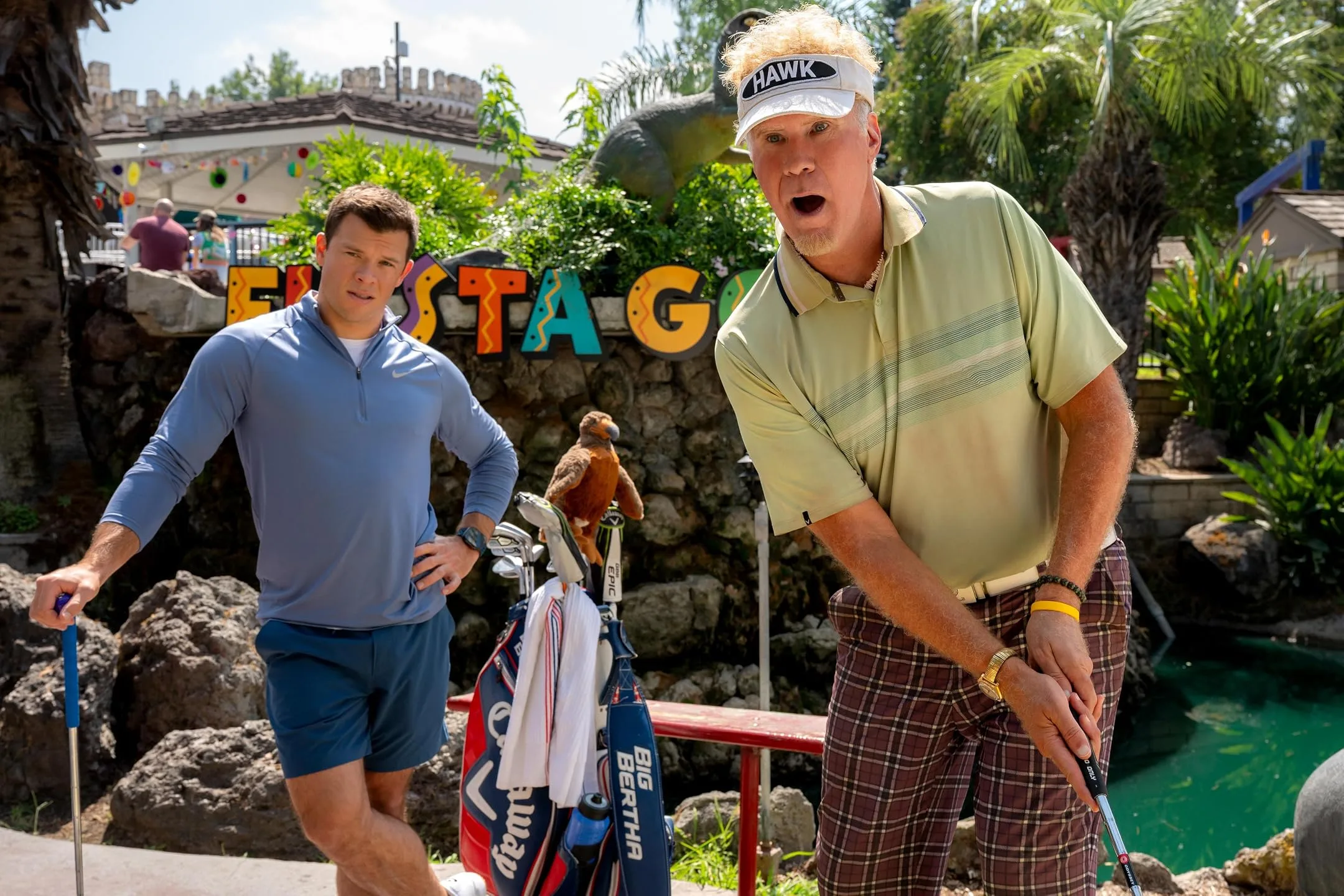
David Gordon Green’s visual approach gives the production a stronger identity than its narrative construction. The camera races with golf balls, flips perspectives and occasionally transforms ordinary spaces through playful post-production. Aggressive colour grading and carefully arranged frames make Lonnie’s world resemble the music video constantly playing inside his head. Yet this visual energy is only intermittently connected to comic timing. The series often looks more decisive than it moves.
Its later ensemble-heavy passages expose the missed opportunity. When Ferrell, Shannon, Tatro and the supporting cast are forced into the same location, competing desires begin to collide instead of waiting in parallel lanes. Stacy’s opportunism disrupts Lonnie’s comeback. Lance’s restraint starts to crack under direct contact with his father. Secondary characters become obstacles, accomplices or witnesses rather than temporary owners of unrelated stories. The comedy gains pace because one action produces another.
Those sequences clarify the problem. The premise is not too thin for television, and the characters are not incapable of carrying a season. Lonnie’s comeback, Lance’s ascent and Stacy’s unresolved attachment could sustain a richer serial comedy, particularly with Sam caught between professional loyalty and the recognition that her new employer is often indefensible. What fails is the distribution of that material. The Hawk keeps scattering its strongest players across parallel storylines, then reveals how much sharper it becomes when they are made to affect one another.
The comedy television series The Hawk officially premiered on Netflix on July 16, 2026. It follows Lonnie “The Hawk” Hawkins, a washed-up, former number-one golfer in the world who attempts to recapture his past glory and win the U.S. Open to complete a Career Grand Slam. You can stream the entire 10-episode first season exclusively on Netflix.
Where to Watch The Hawk Online


Full Credits
Title: The Hawk
Distributor: Netflix
Release date: July 16, 2026
Rating: TV-MA
Running time: ~30 minutes per episode
Director: David Gordon Green, Jonathan van Tulleken
Writers: Will Ferrell, Harper Steele, Chris Henchy
Producers and Executive Producers: Will Ferrell, Jessica Elbaum, Alix Taylor, Rian Johnson, Ram Bergman, Nena Rodrigue
Cast: Will Ferrell, Molly Shannon, Jimmy Tatro, Fortune Feimster, Chris Parnell, Katelyn Tarver, David Hornsby, Luke Wilson, Gabriel Hogan, Aida Osman, Keith David
Director of Photography (Cinematographer): Michael Simmonds
Editors: Todd Downing, Craig Alpert
Composer: Joseph Stephens
The Review
The Hawk
The Hawk finds more melancholy in Will Ferrell’s familiar sports buffoon than expected, with Molly Shannon and Fortune Feimster helping turn Lonnie Hawkins’s comeback into a damaged-family comedy. Its ten-episode structure is less successful. Rivals, cameos, side stories and tonal detours repeatedly dilute a clear tournament spine, while the strongest sequences bring the ensemble together and let one conflict affect another. Ferrell’s commitment and David Gordon Green’s visual energy keep it lively, but the season’s scattered construction prevents a promising premise from sustaining a full run.
PROS
- Ferrell gives a familiar comic archetype greater melancholy and self-awareness.
- Molly Shannon and Fortune Feimster bring energy and emotional pressure to the ensemble.
- The visual direction gives the series a distinctive, playful identity.
CONS
- The ten-episode structure overextends a focused sports-comedy premise.
- Rivals, cameos and supporting subplots repeatedly weaken the comeback spine.
- Broad comedy and family drama coexist more often than they strengthen each other.