






















Every directional input in KAZ performs two jobs. It moves the character across a grid and attacks anything occupying the destination tile. That single rule removes the usual separation between traversal and combat, turning route selection into the entire action system.
Survivor mode gives the design its clearest form. A round begins on a compact grid with enemies scattered across its nodes. The player has roughly fifteen seconds to reach a score target, and each later round raises that requirement while expanding the board. Early stages allow a few corrections. Later ones introduce gaps, shielded enemies, moving targets, fugitive enemies, and curse tiles that punish sloppy paths.
The controls remain simple, yet the decisions become dense. Chasing a high-value star may rescue a weak round, but crossing the grid for it can waste the seconds needed to clear nearby enemies. A shielded target costs extra movement. A fugitive becomes increasingly valuable as it escapes. The best route can change between two keystrokes. KAZ does not need a conventional combat button because movement already carries intent. The system asks one question repeatedly: where should the next input land?
Building Between Bursts
The run pauses after each successful round and offers a choice of upgrades. These choices determine how long raw reflexes can keep a run alive. Extra time creates room for imperfect movement. Faster enemy spawning produces additional scoring opportunities but demands greater control.
Stars provide large point bursts if the player can reach them. Other items reward shield breaks, increase fugitive values, add armour against traps, or trigger attacks such as lightning and lasers. A jump upgrade changes how gaps are handled, opening routes that would otherwise require a detour.
Weapons and automatic abilities activate after a set number of moves, which makes movement cadence part of build planning. Spells require deliberate directional combinations during play. A tidal wave, for example, can clear enemies across horizontal lines after the correct input sequence. The catch is spatial. Some grid layouts do not leave enough room to enter a complex spell cleanly, making a powerful selection useless during the round that needs it most.
Curses create the opposite form of progression. Stepping on enough traps fills a meter and forces the player to choose a malus. Scrambled controls interfere with muscle memory. Random teleportation destroys route planning. Stronger shields increase the movement cost of each kill. These penalties work because they attack the same system the upgrades support: efficient inputs. A good build does not replace dexterity. It buys forgiveness when dexterity starts to fail.
Progress Through Failure
Each ended run feeds a persistent quest structure containing over 140 objectives. The game tracks enemy kills, cleared rounds, trap collisions, weapon use, and character-specific actions, then converts completed goals into coins.
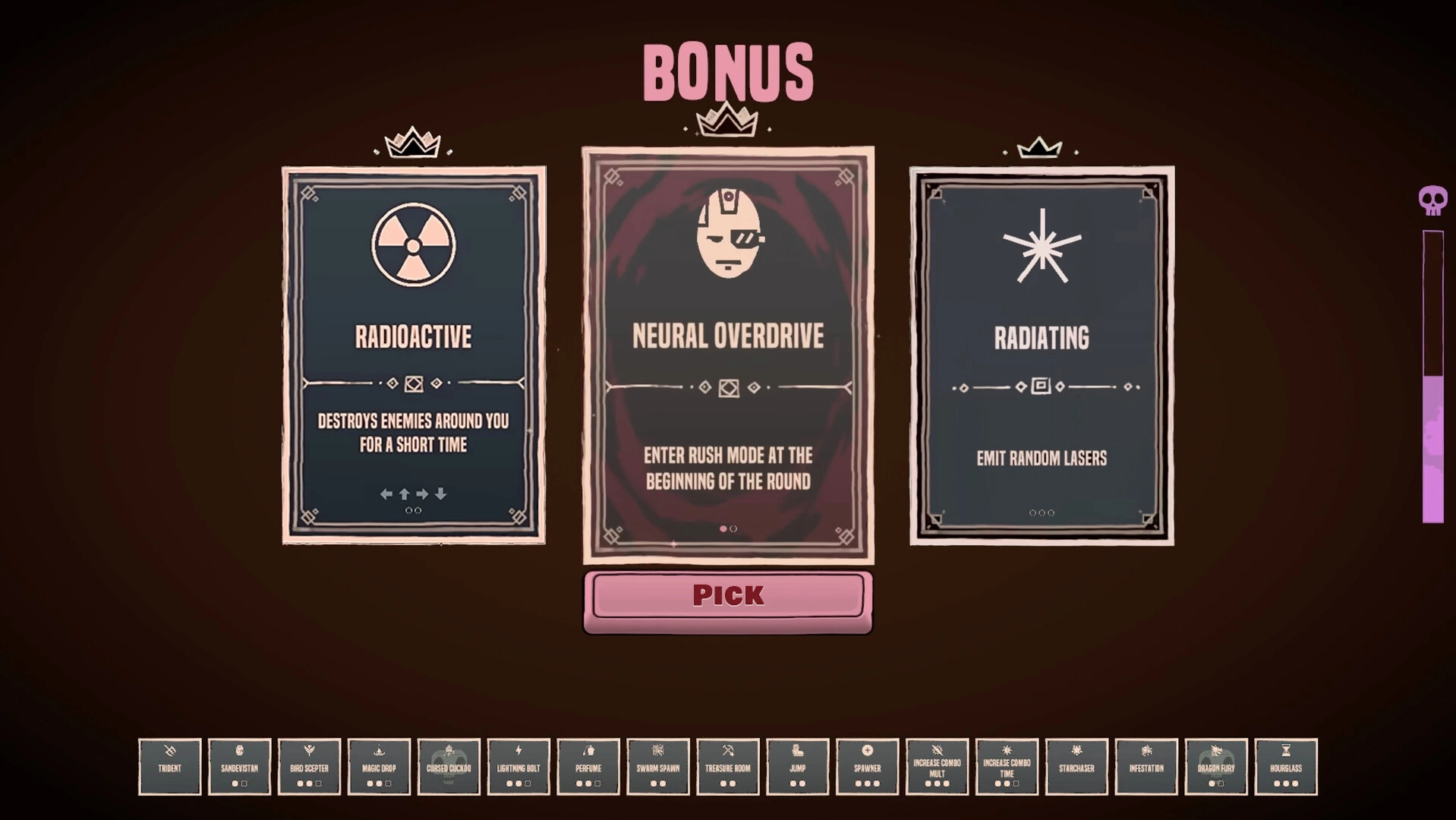
Those coins unlock themes, avatars, weapons, and further quests. The structure gives failed runs value without weakening the score attack. A poor attempt may still finish an objective, while a successful attempt can unlock a character that changes the next opening strategy.
The playable cast supplies mechanical identity in place of narrative. Kaz triggers a large explosion at the end of a round. Bunny Bento begins with a small multiplier. Aku receives shorter spell cooldowns. These are restrained bonuses, yet each one nudges upgrade priorities. Aku makes active spells easier to build around, while Bunny Bento benefits from early score amplification.
Themes also replace the story function that many roguelites assign to lore. Each character brings a distinct visual design, enemy set, and musical track. The interface keeps traps, shields, stars, and targets readable when effects fill the grid. Post-round statistics list successful moves, dead moves, and actions per minute, exposing exactly where efficiency collapsed. The soundtrack is especially well integrated. Its rising intensity follows the pressure of the run, while clear impact sounds confirm kills during moments when the board becomes difficult to parse visually.
Modes and Physical Limits
Survivor remains the strongest mode because its timer makes every upgrade compete against immediate failure. Too Many Items accelerates the build economy by allowing three selections after each round, making it useful for completing several quests in one run.
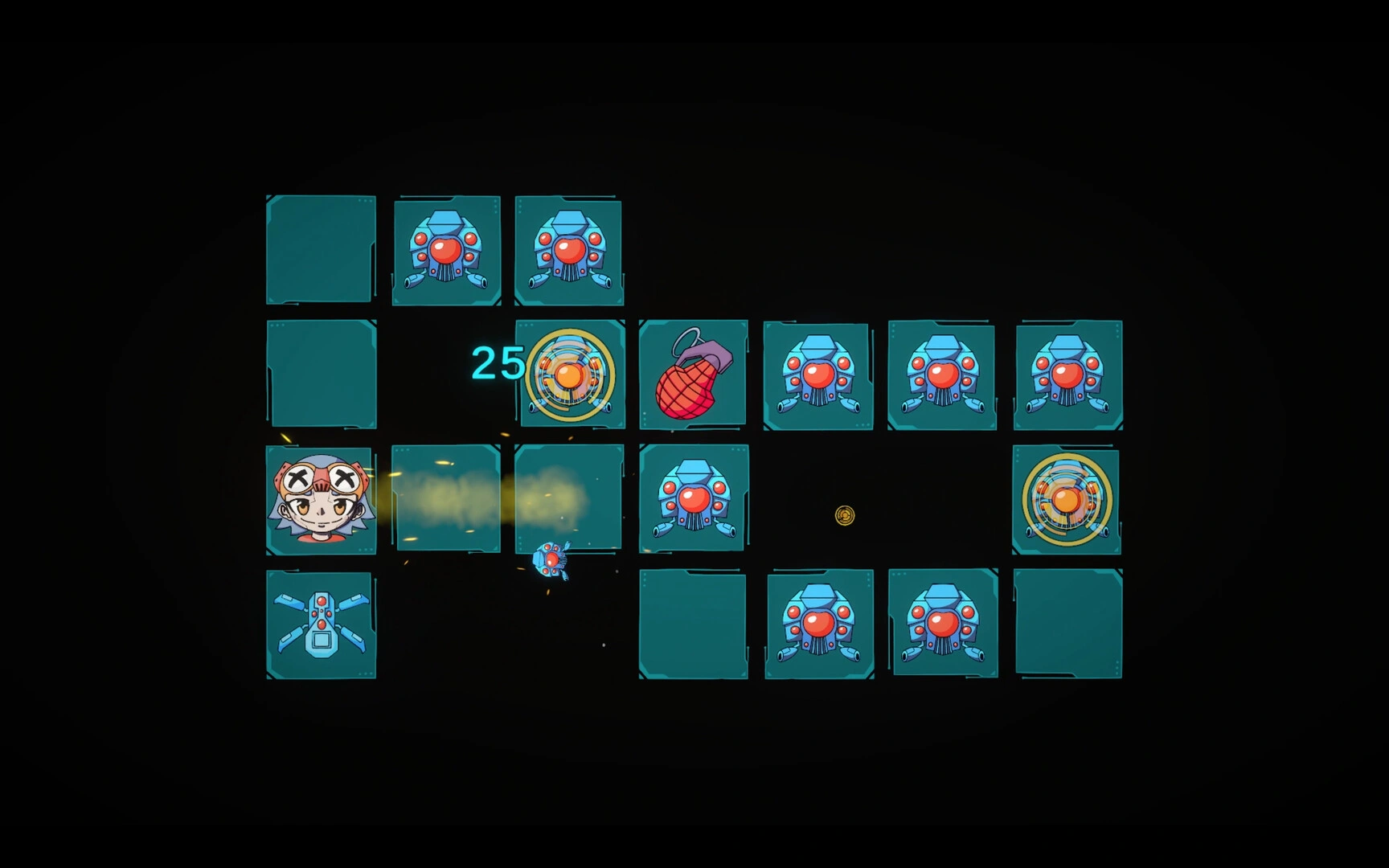
No Stress mode replaces time with a fixed number of moves. That change reveals the tactical structure beneath the reflex test. Routes can be planned, shield costs can be counted, and stars can be evaluated without hurried inputs.
Its item pool does not fully adapt to the new rules. Upgrades tied to time or movement speed can become dead picks, while direct score bonuses gain excessive importance. A mode designed around planning can therefore hinge on receiving the right scoring item early, which weakens its claim to tactical purity.
Weekly boards place every player on the same layout with the same rare items, giving leaderboard competition a cleaner baseline. Monthly challenges built around repeated debuffs test how well players understand the curse system. Dance-pad support takes the four-direction concept to its logical and slightly alarming endpoint.
Input hardware matters. Full-sized cursor keys provide the responsiveness that later rounds demand. Cramped laptop arrows and controllers can introduce enough resistance to break a high-speed route. Long sessions create a harsher problem: optimal patterns require sustained, uncomfortable finger movement. The system is precise enough to produce muscle memory, and demanding enough to make that memory hurt.
The Review
KAZ
KAZ turns four directional keys into a tightly connected system of movement, attack, scoring, and risk. Stars and multipliers can rescue a slowing run, while traps convert careless routes into lasting curses. Survivor mode delivers the sharpest test of reflexes and build planning, though No Stress mode loses balance when timer-based upgrades become useless. Short sessions reveal a focused arcade roguelite with strong audiovisual feedback, meaningful unlocks, and a physical intensity that can punish extended play.
PROS
- Movement doubles as combat
- Strong upgrade synergies
- Clear visual feedback
- Excellent character soundtracks
- Extensive quest progression
CONS
- High-level play strains the hands
- No Stress has dead upgrades
- Controllers feel less responsive
- Longer sessions grow repetitive