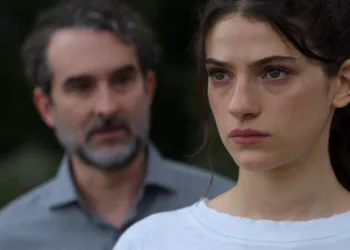



























Kate’s marriage would be much easier to abandon if her husband were awful. Maria Bäck understands this, then denies her protagonist the convenience. Orla is attentive, patient, attractive, and capable of looking after their daughter without requiring applause for basic domestic competence. Andreas, the archaeologist Kate meets while camping, is appealing too. There is no obvious mistake here. There is simply desire, arriving at an inconvenient time.
Their first encounter establishes the problem with almost comic efficiency. Kate and Andreas have both been swimming naked in a forest lake. They look at each other while getting dressed, and Kate later leaves her phone number beneath his towel. Bäck does not frame this as destiny descending from the heavens. It feels impulsive, slightly ridiculous, intensely human.
Three years later, Kate is still married to Orla and still involved with Andreas. Call it the good-marriage problem: what happens when infidelity cannot be explained as an escape from misery? That question gives Brave New Love its sharpest edge.
Three Years, Two Lives
Bäck wisely skips much of the machinery that usually surrounds adultery stories. There are no prolonged sequences of Kate inventing excuses, deleting messages, or nearly getting caught beside suspiciously vibrating phones. Julius Krebs Damsbo’s editing jumps across the affair instead, presenting scattered pieces of a relationship that has already acquired rules, habits, and history.
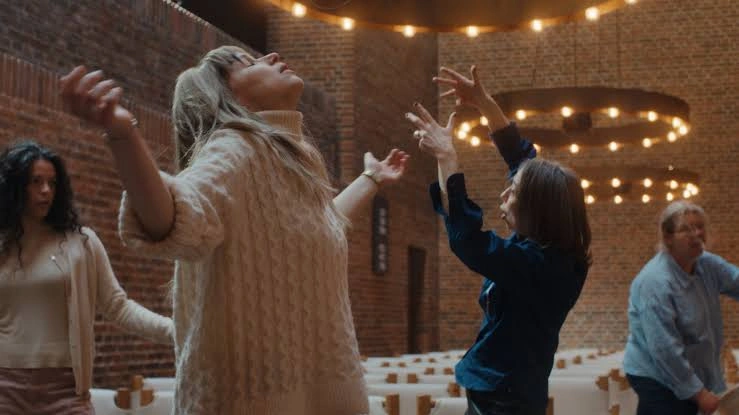
Those rules are peculiar. Kate later explains to a church group that she and Andreas rarely kiss and have avoided conventional sex. She takes genuine pride in that boundary. The distinction sounds absurd for about five seconds. Then it becomes fascinating.
Also Read






Kate has apparently constructed a private moral mathematics in which emotional intimacy can expand almost indefinitely while certain physical acts remain prohibited. She has betrayed Orla, yet she also believes she has preserved something. Is this self-deception? Probably. I am less certain that makes it meaningless.
Andreas disrupts the arrangement by announcing that he is moving to Greece for work. Kate’s reaction reveals how deeply she has depended on the fantasy of permanence. Andreas was supposed to occupy his compartment forever, accessible yet separate, passionate yet controlled. His independent future ruins the architecture.
The film begins moving between the present and fragments of Kate’s memories with Andreas. This gradually changes our understanding of their connection while Orla and their teenage daughter Athena notice Kate withdrawing. Athena’s presence creates another moral pressure point. Kate worries that her secrecy has deceived her daughter too, though the screenplay gives Athena fewer chances to define that betrayal herself.
Here the structure occasionally becomes too withholding for its own good. Mystery around a murder suspect can create tension. Mystery around the emotional interior of your supporting characters can simply leave them underwritten.
The Circle of Shame
Kathrine Thorborg Johansen keeps Kate from becoming a thesis wearing Scandinavian knitwear. Her performance is nervous without turning frantic, selfish without becoming monstrous. Watch how her composure changes once Andreas announces his departure. The grief arrives before Kate has language capable of legitimizing it.
Simon Sears has the less flashy task as Orla, which may be why his performance carries such force. His decency creates pressure. During a tense argument, cinematographer Maria von Hausswolff places Kate and Orla in separate bathroom-vanity mirrors. They occupy the same room, the same marriage, the same domestic routine, yet the composition divides them into isolated images.
It is a beautiful visual idea, possibly a little too perfect (cinema occasionally discovers symbolism and refuses to leave it unattended). Anders Danielsen Lie plays Andreas with an understated independence that Kate herself seems slow to recognize.
His move to Greece matters because it reminds her that he possesses a life beyond their arrangement. He has work, history, intentions. Kate has treated the affair as her existential crisis, while Andreas has inconveniently continued being a person. Then Kate joins a women’s church knitting group and confesses.
The women’s reactions transform the group into a social jury. Kate is accused of selfishness. Her motherhood is questioned. Orla’s competence becomes evidence against her, as if sufficiently good housekeeping should eliminate unauthorized desire. Yet the group also gives Kate something her carefully separated relationships have denied her: a room where the secret can be spoken aloud. Judgment and liberation arrive together. Human institutions do enjoy efficiency.
Freedom Gets Organized
Bäck’s most interesting choice is refusing to treat Kate’s situation as a competition between two men. Fifteen years with Orla have meaning. Andreas has meaning too. One relationship does not magically invalidate the other.
This leaves Kate facing a less comfortable question about identity. Has marriage failed her, or has the cultural promise attached to marriage failed? We expect commitment to regulate behavior. We often expect it to regulate desire as well, which is a much stranger demand when considered for longer than polite society recommends.
The church scenes make this contradiction especially clear. Kate keeps trying to establish categories. Does avoiding sex make the affair less serious? Does loving Orla make loving Andreas impossible? Does motherhood alter the moral status of romantic dissatisfaction? The film is strongest when nobody can answer her.
Its late movement becomes gentler. A pregnancy enters the story, reconciliation grows possible, and the narrative begins arranging the disorder it spent so much time examining. I understand the impulse. I am not convinced by it. The earlier film allows Kate’s contradictions to remain contradictions; the later passages seem increasingly interested in finding furniture for them.
A dreamlike closing movement restores some of Bäck’s ambiguity, yet the pregnancy still carries the faint sensation of convention arriving with paperwork. The image that stays with me is simpler: Kate and Orla reflected in separate mirrors, close enough to touch and visually sealed apart. Marriage has not collapsed. Love has not disappeared. Desire has simply refused to behave, which may be the one thing here nobody can discipline.
Brave New Love premiered at the 79th Locarno Film Festival on August 9, 2026. The dramatic feature follows a hypnotherapist maintaining a secret double life with another man while living with her husband and daughter.
Full Credits
Title: Brave New Love
Distributor: REinvent
Release date: August 9, 2026 (Locarno Film Festival)
Running time: 105 minutes
Director: Maria Bäck
Writers: Maria Bäck
Producers and Executive Producers: Anna-Maria Kantarius
Cast: Kathrine Thorborg Johansen, Anders Danielsen Lie, Simon Sears, Noemi Carbone Mannov, Angeliki Papoulia
Director of Photography (Cinematographer): Maria von Hausswolff
Editors: Julius Krebs Damsbo
Composer: Jenny Hval
The Review
Brave New Love
Brave New Love is sharpest when it refuses the courtroom logic of infidelity. Kate has no villain to blame, no disastrous marriage to flee, and no neat vocabulary for what Andreas gives her. Maria Bäck turns that absence into the film’s richest question: if love can coexist with betrayal, what exactly has been violated? The separate bathroom mirrors and Kate’s bruising church confession make that question painfully concrete. The final pregnancy and softened resolution narrow a film that had been braver while remaining unresolved, yet its discomfort lingers.
PROS
- Johansen’s restless, unsentimental performance
- Morally complex treatment of infidelity
- Striking mirror compositions
- Sharp church-group confrontations
CONS
- Andreas remains partly opaque
- Athena receives limited development
- Final act loses precision
- Pregnancy resolution feels overly tidy