




























Adulthood arrives in An Autumn Summer as an appointment everyone has agreed to ignore. Cody, Kevin, Jared and Martin spend their final weeks before college swimming, boating, drinking, wandering through Northern Michigan and talking with the particular confidence of eighteen-year-olds who suspect time is running out but have yet to accept that time does not negotiate.
Writer-director Jared Isaac builds his debut around that avoidance. Cody (Lukita Maxwell) and Kevin (Mark McKenna) are already a couple when Cody arrives at Kevin’s family vacation home with Jared (Jun Yu) and Martin (Julian Bass), so there is no courtship mechanism pushing the story forward. Nor does Isaac manufacture a betrayal, sudden death or friendship-ending argument to provide the usual coming-of-age machinery. The threat is simply September. That sounds almost aggressively modest. It is also the film’s most interesting idea.
For these four friends, summer has become a temporary political system governed by leisure, intimacy and the collective refusal to discuss succession. Kevin’s parents are nearby, boats are available, the landscape is absurdly beautiful and everyone seems genuinely fond of everyone else. Isaac understands that leaving such a place can feel like an injustice even when nothing has actually gone wrong.
The Problem With Paradise
Removing conventional conflict gives An Autumn Summer an appealing gentleness, yet it also exposes how much character writing depends on friction. Cody, Kevin, Jared and Martin joke, lounge around and drift through conversations about adulthood with convincing affection.
Their physical ease matters. The boys can touch each other without the screenplay nervously announcing what that affection means, while Cody slips naturally into the group rather than being treated as Kevin’s romantic annex. These choices make the friendship believable at the level of behavior.
The dialogue is less dependable. “Come here often?” and “Am I not the chillest?” sound like lines waiting for actors rather than things these people happened to say. Several philosophical exchanges suffer from the same problem. The teenagers discuss existence, love and change before Isaac has given them enough peculiarities to make those ideas feel personally owned. Then a conversation about dinosaurs and mushrooms suddenly works.
Also Read





Its specificity changes everything. Kevin and the others briefly stop sounding like representatives of Youth Facing Change and become weird young people amusing each other. The scene inadvertently diagnoses the surrounding screenplay: abstraction has been doing work that personality should handle.
Their economic insulation complicates matters further. Annual vacations, boats and an accommodating family home place these characters inside a remarkably protected version of adolescence. There is nothing inherently dishonest about depicting privilege, but the film rarely examines how that security shapes their anxiety.
The future therefore remains metaphysical when a few practical details about money, distance or family expectations could have given it teeth. Call this the Summer Bubble Problem: a film creates a sanctuary so convincing that reality struggles to enter it.
Cody Sees September Coming
Cody is the first character who seems to understand that nostalgia can begin before an experience has ended. Maxwell plays that realization through hesitation rather than speeches. During group exchanges, Cody will momentarily withdraw into a look or pause while everyone else keeps the conversational rhythm moving. Those small interruptions give her a private emotional timeline. She is already measuring what will disappear.
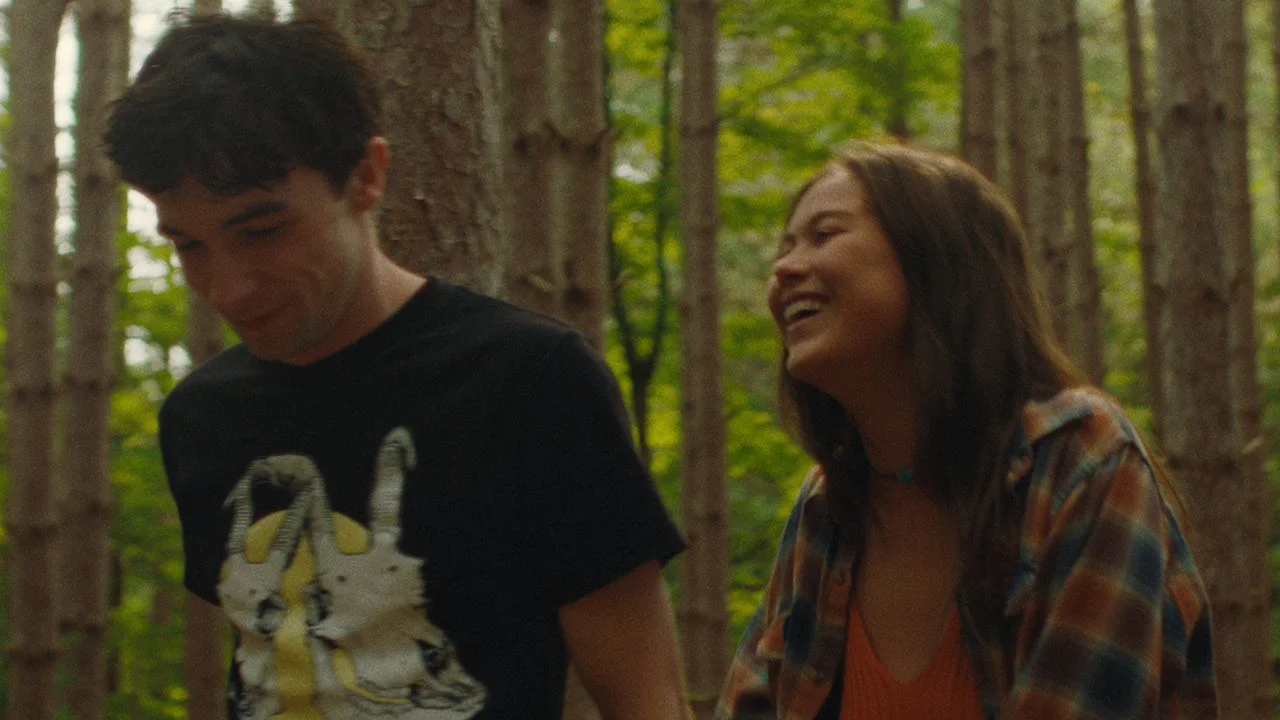
Kevin takes longer to arrive there, which gives Mark McKenna useful tension opposite her. Their chemistry comes from familiarity: casual touches, teasing, the absence of ceremonial romance. They behave like two people who stopped performing courtship for each other some time ago.
That strength creates another limitation. Because Isaac introduces them after the relationship has settled, we understand their comfort better than their attraction. When college forces the question of staying together, the decision carries intellectual weight, but part of the emotional history remains inaccessible. The film asks us to mourn a beginning we never witnessed.
Still, the third act sharpens once Cody and Kevin stop treating the future as weather. Their conversations finally concern a choice rather than an atmosphere. Maxwell’s restraint becomes especially valuable here because she refuses to turn uncertainty into theatrical anguish.
Cody can love Kevin and still recognize that preserving their relationship exactly as it exists may be another version of refusing adulthood. The film’s hopeful direction works because it does not require catastrophe to certify maturity. Sometimes growing up means admitting that love cannot freeze a calendar. Cruel system, really.
Michigan as a Memory Machine
Brandon Somerhalder’s cinematography understands Isaac’s project with greater precision than the screenplay sometimes does. Lakes, green forests, sandy beaches and the Sleeping Bear Dunes appear less like tourist imagery than locations being mentally archived.
The muted palette helps. Summer cinema often treats sunlight as a saturation contest, but Somerhalder keeps the colors softer, allowing the landscape to resemble a recollection forming in real time. Interiors at Kevin’s family home carry the same comfortable texture. The house feels inhabited rather than arranged for prettiness, which matters in a film built around the terror of leaving somewhere familiar.
Daniela Ovi’s montages extend that idea. Swimming, walking and scattered moments of shared leisure are compressed into fragments, giving ordinary activity the strange importance it acquires once people suspect they may never repeat it under the same conditions. The occasional touch of magical realism nudges the lake town further outside normal chronology without breaking Isaac’s otherwise naturalistic register.
There is a contradiction here, and the film cannot quite escape it. The imagery makes this suspended summer persuasive enough that its narrative thinness can initially seem intentional. Stay in the bubble long enough, however, and beauty begins protecting the characters from the sharper scrutiny they need.
Yet the landscape also supplies the pressure the script often withholds. Water moves. Light changes. August expires. The teenagers can keep talking as if September were theoretical. Michigan, quietly and beautifully, knows better.
An Autumn Summer was released on digital platforms on June 2, 2026, following its theatrical screening at the Music Box Theatre. Written and directed by Jared Isaac, the coming-of-age romance follows four best friends spending the final month before college at a Northern Michigan lake house, capturing the bittersweet transition into adulthood.
Where to Watch An Autumn Summer (2026) Online






Full Credits
Title: An Autumn Summer
Distributor: Blue Harbor Entertainment
Release date: June 2, 2026
Running time: 1 hour 38 minutes
Director: Jared Isaac
Writers: Jared Isaac
Producers and Executive Producers: Zach Aries, Becky Boggs, Jared Isaac, JohnPaul Morris, Brandon Somerhalder
Cast: Mark McKenna, Lukita Maxwell, Jun Yu, Julian Bass, Louise Barnes, Tony Horton
Director of Photography (Cinematographer): Brandon Somerhalder
Editors: Daniela Ovi
Composer: Hayes Bradley
The Review
An Autumn Summer
An Autumn Summer treats the end of adolescence as a strange temporal loophole, a month when everyone knows change is coming and politely behaves as if calendars are negotiable. Jared Isaac captures that suspended feeling beautifully, especially through Brandon Somerhalder’s lakeside photography and Lukita Maxwell’s restrained performance. The trouble is that the characters occasionally seem suspended too. Thin personal detail and overly polished conversations keep their friendships at a slight remove. When Cody and Kevin finally confront what college means for them, the film finds the emotional specificity it has been chasing.
PROS
- Lukita Maxwell’s understated performance
- Gorgeous Northern Michigan photography
- Tender group chemistry
- Strong final-act relationship material
- Memory-like editing and atmosphere
CONS
- Characters lack personal specificity
- Several conversations feel overly written
- Minimal conflict weakens momentum
- Privileged setting creates emotional distance