

























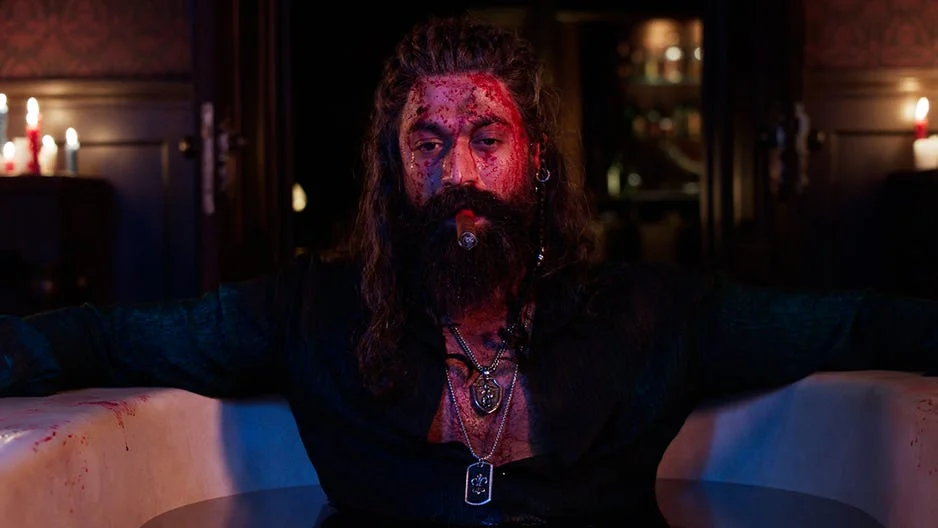

Goa becomes a gangster fantasia under Geetu Mohandas, a place where Portuguese colonial history, opium money, sharp suits, nightclub smoke, tommy guns, and circus imagery are folded into one extravagant crime mythology. Toxic: A Fairytale for Grownups stretches across decades and runs for roughly 194 minutes, yet its scale rarely produces the emotional space such a story needs. The film keeps moving, cutting, firing, seducing, betraying, and killing until spectacle begins consuming the drama meant to support it.
That tension is especially striking given the people behind the film. Mohandas has previously demonstrated an ability to find private anguish inside violent environments, while Yash arrives carrying the formidable screen identity built through the KGF films. He also co-writes here. Their collaboration appears designed to merge two traditions: the psychological intimacy associated with independent Indian cinema and the hero worship of contemporary pan-Indian action filmmaking.
Raya, played by Yash, sits at their collision point. He is an ambitious gangster moving through Goa’s opium trade around the period of Indian independence, when the territory remains under Portuguese control. Years later, Yash also plays Raya’s son, Rumi, known as Ticket, whose anger transforms the story from gangster chronicle into something resembling a hereditary curse. The film reaches for tragedy. It often settles for impact.
The Making of Raya
Raya begins as an associate of crime boss Salvador, but obedience is hardly written into his temperament. His ambitions gradually expand toward controlling the trade himself, with rival families, Portuguese gangsters, and shifting loyalties creating the scaffolding around his ascent.
His protective relationship with his elder sister Ganga, played by Nayanthara, supplies one of the clearer human motives behind his early violence. When danger closes around her, brutality can still be understood as a desperate response. That distinction disappears quickly.
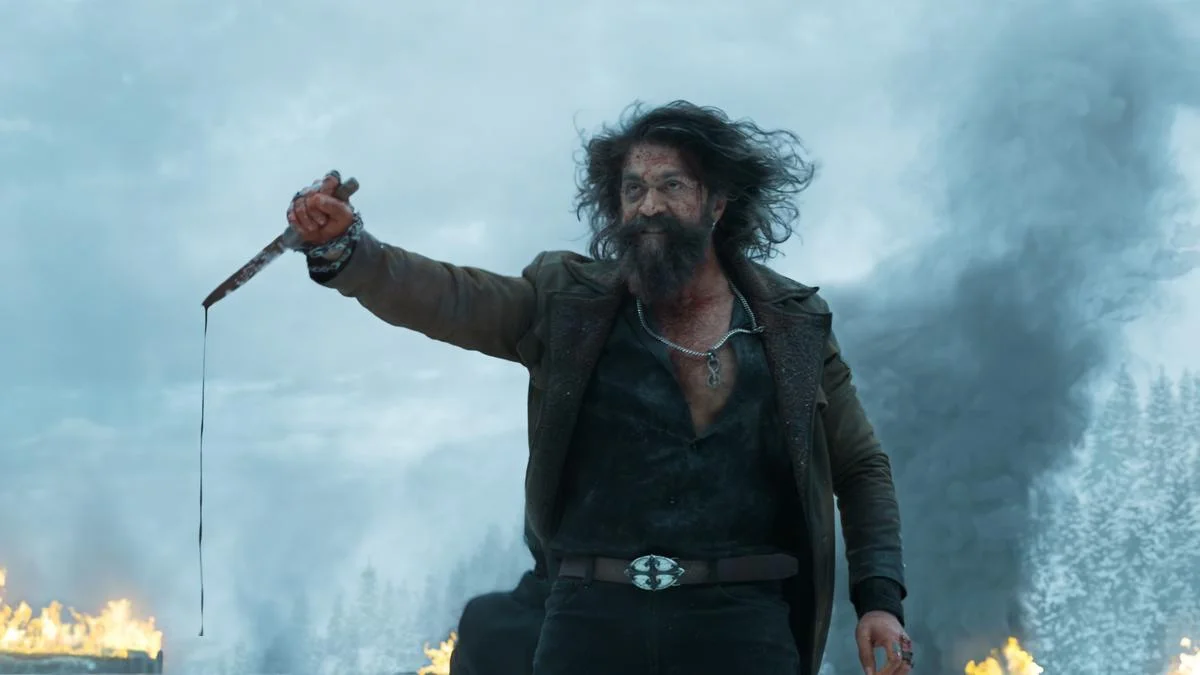
Soon every difficulty is solved through another display of physical supremacy. Rival gunmen attack, Raya stands against impossible odds, bodies fall, limbs break, and the scene pauses long enough to turn survival into coronation. His line, “I don’t like violence but violence likes me,” is supposed to frame him as a man chased by brutality. The images tell a different story. Raya increasingly seeks it out, wears it, and uses it as part of his sexual and social identity.
Also Read





Indian star vehicles have long negotiated the gap between character and persona. Amitabh Bachchan’s angry young man roles could echo one another while still belonging to distinct social worlds. Rajinikanth’s gestures often become part of the storytelling grammar itself. Yash’s difficulty here is that Raya frequently feels imported from KGF. The beard, pauses, explosive declarations, masculine swagger, and invincibility are so closely tied to his established mass-action image that the period setting starts bending around the star.
Mohandas occasionally finds another Raya beneath that surface. Yash is strongest during flashes of self-disgust, when the character’s posture relaxes and his confidence looks less like power than something rehearsed for survival. Those moments hint at a man dimly aware of what he is becoming. Then someone opens fire.
The repetition matters because violence is supposed to acquire a deeper meaning once Ticket enters the story. For that generational idea to land fully, Raya’s transformation needs room. Instead, the film often treats his moral collapse as another opportunity for iconography.
Women Under the Star
The women reveal how conflicted Toxic is about the masculine fantasy it spends so much time constructing. Ganga has the authority of an elder sister whose relationship with Raya predates his gangster identity. Tara Sutaria’s Rebecca, Salvador’s daughter, offers another path into Raya’s emotional life.
Huma Qureshi and Rukmini Vasanth occupy different corners of the criminal and romantic network around him. Each arrives carrying enough presence to suggest a fuller story, yet the film repeatedly defines them through fathers, lovers, brothers, or gangland alliances.
Kiara Advani’s Nadia comes closest to escaping that gravitational pull. A circus trapeze artist, Nadia confronts Raya in language far sharper than the romantic writing surrounding his other relationships. After intimacy, she tells him she wants to feel cared for rather than attacked. It is one of the film’s most revealing exchanges because sex and violence have already begun collapsing into the same behavior for Raya. He approaches affection as possession, tenderness as another form of conquest.
Advani plays Nadia with enough emotional clarity to interrupt the machinery around her. Her circus scenes, her relationship with Ticket, and her growing grief give the film a texture absent from many of its gangster exchanges. Around Nadia, Yash lowers some of Raya’s imposing stillness. The character appears briefly capable of listening.
The relationship still lacks development. Conversations regularly move toward sex before Raya and Nadia have had enough time to expose fear, resentment, or dependence through dialogue. Raya’s philandering and sexist remarks make the imbalance harsher. The film wants Nadia to awaken softness in him while frequently staging his coarseness as part of his charisma.
Mohandas’ camera does push against familiar tendencies in Indian mass cinema. Sex scenes concentrate heavily on Yash’s body, his chest, arms, and physical presence, while the women are granted greater visual dignity than many commercial heroines receive. It is a meaningful directorial choice. The screenplay places stricter limits around them. For a film with five prominent women, remarkably little of its criminal world belongs to them.
Three Hours at Trailer Speed
The most damaging problem is structural rather than ideological. Toxic has the material for a sweeping criminal family saga, yet Ujwal Kulkarni’s editing often compresses it into the rhythm of promotional footage.
Decades pass. Alliances shift. Relatives enter. Rivalries ignite. Locations change. Gunfights begin before the film has firmly established who stands on each side. Speed ramps arrive repeatedly during action, while rapid cuts interrupt spatial geography before the eye has mapped a room, street, or battlefield. This creates a strange sensation. A 194-minute film somehow feels rushed.
Classical gangster cinema depends heavily on orientation. The Godfather can fill a room with competing interests because staging, eyelines, and editing teach us exactly where power sits. Toxic borrows the suits, shadows, cigarettes, family hierarchies, and underworld glamour of that tradition, then abandons much of its patience. Characters frequently stand in arranged positions and exchange threats or declarations, as though the scene has been composed for isolated lines rather than dramatic progression.
The dialogue reinforces that feeling. Nearly every sentence wants to be a quip, prophecy, threat, or poetic statement. The English-language material, shaped around the film’s violent-fairytale register, often explains emotions that could have emerged through gesture or silence. Raya’s speeches especially lean back toward the heightened cadence associated with KGF.
Music creates another layer of cultural borrowing. The soundtrack gestures toward international films such as In the Mood for Love, Requiem for a Dream, Donnie Darko, and The Dark Knight. These echoes can be attractive in isolation, but they struggle to form a musical identity specific to Goa, Raya, or the world Mohandas has constructed.
This matters because Indian cinema has such a deep history of letting music establish character, geography, memory, and time. Here, music often behaves like another cinematic reference placed inside an already crowded collage.
The production design deserves to be seen with greater patience. Nightclubs glow with period decadence, circus imagery carries a macabre theatrical quality, and rain, snow, coastal spaces, and lavish interiors repeatedly give the film striking surfaces. The edit rarely allows those surfaces to breathe before pushing toward the next sensation.
The Son Inherits the Violence
Ticket finally gives Toxic the dramatic idea its violence has been waiting for. The circus material involving Nadia and the young boy initially plays like a fragment from a tragedy whose shape remains hidden. Ticket’s painted face, Nadia’s desperation, and Raya’s presence establish a wound before the film explains who caused it. When the adult Ticket emerges, Raya’s years of violence stop being individual episodes of gangster mythology. They become an inheritance.
Yash makes the dual casting productive through physical contrast. Raya moves like someone accustomed to rooms rearranging themselves around him. Ticket is restless and unpredictable. His thinner facial hair, altered appearance, digital de-aging, and parkour-like movement give him a different silhouette, but the shared fury connects father and son. The similarity is the point.
Raya built masculinity around domination, appetite, and retaliation. Ticket inherits the emotional wreckage left behind by those choices. When the two generations finally collide, the bodies accumulated across the film gain retrospective weight. Violence is no longer simply the proof of a hero’s power. It becomes something taught without instruction, transmitted from parent to child through abandonment and trauma.
The idea also gives Nadia greater importance. Her relationship with Raya, her treatment by him, and the pain surrounding Ticket become the bridge between two versions of Yash. Advani’s earlier scenes gain new force because the son’s rage exposes the cost of Raya’s inability to separate love from possession.
This is the film Mohandas seems closest to owning completely: a gangster story in which masculine mythology becomes hereditary damage, filtered through the commercial grammar of Indian action cinema and the tragic structure of a family curse. It arrives very late.
Toxic: A Fairytale for Grownups premiered in theaters worldwide on August 26, 2026. Set against the backdrop of crumbling Portuguese rule in Goa, a gritty underworld figure rises through betrayal and bloodshed to claim absolute power.
Where to Watch Toxic: A Fairytale for Grownups (2026) Online
Full Credits
Title: Toxic: A Fairytale for Grownups
Distributor: KVN Productions, Monster Mind Creations
Release date: August 26, 2026
Rating: A
Running time: 3 hours 12 minutes
Director: Geethu Mohandas
Writers: Geethu Mohandas, Yash
Producers and Executive Producers: Venkat K. Narayana, Yash
Cast: Yash, Kiara Advani, Huma Qureshi, Nayanthara, Tara Sutaria, Rukmini Vasanth, Akshay Oberoi, Darrell D’Silva, Sudev Nair
Director of Photography (Cinematographer): Rajeev Ravi
Editors: Sreekar Prasad
Composer: Jeremy Stack
The Review
Toxic: A Fairytale for Grownups
Toxic: A Fairytale for Grownups dresses Goa’s criminal history in Hollywood gangster iconography, then lets Yash’s star persona swallow much of Geetu Mohandas’ darker dramatic intent. The lavish sets, period styling, and Kiara Advani’s Nadia suggest a richer fusion of Indian mass cinema and tragic romance, yet frantic editing and repetitive violence keep emotional detail at a distance. Yash finds sharper territory once Ticket confronts Raya, turning inherited rage into the film’s strongest idea. It arrives after nearly three exhausting hours of spectacle searching for purpose.
PROS
- Lavish period production design
- Kiara Advani’s affecting Nadia
- Yash’s contrasting dual performance
- Strong father-son thematic payoff
- Striking Goa gangster imagery
CONS
- Frantic, disorienting editing
- Repetitive action sequences
- Female characters lack space
- Romance rushed toward sex
- Star persona overwhelms drama