




















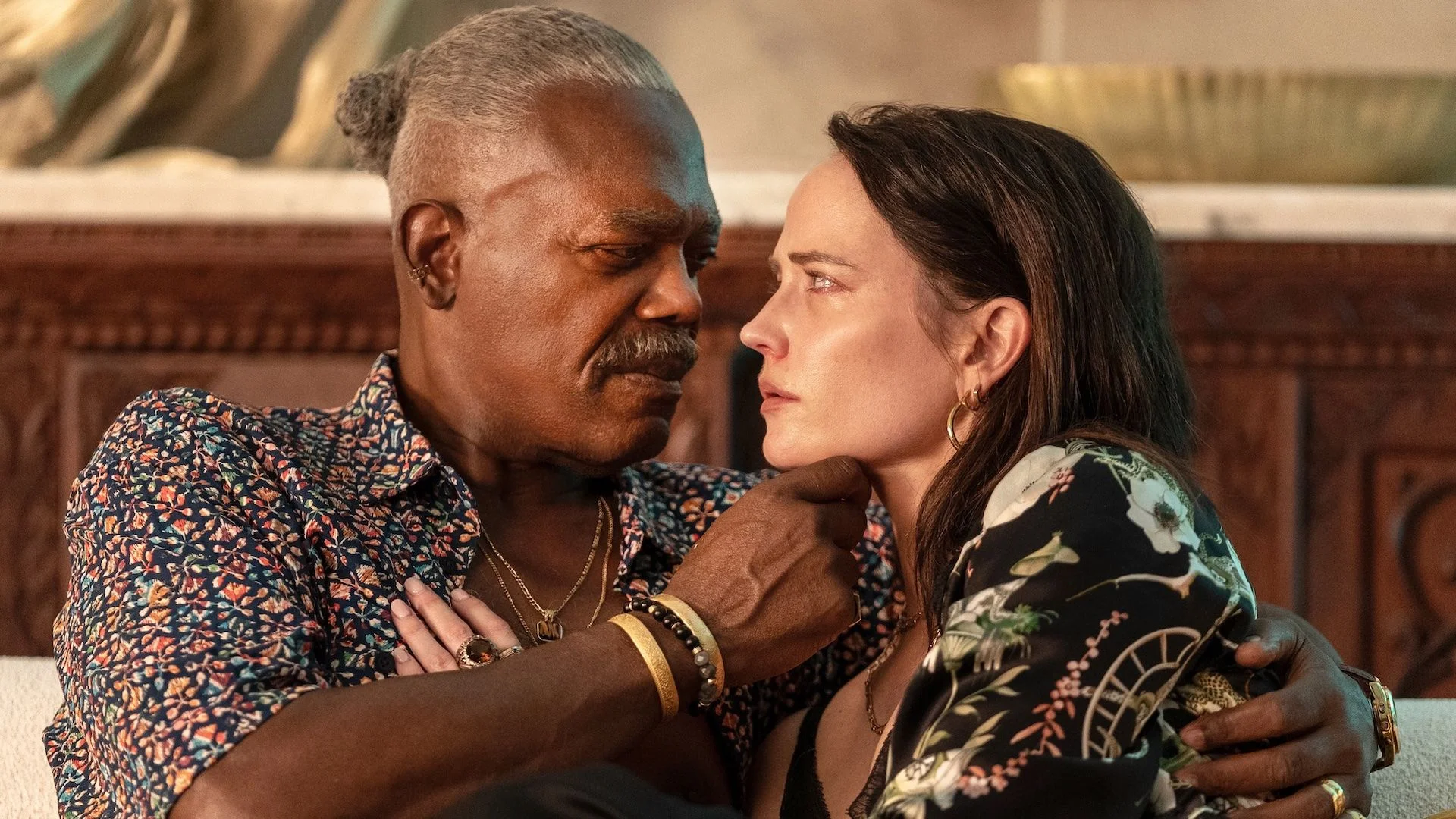

Jack Wolfe has the sort of retirement plan that only makes sense to a criminal who assumes everyone around him is nearly as dishonest as he is. Facing prosecution after evidence threatens to expose the illegal origins of his fortune, he asks his wife Nora to help stage his murder, collect a $30 million life-insurance payout, and split the money before the two finally part ways.
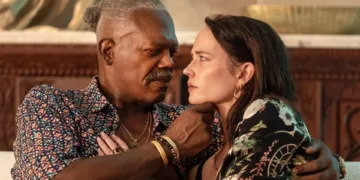
Just Play Dead, directed by Martin Campbell from Dan Gordon’s adaptation of his own novel, transports this setup to the Canary Islands, where criminal calculation plays out against villas, beaches, and postcard-blue water. Samuel L. Jackson plays Jack with sleepy confidence, while Eva Green takes the role of Nora, a former sex worker who has spent years learning exactly how far desire can move a man.
The film belongs to a recognizably American lineage of post-Pulp Fiction crime comedies, built around crooks talking circles around each other while every agreement conceals a second agreement. Moving that formula to the Canary Islands could have given it a different rhythm or texture. Instead, the location mostly remains scenery surrounding a story that feels imported whole from another era.
Everyone Has a Backup Plan
Nora is already planning Jack’s actual death before he proposes pretending to die. She has two potential accomplices waiting in reserve: Dani, a homicide detective who wants her to leave Jack, and Chad, a younger surfer who appears easier to manipulate.
Neither man proves as pliable as she expects. Dani refuses to murder Jack and presses Nora to run away with him. Chad also balks, prompting her to turn seduction into blackmail. Jack, meanwhile, knows about the affairs because investigators have been photographing Nora. He eventually approaches Chad with his own arrangement, offering to divide the insurance money while leaving Nora to absorb the consequences.
This sort of plot works when information creates instability. Here, information tends to create explanation.
Also Read





Gordon’s screenplay repeatedly stops to clarify which character knows which secret, who intends to betray whom, and how the insurance arrangement functions. Flashbacks reaching several weeks into the past fill in additional motives. The structure keeps accumulating moving parts without generating equivalent suspense.
Dani’s partner Bianca warns him that getting involved with Nora will end badly. Jack has an older fixer with knowledge of buried crimes. A former police officer turned nun enters the picture and proves surprisingly capable at following the trail. Each addition could widen the comic paranoia. Most simply creates another person who needs to be briefed on the plot.
Familiar Faces, Missing Friction
Jackson understands Jack immediately. The loose shirts, ponytail, and almost leisurely delivery create a man who behaves as if betrayal is merely another business expense. There are faint visual echoes of Ordell Robbie from Jackie Brown, which makes the comparison slightly cruel to this screenplay. Jackson gets several monologues designed around his ability to dominate a room through speech, yet the dialogue rarely gives him the rhythmic danger those scenes need.
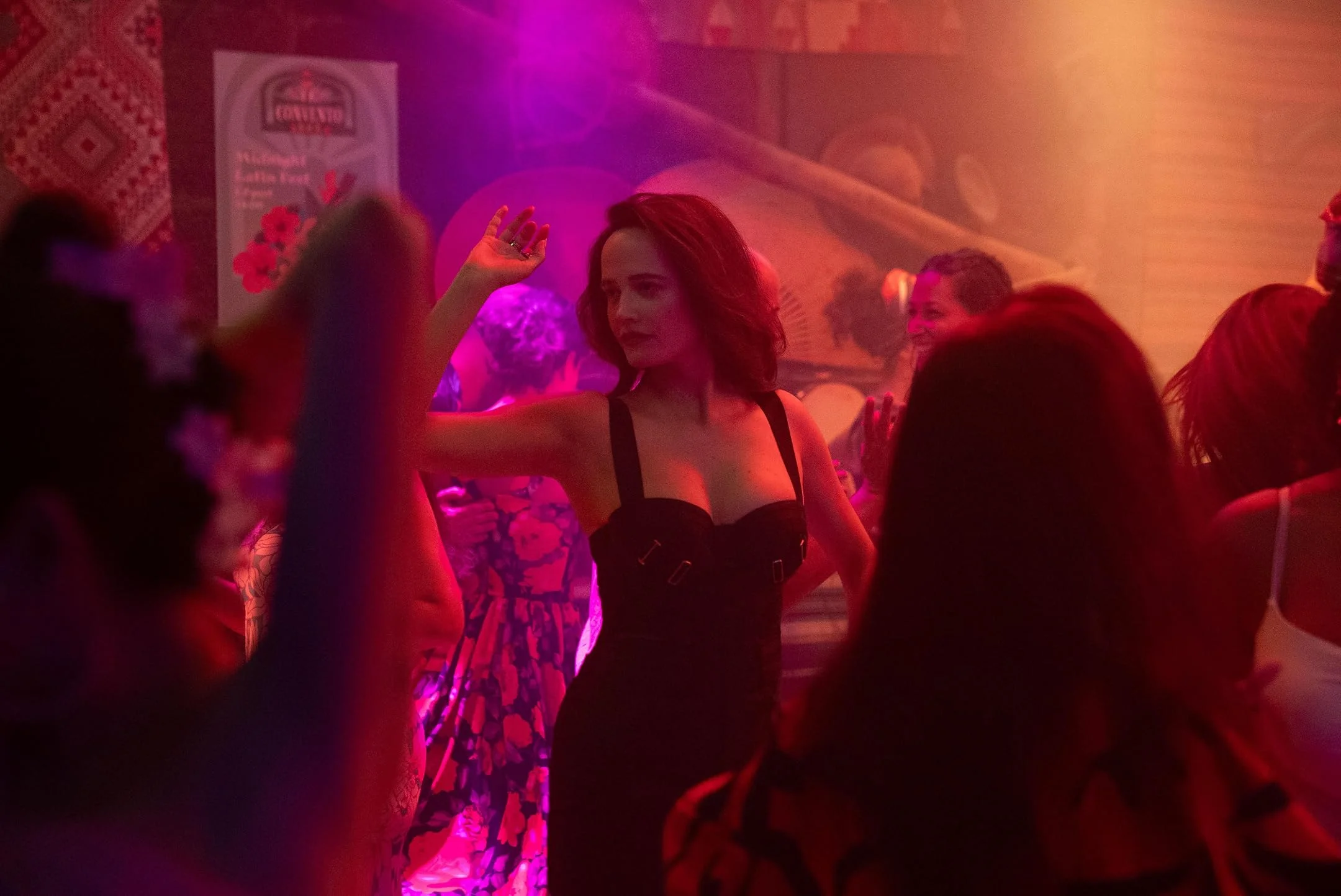
Green should have the richer challenge. Nora has built much of her adult life around reading male desire and turning it into leverage. Her fitted dresses and calculated entrances preserve the visual language of the seductress, yet Dani and Chad push back against her in ways that expose how fragile that power has become.
There is material here for a story about a woman discovering that an identity built around desirability cannot remain static forever. The screenplay rarely allows Nora to confront that idea directly. Green moves between impatience, calculation, and irritation, but the character seldom acquires the psychological specificity her situation invites.
The central disappointment is the marriage itself. Jack and Nora discuss adultery, murder, blackmail, and money with the exhausted familiarity of two people negotiating household expenses. That could be very funny. Campbell occasionally lets a pause or glance suggest years of mutual contempt, but the dialogue keeps flattening the hostility into exposition.
Paradise as Backdrop
Campbell still knows how to make a thriller look expensive. Working with cinematographer Giles Nuttgens, he uses the Canary Islands for clean coastal vistas, gleaming interiors, and bright exteriors that make Jack’s criminal refuge feel conspicuously comfortable. The imagery has the polished international sheen associated with Campbell’s later career.
Yet the islands rarely shape the drama. The local setting does not alter how the characters speak, how the plot develops, or how the criminal world operates. Even the accents among the supporting cast feel inconsistent, weakening the sense that these people belong to the same place. The result resembles an American crime story temporarily renting European scenery.
Campbell has spent decades moving between British filmmaking, Hollywood genre cinema, and international productions, often translating familiar forms across locations with impressive clarity. Casino Royale found emotional severity inside Bond spectacle. The Protégé and Memory showed that his action staging still had snap. Here, he is handed a talk-heavy caper that gives him little physical tension to organize.
The final 15 minutes finally allow the plot to become as ridiculous as the premise always promised. Hidden arrangements surface, loyalties shift, and the accumulated deceptions collapse into increasingly improbable reversals. For a short stretch, Just Play Dead finds the trashy pleasure of watching greedy people discover that their carefully engineered plans were built on assumptions made by other greedy people.
Getting there is the problem. A 90-minute crime caper should move with the confidence of a con artist crossing a hotel lobby. This one keeps stopping to explain where the lobby is.
Just Play Dead premiered in select theaters on August 28, 2026, with digital release following through Vertical. A criminal mastermind attempts to fake his own death for an insurance payout by framing his wife’s lover, unaware that his wife is plotting to murder him for real.
Where to Watch Just Play Dead (2026) Online
Full Credits
Title: Just Play Dead
Distributor: Vertical
Release date: August 28, 2026
Rating: R
Director: Martin Campbell
Writers: Dan Gordon
Producers and Executive Producers: Moshe Diamant, Sagiv Diamant, Valentin Dimitrov, Phil Hunt
Cast: Samuel L. Jackson, Eva Green, María Pedraza, Eoin Macken, Jason Fernández
Director of Photography (Cinematographer): Giles Nuttgens
Editors: Álex Rodríguez
Composer: Robert Folk
The Review
Just Play Dead
Just Play Dead borrows the machinery of an American crime caper and drops it into the Canary Islands, yet the change of scenery never gives the formula a new cultural or cinematic identity. Martin Campbell and Giles Nuttgens make the coast gleam, while Dan Gordon’s screenplay keeps Jack and Nora explaining schemes that should unfold through behavior. Samuel L. Jackson’s relaxed menace and Eva Green’s practiced seduction occasionally suggest a sharper film. The late cascade of absurd betrayals finally finds some energy, arriving far too late to rescue the preceding talk.
PROS
- Polished Canary Islands photography
- Jackson’s easy criminal swagger
- Wild late-stage reversals
CONS
- Exposition-heavy plotting
- Flat central chemistry
- Thin supporting characters
- Sluggish pacing