






















![Kingdom Hearts Collection [I-III] Review](https://gazettely.com/wp-content/uploads/2026/10/Kingdom-Hearts-Collection-I-III-1-360x180.webp "Kingdom Hearts Collection [I-III] Review: KHII Holds Steady as Newer Entries Fluctuate 34")








Television has spent decades treating sixty as the age when characters become parents to protagonists, sources of inherited trauma, or convenient owners of suspiciously large houses. Dalliance has a simpler proposition: give people in their sixties sex lives, bad judgment, money problems and unfinished arguments, then resist congratulating yourself for the innovation.
The six-part Australian drama, produced by John and Dan Edwards, gathers an enviable cast around a Sydney friendship circle whose members have known one another for decades. Writers Pip Karmel, Chris Lee, Liz Doran and Jock Serong understand that history is useful dramatic material because every joke can contain a grievance and every grievance can contain an old joke.
Dani (Heather Mitchell) enters this world through retired cameraman Billy (Hugo Weaving), who ducks beneath her catering counter aboard a Sydney Harbour ferry while hiding from his furious brother Gary (David Wenham). Billy later repays the favor with a long-odds yacht bet that wins, which carries Dani into the home he shares with Rose (Georgie Parker). The situation already has enough combustible material for television to behave badly. It mostly behaves itself.
Borrowing Billy
The smartest writing around Billy comes from refusing to make his charm sinister by default. After the bet pays off, he tries to give Dani the winnings. When she refuses, he takes her home, introduces her to Rose and promptly falls asleep while the two women drink together. Weaving plays these beats with loose physical ease, especially his transition from animated storyteller to useless sleeping husband, making Billy’s social magnetism feel habitual rather than engineered for the plot.
Dani asking Rose to “borrow” Billy as her plus-one for a professional event could easily become a flashing warning sign. Instead, Rose’s first concern is comic clarification: no sex? Dani’s horrified response establishes how safe the arrangement appears to everyone involved.
The series then withholds pieces of Dani and Billy’s evening, returning to it across the six episodes. That structure gives the season forward motion without turning grief and friendship into clues on a corkboard. Mitchell’s guarded delivery around those memories contrasts neatly with Weaving’s expansive Billy, while Parker has the harder task once Rose begins examining what people around her have failed to say.
Her strongest scenes are built around suspicion that stays socially polite. Rose does not immediately detonate every room she enters. She watches, asks another question, notices another hesitation. Television often confuses grief with a license for actors to shout. Parker gets something richer to play.
Desire Has No Retirement Plan
The surrounding ensemble gives Dalliance its wider argument about age. Billy’s old rugby league circle includes Rex (Russell Dykstra), Luke (Wayne Blair), Manaaki (Kirk Torrance) and longtime friends Sarah (Catherine McClements) and Adele (Carolyn Bock). Their conversations have the shorthand of people who stopped needing introductions years ago.
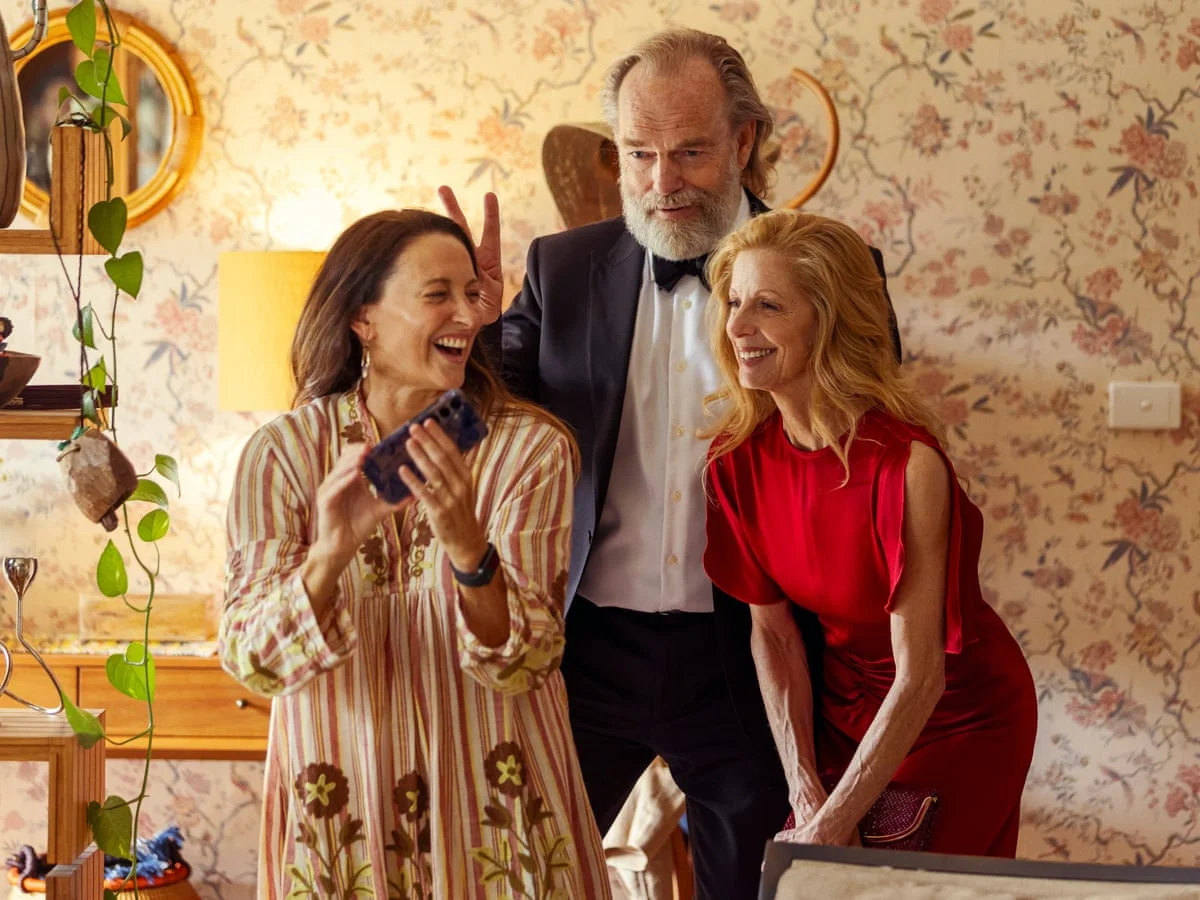
Sarah and Manaaki checking the expiration date on lubricant pulled from her handbag before sleeping together is exactly the kind of scene that explains what the series is doing better than a speech about representation ever could. Sex remains funny, practical, embarrassing and desirable. Nobody needs a solemn orchestral cue announcing that older adults possess bodies.
Luke’s decision to reconsider his 34-year marriage to Adele takes the same approach to partnership. His movement toward dating does not frame him as a courageous late-life explorer. He looks uncertain and occasionally ridiculous, because dating can do that at any age. Sarah’s van-based freedom receives similar scrutiny as she begins questioning what her carefully maintained independence now provides.
Rex’s younger partner Dylan pushes against another comfortable assumption. Their age gap matters, yet their conflict also turns on Rex’s habits and reluctance to change. Manaaki, meanwhile, tries to repair the damage of having been an inadequate father by becoming a steadier grandfather.
Adele exposes the season’s representational weakness. The series can recognize the complexity of a marriage lasting three decades while still giving the husband greater dramatic room to define why it failed. Old television habits die hard. Apparently they have excellent superannuation.
A Sydney Built From Shared History
Directors Emma Jackson and Matt Saville make Sydney feel connected to these relationships rather than rented for postcard value. The harbour ferry where Dani meets Billy, backyard gatherings and the Clovelly bowling club repeatedly place private crises inside communal spaces. People fall apart while somebody nearby is having a perfectly pleasant afternoon.
Smaller details do similar work. Friends bond over Aldi wine. Financial anxiety appears through the prospect of selling designer clothes. A former rock star brother and a semi-retired cameraman can occupy the same social world as people worrying about marriages, grandchildren and dwindling security. The glamour is present, but it keeps bumping into ordinary arithmetic.
That places Dalliance within an Australian ensemble tradition associated with series such as The Secret Life of Us, Love My Way and Tangle. Those shows frequently asked younger adults who they might become. Here, the question has changed. These characters already became people, often several versions of them, and the unsettling discovery is that identity apparently refuses to become fixed on schedule.
Six episodes leave some members of the group waiting for fuller attention, with Adele the clearest casualty. Yet the decision to leave certain relationships unresolved feels truer than assigning everyone a neat emotional settlement. Friendships built across decades do not suddenly become legible because the streaming service has reached episode six.
For an industry still prone to treating age diversity as an occasional programming initiative, Dalliance offers a useful corrective in the form of people behaving badly at a bowling club, flirting badly on dating apps and saying things to old friends that cannot be retrieved once spoken. Imagine letting that count as ordinary television.
Dalliance premiered on Paramount+ on August 27, 2026. The six-part Australian drama series follows a group of friends in their sixties who are forced to rethink their lives following an unexpected loss.
Where to Watch Dalliance Online





Full Credits
Title: Dalliance
Distributor: Paramount+
Release date: August 27, 2026
Rating: TV-MA
Running time: 45 minutes
Director: Matthew Saville, Emma Jackson
Writers: Pip Karmel
Producers and Executive Producers: Roadshow Rough Diamond
Cast: Hugo Weaving, Heather Mitchell, David Wenham, Georgie Parker, Catherine McClements, Wayne Blair, Russell Dykstra, Ryan Panizza
Director of Photography (Cinematographer): Martin McGrath
The Review
Dalliance
Dalliance gives viewers in their sixties the kind of messy romantic, sexual and emotional lives television has long reserved for younger casts. Its strongest material comes from Rose confronting the fractures beneath decades of friendship, while Dani and Billy's gradually revealed connection keeps the six episodes moving without reducing the series to a mystery. Some secondary characters, especially Adele, receive less attention than they deserve, yet the ensemble's chemistry and distinctly Australian texture make the omission sting precisely because this world feels so inhabited.
PROS
- Excellent veteran ensemble
- Sharp treatment of older sexuality
- Rose's layered grief and suspicion
- Natural long-term friendship dynamics
- Strong Sydney cultural texture
CONS
- Adele remains underwritten
- Several peripheral arcs feel abbreviated
- Six episodes limit secondary development