

















Four years have passed for the audience. For the people inside GCHQ, barely two weeks have gone by. That mismatch gives The Undeclared War Season 2 its first problem before anyone has opened a laptop: the series has to recreate urgency around a crisis most viewers have already filed somewhere near forgotten passwords and discontinued streaming subscriptions.
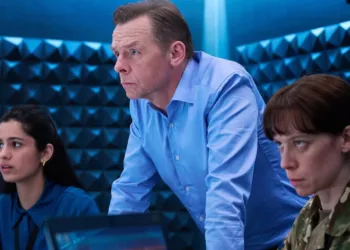
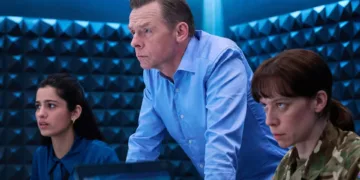
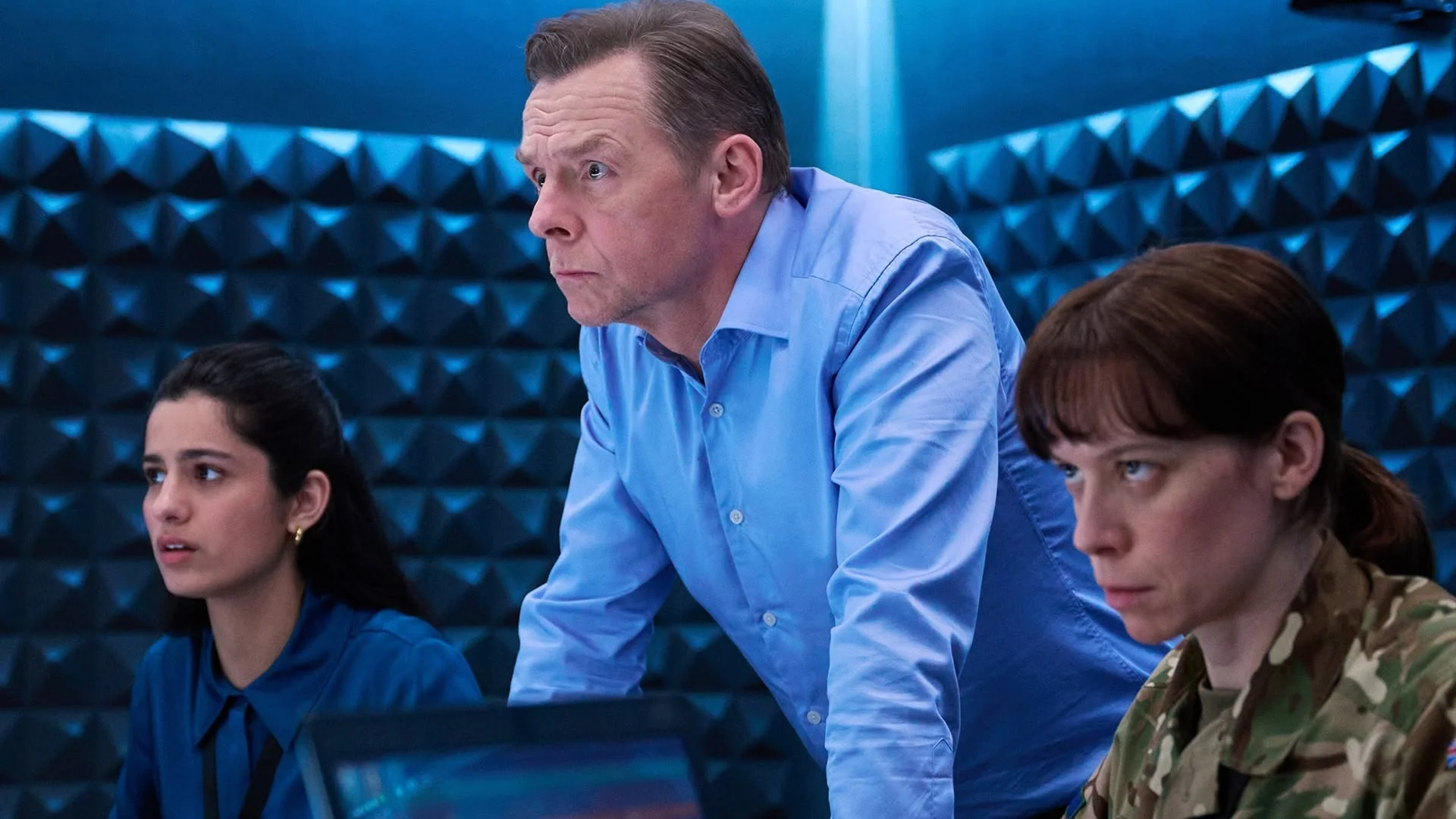
The opening handles the problem with unusual aggression. A lengthy continuous shot follows Danny Patrick through GCHQ as radar screens suggest Russian aircraft are approaching Britain. Foreign Secretary Richard Marston wants retaliation. Danny suspects the attack itself may be fabricated. The camera keeps moving while everyone else seems trapped at a workstation, turning Simon Pegg into a courier carrying panic between sealed rooms.
Danny is right. The incursion is fake, designed to provoke Britain into becoming the aggressor. It is a clever re-entry because it immediately clarifies what this series considers modern warfare: the dangerous weapon is sometimes the information that persuades someone to fire another weapon.
There is a small irony here. The first season, aired in 2022 but set slightly ahead of its audience, wanted cyberwar to feel like tomorrow’s nightmare. Season 2 arrives in 2026, when manipulation campaigns, infrastructure attacks and geopolitical misinformation hardly require speculative framing. Reality has rudely stolen part of the premise. That may explain why the series wisely changes what it wants to be.
The Enemy Has a Desk
Peter Kosminsky’s first season often tried to turn computing into visible drama, translating digital processes into metaphorical spaces so that abstract concepts could become television. Colin Teevan, taking over the writing here, largely abandons that strategy. Instead, he reaches backward toward one of espionage fiction’s oldest pleasures. There is a mole inside GCHQ.
It sounds almost disappointingly conventional until the season demonstrates why conventional devices survive. Malware may endanger millions, but code has poor body language. A colleague who might be lying across the table is immediately dramatic.
Also Read





The difference becomes obvious around the season’s midpoint, once the identity and circumstances of the mole begin taking shape. Suspicion stops being institutional and becomes intimate. Every meeting acquires a second meaning. Information that previously sounded like exposition can now be evidence, misdirection or confession.
A security officer explains that betrayal rarely begins with someone announcing an intention to sell out friends, family and country. People are pressured, seduced, compromised, frightened. The idea is hardly new to spy fiction, yet it gives this season its most useful philosophical question: at what point does coercion become choice?
Espionage stories often divide the world into patriots and traitors because labels make morality wonderfully convenient. Season 2 is better whenever it refuses that convenience. A person can understand the harm they are causing and still feel trapped inside the circumstances that produced it. Agency survives, but in damaged form.
The writing occasionally loses confidence in the audience. Danny’s stunned reaction to learning that the threat could come from inside his own operation carries the dramatic emphasis of someone discovering that spies occasionally infiltrate intelligence services. Subtle, it is not.
Still, Teevan’s approach works. Season 1 sometimes behaved as though research itself were suspense. Season 2 remembers that information becomes dramatic when somebody has something to lose by revealing it.
Danny Patrick Is Running Out of Room
Simon Pegg’s Danny spends much of the season looking like a man who has been told civilization will collapse unless he answers six emails before lunch. That anxiety is productive. Pegg avoids turning Danny into the usual unflappable intelligence chief. During the false Russian incursion, he moves from station to station trying to prevent political panic from becoming military action. Later, the discovery of a mole turns the same workplace into hostile territory. His authority remains intact while his certainty begins disappearing.
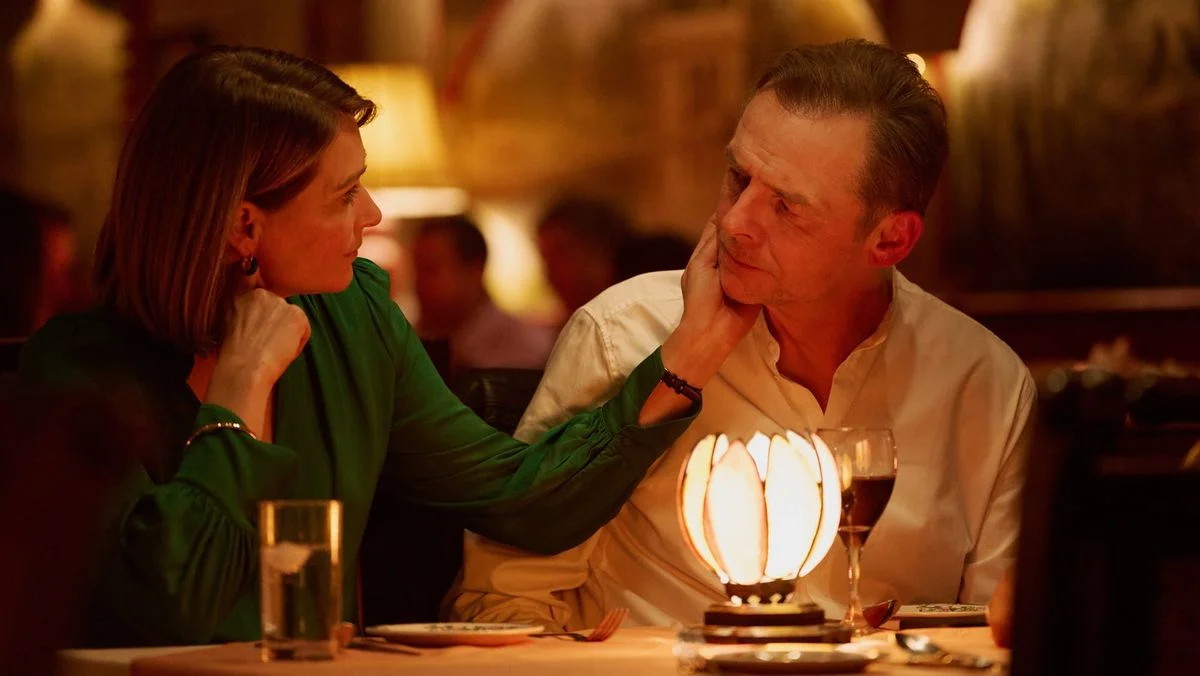
The introduction of Barbara, Danny’s wife, gives that pressure somewhere to go after office hours. Siân Brooke plays her with the quiet authority that prevents domestic scenes from feeling like scheduled opportunities to remind viewers that spies have spouses. She works at GCHQ too, specializing in China, which means their marriage exists inside the same culture of secrecy that exhausts Danny professionally. There is something almost absurd about a relationship in which both partners understand perfectly why the other cannot explain what happened at work.
The political material is less controlled. Ed Stoppard’s Richard Marston functions as the government’s hawkish counterweight to Danny, pushing for retaliation during the fabricated incursion and later supporting a military rapid-reaction unit inside GCHQ. He often feels written to embody escalation rather than to think through it.
Chloe Pirrie’s lieutenant colonel is more interesting because her presence changes the institution itself. Soldiers enter rooms built for analysts. Two ideas of security begin occupying the same fluorescent space: one based on interpretation and patience, the other on intervention.
That conflict gives GCHQ a physical tension it previously lacked. The building is no longer full of people attempting to solve the same problem through similar means. Everyone agrees something terrible is happening. Agreement ends there.
Signals From China
Saara Parvin remains one of the strangest inheritances from Season 1. Hannah Khalique-Brown originally played her as a computer science student whose extraordinary ability propelled her into rooms where people with decades of intelligence experience somehow needed her immediately. It was difficult to accept then. Season 2 benefits from treating the promotion as established history rather than reopening the argument. Saara’s connection to Vadim Trusov gives her a clearer dramatic function now.
Vadim, the FSB programmer who previously passed Russian intelligence through a video-game chat, is alive. He has been taken to China. His renewed communication with Saara creates the kind of uncertainty the series handles well because nobody can know how freely he is speaking. A message from a captured source contains two pieces of information at once: what he says and whatever his captors may want him to say.
Moving Vadim to China also prevents the geopolitical story from repeating the first season beat for beat. Russia remains central, but Chinese interests enter the picture, while Barbara’s expertise suddenly intersects with Danny’s crisis. The British government’s interest in maintaining productive relations with China creates another fracture between diplomacy and intelligence.
This is where the series’ politics become sharper than Marston’s speeches. Governments rarely have one desire. Security services may identify a threat while ministers see an essential economic partner. Both assessments can exist simultaneously, and bureaucracy must somehow manufacture policy from the contradiction.
The missing prime minister weakens that idea. Adrian Lester’s limited involvement leaves Marston with an implausibly large amount of dramatic oxygen, and the explanation for the PM’s absence feels designed around casting availability rather than political behavior. Television occasionally asks geopolitics to accommodate scheduling.
The Trouble With Cyberwar
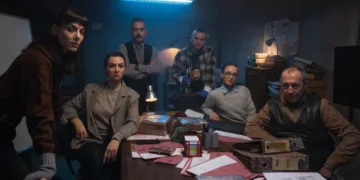
The central aesthetic problem has never changed: people typing are difficult to photograph as an existential threat. Season 2 still spends long periods under harsh office lighting while analysts stare at monitors and exchange acronyms. EMC, FSB, CCP, NSA. Enough institutional shorthand eventually produces the sensation that the alphabet itself has joined the conflict.
The consequences frequently occur elsewhere. Airport disruption appears through reports and screens. Malware becomes a national emergency described inside a room. The scale is enormous while the imagery remains stubbornly administrative.
Paul McGuigan’s extended opening take provides one solution. Instead of attempting to make a keyboard exciting, the direction turns information flow into movement. Danny crosses the building, conversations overlap, decisions migrate between departments and the camera makes bureaucratic coordination feel physical.
The military presence offers another solution. Uniformed personnel interrupt the visual sameness of the GCHQ offices while their command structure disturbs the rhythms of the analysts already there. The best solution, however, is the simplest one: the mole.
Once the danger becomes human, fluorescent offices stop being merely dull. A corridor can hide a secret conversation. A workstation can belong to someone compromised. A colleague’s hesitation can matter as much as whatever appears on their monitor.
Season 2 still cannot make every line of code cinematic, and at times it seems determined to punish viewers who have an acronym allergy. Yet its reset reveals something the first season only intermittently understood. Technology may provide the mechanism for modern espionage. People still provide the drama.
The Undeclared War second season premiered on Channel 4 and Peacock on July 21, 2026. The cyber-thriller follows the elite team at GCHQ as they face an intense new wave of international espionage and digital warfare.
Where to Watch The Undeclared War Season 2 Online


Full Credits
Title: The Undeclared War Season 2
Distributor: Channel 4, Peacock
Release date: July 21, 2026
Rating: TV-MA
Running time: 60 minutes
Director: Paul McGuigan
Writers: Colin Teevan
Producers and Executive Producers: Colin Callender, Daniel Gratton, Noëlette Buckley, Peter Kosminsky, Colin Teevan, Paul McGuigan, Caroline Levy
Cast: Simon Pegg, Hannah Khalique-Brown, Siân Brooke, Alex Jennings, Ed Stoppard, Chloe Pirrie, Tom McKay
Director of Photography (Cinematographer): Tony Slater Ling
Composer: Craig Armstrong
The Review
The Undeclared War
Season 2 finds its pulse once the threat stops being a line of malicious code and becomes a person sitting inside GCHQ. The mole story gives betrayal a human scale, while Simon Pegg makes Danny Patrick look increasingly crushed by the machinery he is supposed to control. The cyber material still suffers from the basic televisual problem of people staring urgently at screens, and some political plotting borders on caricature. Yet Colin Teevan’s sharper pacing and shift toward traditional espionage make this return far easier to get lost in.
PROS
- Stronger mole storyline
- Simon Pegg’s pressured performance
- Faster, cleaner pacing
- Effective opening long take
- Better human stakes
CONS
- Static cyberwarfare scenes
- Heavy acronym-filled dialogue
- Broad political characterization
- Convenient prime minister absence