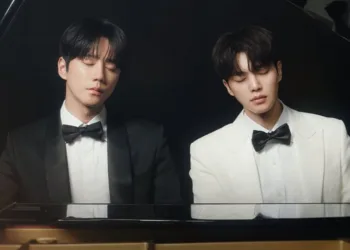











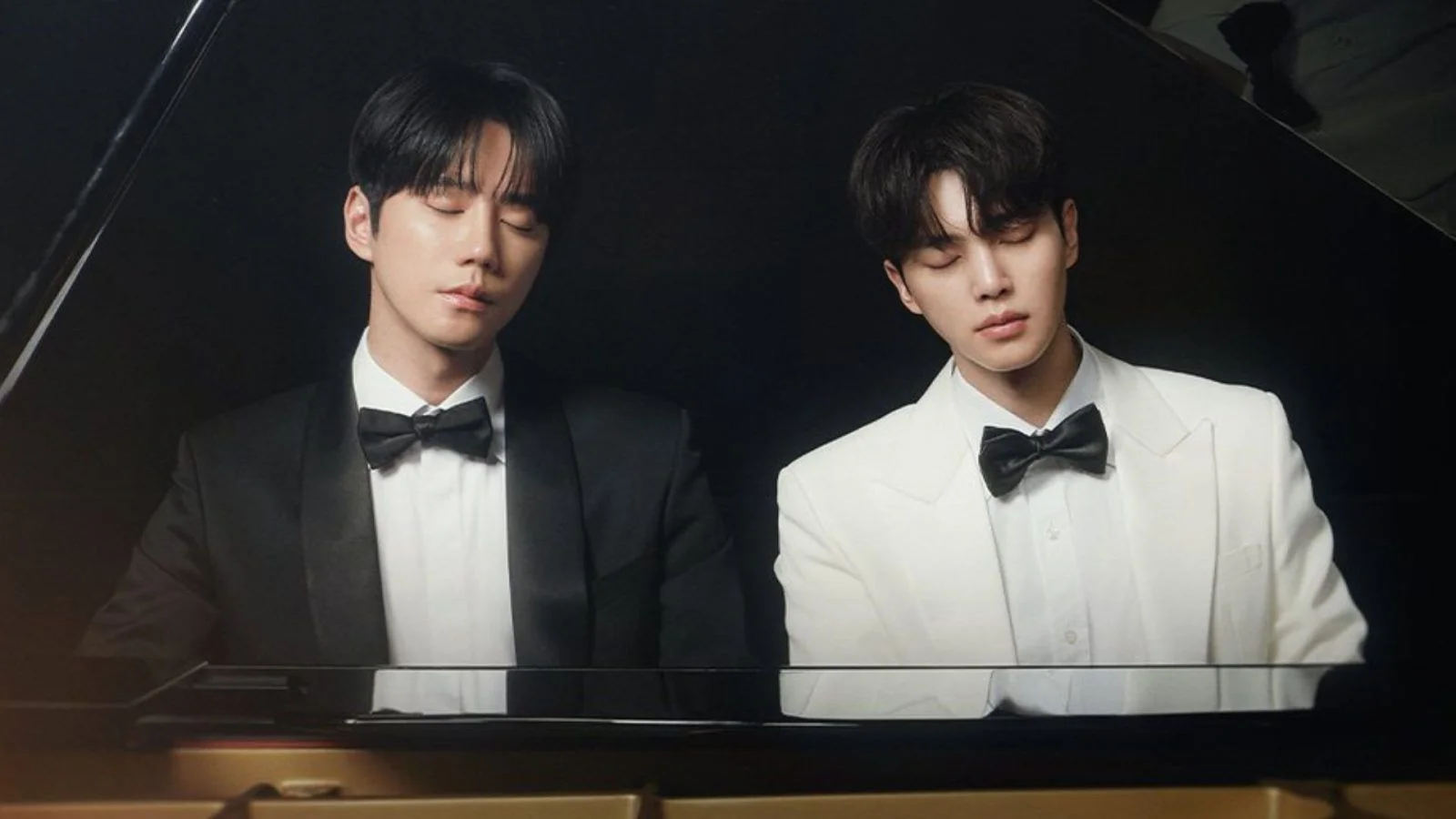

Prague gives Four Hands, Two Sonatas its deadline before the friendship has even started. Kang Pi-o sits at a piano during the International Harmonie Competition, playing through a bleeding finger, while Choi Jeong-yo is being driven away by armed kidnappers. Jeong-yo fights back, escapes the vehicle, gets shot, and disappears into the water. Six months earlier, these two are still teenagers struggling to tolerate each other.
That flash-forward is an aggressive opening move, yet it gives the school material an extra charge. Every argument, rehearsal, and accidental moment of affection comes with the knowledge that something has gone catastrophically wrong by 2017. Episode 2 tightens that screw with another glimpse ahead, this time showing Pi-o breaking Jeong-yo’s watch and recalling a physical fight between them.
The series then has the confidence to spend long stretches on smaller things. Pi-o wins the Lake Erie International Junior Competition, accepts his school award, and promptly throws it away in a restroom. Jeong-yo works for money connected to his father’s debts, comes home to find that same father drunk, cleans up after him, and heads back out. One teenager has awards he cannot value. The other has talent he cannot afford to value. It is melodrama operating with the lid already off, but at least it tells you where the smoke is coming from.
Perfect Technique, Wrong Sound
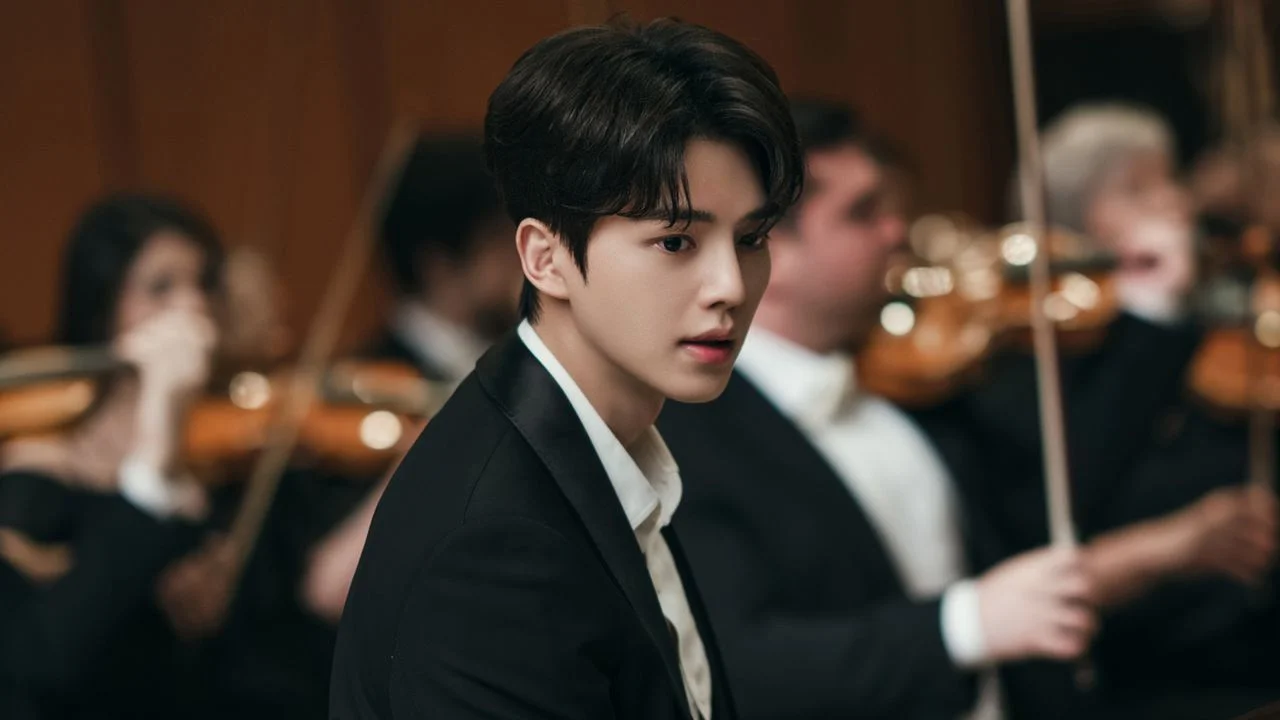
Song Kang’s Pi-o could easily become exhausting. He rejects cellist Hong Jae-in because he considers her beneath his ability, clashes with Professor Seo, responds to friendly gestures with hostility, and carries himself like someone who has never encountered a room he could not make colder. The performance gives those edges a source.
Watch Pi-o after his grandfather Kang Seung-woon dismisses his playing. His posture changes before his attitude does. This is a boy who can win international competitions and still feel like he has failed because the one person whose approval matters refuses to give it. When Pi-o kneels before Seung-woon and asks for a chance to prove himself at the Noblesse Concert, his arrogance suddenly looks less like confidence and closer to armor.
Seung-woon hardly helps. He refuses to accept Pi-o fully as his grandson because Pi-o’s father remains unidentified, humiliates his daughter Ji-hye over it, then pours warmth onto pianist Do Hyun-soo right in front of the family. Pi-o sees his grandfather embrace another musician with an ease he has never received himself.
Also Read




Television parents and grandparents have invented some spectacular methods of emotional damage. This one comes with an orchestra. Hyun-soo eventually provides the criticism Pi-o has been chasing. His technique is excellent. His music sounds false. Pi-o can execute the piece, yet he cannot communicate what lives inside it.
That idea pays off because the series demonstrates it instead of leaving it as teacherly wisdom. Pi-o wins another competition and fixates on a small mistake in his cadenza. The applause does nothing for him. A technically inferior performance with emotional truth would probably scare him senseless. Then Jeong-yo walks into the room and supplies exactly that problem.
The Boy Who Can Play but Cannot Perform
Lee Jun-young gives Jeong-yo a different physical rhythm. Pi-o tends to lock himself down; Jeong-yo seems ready to move before he has decided where he is going. That looseness follows him to the piano. Jeong-yo hears Pi-o perform and can later reproduce his piece with modifications that immediately catch Hyun-soo’s attention. School director Yoon Seon-joo hears him too and offers a scholarship. The strange part is that Jeong-yo has spent much of his life trying to move away from music.
His reasons are painfully practical. His father is buried under debt. Loan sharks treat Jeong-yo as collateral. He works at a convenience store, refuses to sell alcohol to underage students, watches those students wreck the place, then gets fired for the privilege. When his father disappears and the loan sharks come for him, the elite arts school stops looking like an artistic opportunity and starts looking like somewhere safe to sleep.
The show is sharper whenever class pressure works this concretely. Pi-o can argue about artistic authenticity because the roof over his head is secure. Jeong-yo has to calculate what a scholarship costs, what a performance pays, and what happens if he cannot work that night.
His mother sits behind his relationship with music. Her annotated sheet music is precious enough that when school bullies throw it from a window, Jeong-yo responds with violence and nearly gets expelled. Earlier memories show her teaching him to play with feeling. His expressive ability carries her influence, but performance also carries trauma.
That becomes obvious once Hyun-soo asks Pi-o and Jeong-yo to perform a four-hand piece together. Jeong-yo can play. Put an audience in front of him and his body refuses. A lesser teen drama would cure that with one inspirational speech. Pi-o, mercifully, has candles.
Four Hands, Finally
Episode 2 improves the series because it stops arranging Pi-o and Jeong-yo as opposites and starts testing how they behave together.
Pi-o initially handles Jeong-yo’s missed rehearsals with his usual bedside manner, meaning there is no bedside and very little manner. Then Jeong-yo saves him from shards of glass hidden beneath their desks. In the medic room, while removing glass from Pi-o’s knee, Jeong-yo explains his stage fright. Pi-o listens.
That tiny adjustment matters because listening is exactly what his music lacks. He has spent years approaching piano as an act of control. Jeong-yo gives him someone he cannot control and a problem technique cannot solve.
Pi-o’s answer is to fill the auditorium with candles and create a rehearsal space where Jeong-yo can ignore the imagined crowd. They play late enough to get locked inside school, then escape by jumping from the building rather than calling a teacher. Pi-o, who has spent most of the series behaving like a very talented tax auditor, actually looks thrilled.
The street performance pushes the idea further. Jeong-yo freezes when strangers gather. Pi-o tells him to focus on his partner. They begin playing, the crowd responds, and Jeong-yo gets through it.
Direction matters here because the sequence avoids treating the audience applause as the real victory. The emotional beat sits between the two players. Jeong-yo gets through the performance because Pi-o has temporarily replaced the crowd as his point of attention. Four-hand piano is a useful dramatic device for a story about two isolated boys because neither can perform it alone, and the instrument gives them nowhere to hide from each other’s timing.
Their train ride home, asleep against each other’s shoulders, works because the series earned the softness through rehearsal rather than dialogue. They have barely learned how to call each other friends, which is inconvenient, since the opening has already promised us gunfire.
Adults Tune the Instrument
The boys may dominate the screen, but the adults keep deciding what their talent is worth. Ji-hye protects Pi-o fiercely from Seung-woon’s cruelty, then contributes a different kind of pressure herself. When Professor Seo turns other teachers against Pi-o, she pushes him toward studying abroad. Pi-o refuses because leaving without his grandfather’s approval would mean abandoning the argument his entire life has become.
Seon-joo’s treatment of Jeong-yo carries its own ambiguity. Her scholarship saves him at the precise moment he has nowhere else to go. Later, she asks Hyun-soo to ensure bringing Jeong-yo into the school works in their favor. Charity apparently comes with quarterly projections.
Hyun-soo is the most interesting adult because he reads both boys accurately. He identifies the emptiness in Pi-o’s polished playing, then hears something immediately alive in Jeong-yo. His decision to make them perform together feels less like a cute teacher trick and closer to targeted intervention. Pi-o needs another musician to disrupt his obsession with perfection. Jeong-yo needs another musician sturdy enough to stand between him and the audience.
Jae-in deserves credit for getting this machinery moving. She hires Jeong-yo to accompany her when he needs money, recognizes his ability early, and repeatedly pushes Pi-o toward basic human behavior. Jang Gyu-ri gives her enough snap that she does not disappear between the two male leads, especially when Jae-in refuses to indulge Pi-o’s arrogance.
Some surrounding material is shakier. The school bullies repeatedly arrive carrying exactly the cruelty required by that episode. Professor Seo threatens Pi-o’s entire career with such speed that he seems to have skipped anger and gone straight to supervillain administration. The series occasionally reaches for the largest available dramatic hammer when a smaller one would make the bruise hurt longer.
Still, the piano keeps rescuing it. Pi-o’s obsession with immaculate execution, Jeong-yo’s inability to face a crowd, their childhood competition, the four-hand recital, and the future competition in Prague all turn musical performance into dramatic action. A wrong note can expose character. Sharing the bench can change a relationship. Playing alone can become a punishment. And somewhere between that candlelit auditorium and Prague, these two boys are going to stop listening to each other. That is the performance worth waiting for.
Four Hands, Two Sonatas premiered on tvN and Netflix on August 29, 2026. Set inside an elite arts high school, the musical drama follows two contrasting pianists whose intense rivalry gradually transforms into deep connection.
Where to Watch Four Hands, Two Sonatas Online


Full Credits
Title: Four Hands, Two Sonatas
Distributor: tvN, Netflix
Release date: August 29, 2026
Rating: 15+
Running time: 60 minutes
Director: Park Hyun-suk
Writers: Shin Yi-won
Cast: Song Kang, Lee Jun-young, Jang Gyu-ri, Kim Joo-hun, Yun Se-ah, Jung Jin-young, Seo Jae-hee, Kim Hye-hwa
The Review
Four Hands Two Sonatas
Four Hands, Two Sonatas makes its strongest music when Pi-o and Jeong-yo stop competing long enough to actually listen to each other. Their candlelit rehearsal and street performance give the friendship warmth, while those grim flash-forwards promise someone will eventually smash the metronome. Some bullying beats and adult scheming lean hard into melodrama, yet the piano scenes keep finding character inside technique. Song Kang and Lee Jun-young sell two very different kinds of wounded ambition, and the question of how this friendship collapses already has its hook sunk deep.
PROS
- Strong chemistry between the leads
- Piano performances serve character
- Effective future-timeline tension
- Clear contrast between the two musicians
- Hyun-soo makes a strong mentor figure
CONS
- Repetitive bullying conflicts
- Heavy-handed adult antagonists
- Familiar elite-school tropes
- Melodrama occasionally runs hot