














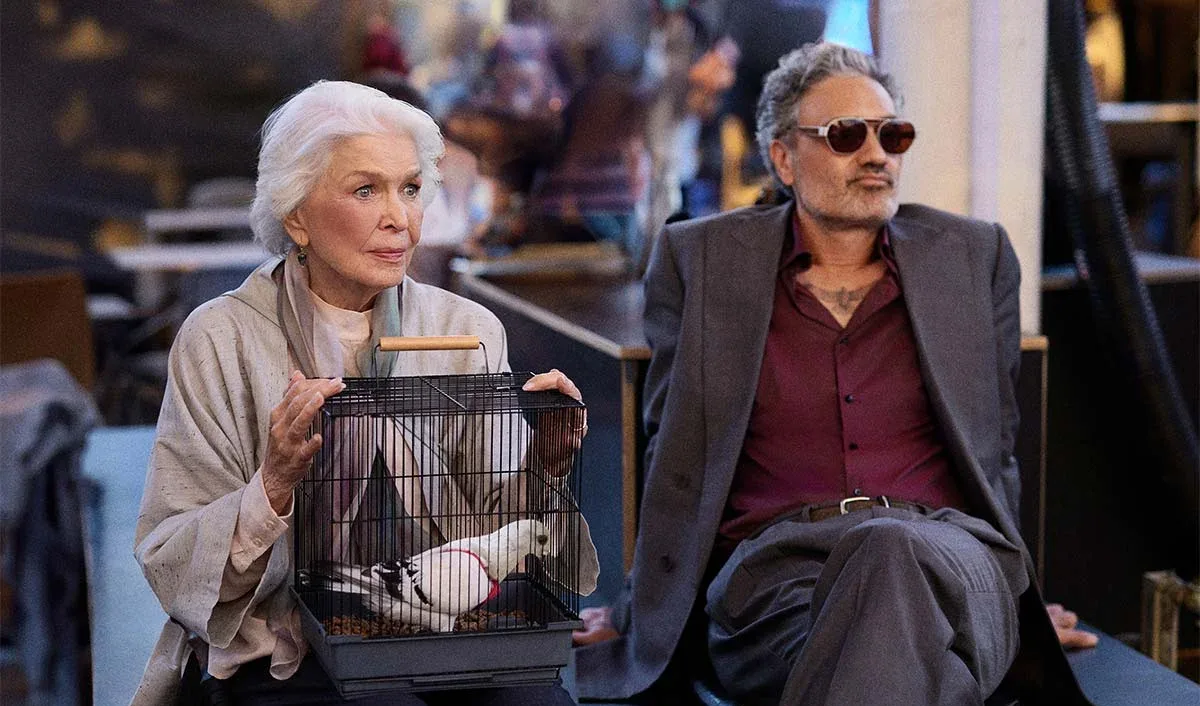

Brooke Graham has reached the age at which everyone around her seems convinced that her future should become a managed service. Her daughter Molly watches her carry a tray of desserts with the alarm usually reserved for bomb disposal. Her son Ron has already contacted an art dealer about his late father’s paintings and arranged a visit to a retirement home. Brooke, meanwhile, is still climbing the stairs to her Chicago apartment and making decisions without requesting permission.
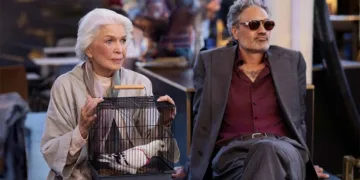
Kornél Mundruczó’s Place to Be, written by Kata Wéber, builds its strongest argument from that mismatch. At 93, Ellen Burstyn plays Brooke as a woman surrounded by people who have quietly converted age into incapacity. The film refuses that conversion. When a white racing pigeon repeatedly enters Brooke’s apartment, she names it Intruder, discovers that it came from the East Coast, and decides to return it herself.
The premise flirts openly with whimsy, yet Burstyn keeps Brooke rooted in irritation, curiosity, and dry intelligence. During a family gathering, Brooke tells Ron about a supposed Papua New Guinea custom where the eldest son strangles a widow after her husband dies. Burstyn barely pushes the joke. The point lands because Brooke knows exactly what her son’s efficient concern resembles.
Still Her Own Person
Cinema has spent decades treating old women as repositories of wisdom, comic inconveniences, or approaching death. Brooke gets to be much less useful than that. She can be stubborn. She can misjudge people. She can want company without surrendering independence. She can decide that returning a pigeon across the country is a perfectly sensible use of her remaining time.
Burstyn finds the character in pauses that Wéber’s screenplay rarely bothers to fill. Brooke spent much of her life caring for children and living beside a successful, domineering artist husband, yet the marriage arrives mainly through scattered references. The script provides an outline of accumulated compromise. Burstyn supplies the years.
Watch her when another character tells Brooke what she should do. The response often arrives before the dialogue, through a glance that moves from patience to appraisal and then toward quiet refusal. That restraint matters because Place to Be periodically leans toward a much easier metaphor. Brooke is being encouraged into institutional care; Intruder is a racing pigeon whose value is defined by where other people expect him to go. The parallel could scarcely announce itself louder if the bird carried cue cards.
The metaphor survives because Brooke does not behave like one. She carries the cage, climbs stairs, gets herself onto a train, loses accommodations, finds alternatives, and keeps moving. Her physical independence is treated as ordinary behavior rather than inspirational spectacle, a distinction the film understands better than many stories about aging.
Brooke and Nelson
The train brings Nelson Green into Brooke’s orbit, and Taika Waititi plays him at a considerably higher frequency. Recently divorced and unhappy selling real estate, Nelson first appears as the sort of man whose personal crisis has become public noise. His ticket problem becomes Brooke’s problem, so she pays for him largely to make the situation stop.
Their continued collisions form the film’s road-movie machinery. Nelson complains about his failed relationships, drinks too much, worries about his child, and occasionally behaves with astonishing selfishness. At one point he leaves Brooke eating alone while he scrolls through dating apps elsewhere. Later, guilt sends him back toward her.
The pairing works best when Waititi lowers Nelson’s volume. Burstyn’s timing leaves little room for theatrical fussing, and their quieter exchanges give the relationship a credibility that its broader comedy sometimes erodes. Brooke recalling her distaste for the free-love culture of the 1960s is funny because the conversation wanders into personality rather than plot. Nelson listening without performing improves him considerably.
The screenplay is less generous to Nelson’s interior life. His divorce, drinking, career dissatisfaction, and difficulties with his child register as several varieties of middle-aged unhappiness placed side by side. Then the film toys with turning companionship into romantic possibility. That gesture misunderstands what has become interesting about the pairing. Brooke does not need romance to prove that she remains emotionally alive.
Twenty-Five Pigeons and a Shaky Landing
Intruder, played across production by 25 pigeons, has an enviable talent for stealing attention without appearing to seek it. Brooke and Nelson refusing to eat chicken “out of respect” gives the bird one of the film’s cleanest jokes. Scenes of Intruder landing on heads or being carried through pigeon lofts gain much of their charm from simple physical precision.
Mundruczó, who has previously staged ambitious animal sequences, occasionally asks the birds to carry too much cinematic grandeur. One large flock sequence arrives with swelling music and digital enhancement, stretching a modest emotional idea into something close to transcendence. The smaller images work better: birds entering their home base, Brooke studying Intruder at close range, the cage becoming alternately protection and restriction depending on who controls it.
The geographical illusion proves shakier. Chicago and New York were recreated through production in Australia, and portions of Brooke’s trip lack the grime, density, and accidental texture that could have made her movement through unfamiliar cities feel materially risky. An eccentric easy-listening rendition of Funkadelic’s “Maggot Brain” gives the soundtrack some welcome personality.
The final stretch grows impatient with the film’s own modesty, piling racing material, emotional turns, action, and renewed complications onto a story that had found its best register in conversations between two mismatched travelers and a bird with no interest in behaving symbolically on command. Brooke remains sharper than the film designed around her. Burstyn makes that imbalance impossible to miss.
Place to Be had its world premiere out of competition at the 83rd Venice International Film Festival on September 9, 2026. The drama follows an unlikely friendship forming between a no-nonsense woman and a divorced man as they travel from Chicago to New York City to return a lost racing pigeon.
Full Credits
Title: Place to Be
Distributor: Festival release
Release date: September 9, 2026 (Venice International Film Festival)
Running time: 1 hour 50 minutes (110 minutes)
Director: Kornél Mundruczó
Writers: Kata Wéber
Producers and Executive Producers: Jomon Thomas, Megan Wynn, Alexander Rodnyansky
Cast: Ellen Burstyn, Taika Waititi, Pamela Anderson, Édgar Ramírez, Lena Waithe, Murray Bartlett, Maika Monroe
The Review
Place to Be
Place to Be gives Ellen Burstyn something cinema still too rarely grants women in their nineties: the right to be difficult, funny, mobile, curious, and unfinished. Brooke’s decision to carry Intruder from Chicago toward New York pushes against the retirement-home future her children have prepared for her, and Burstyn makes that rebellion feel lived rather than symbolic. The film weakens whenever Nelson’s drunken antics, romantic hints, or late dramatic pileup intrude on Brooke’s quieter independence. Mundruczó’s gentleness has value, but his safest choices keep the material from cutting as deeply as its heroine deserves.
PROS
- Burstyn’s precise, restrained performance
- Brooke’s late-life agency
- Charming pigeon work
- Effective family tension
- Sharp moments of dry humor
CONS
- Thinly written Nelson
- Uneven Burstyn-Waititi dynamic
- Overloaded final stretch
- Artificial city environments
- Heavy-handed pigeon symbolism