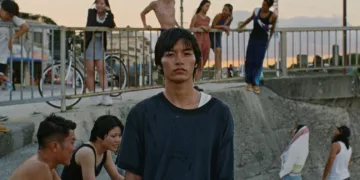




















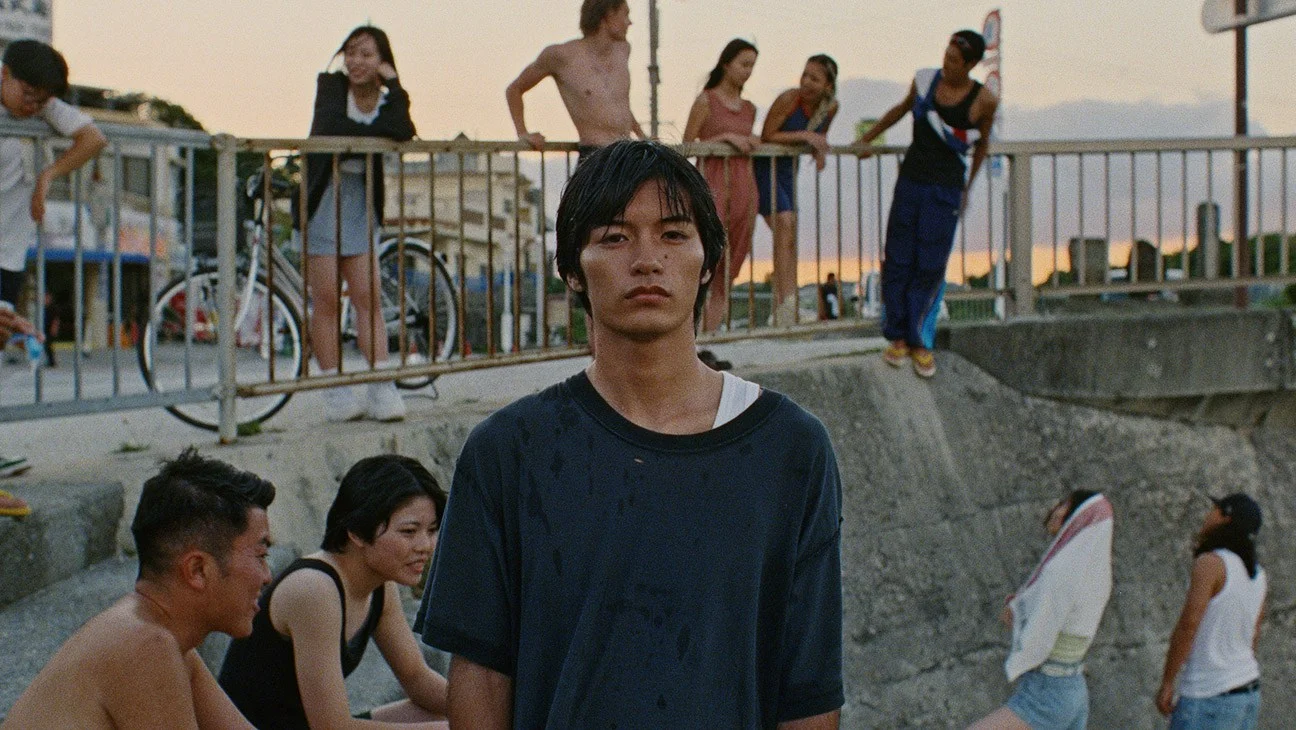

Kamei spends his summer behaving like someone whose life has stalled while everyone around him keeps moving. His friends drink, flirt, leap from bridges into the water, and treat the holiday as one last stretch of freedom. Kamei, played by Naoto Shimajiri, mostly watches. His father has recently died, and that loss has removed whatever sense of direction he once had.
Xavier Tera builds The Color Of The Sun around that inertia. Set on Okinawa in 2012, the film places Kamei inside a landscape full of movement while keeping him emotionally static. Insects hum, waves break, fighter jets tear across the sky, and Kamei listens to dictaphone recordings left behind by his marine-biologist father. The recordings become conversations by proxy because Kamei cannot manage the real kind with his mother.
Then Colin arrives.
West Mulholland plays him with the loose confidence Kamei lacks. He is an American teenager raised around the island’s military bases, outwardly comfortable with a place that technically belongs to someone else. Their first nighttime conversation has a softness that Tera rarely permits elsewhere. Sayombhu Mukdeeprom’s camera lets darkness swallow most of the world around them, giving the encounter the temporary privacy of a secret. That friendship becomes the film’s structural spine.
Two Boys, Two Versions of Home
Kamei wants to leave Okinawa. Colin wants desperately to stay. That reversal gives the relationship its tension before either boy has done much to earn or damage the other’s trust. Kamei grew up on the island but feels trapped there. Colin belongs to a military family that may be transferred at any moment, so his attachment carries an expiration date.
The screenplay complicates things through Sayaka, played by Yuma Taira. Kamei’s tentative attraction to her is already difficult for him to express, and Colin’s presence turns that uncertainty into jealousy. Tera leaves the emotional boundaries between the two boys porous. Friendship, envy, attraction, admiration, and resentment keep occupying the same space.
The visit to Colin’s base is where the film sharpens those tensions. Kamei, standing on his own island, is treated like the suspicious outsider. It is a blunt reversal, but an effective one because the scene changes the relationship between character and place rather than merely restating Okinawa’s politics.
Later, Kamei uses the same logic against Colin during an argument, telling him to go back where he came from. The cruelty lands because Colin has nowhere obvious to return to. Okinawa may reject him politically, yet it is still the closest thing he has to home.
Shimajiri plays these moments through retreat rather than eruption. His shoulders close, his eye contact vanishes, and his responses arrive slightly too late. It is a coherent performance choice. It also points toward the film’s biggest problem: Kamei becomes so withdrawn that the screenplay occasionally hides the character along with his feelings.
The Island Beneath the Story
Okinawa is never permitted to become decorative scenery. Fighter jets repeatedly interrupt quiet moments, turning military presence into something heard before it is discussed. Kamei’s grandfather gives that conflict a face. He organizes local resistance to the American bases and views Colin through the history that produced them. Tera captures that distrust beautifully in a shot where the grandfather’s reflection in a window hangs over Kamei and Colin as they talk. The composition does the political work cleanly. One generation is physically absent from the boys’ conversation yet still dominates the frame.
The family conflict complicates his authority. Kamei resents his grandfather for failing to support his father when he needed him, believing that public reputation mattered to the older man before family responsibility. Politics and grief become tangled, which is far richer than treating the grandfather as a simple mouthpiece for Okinawan resentment.
The screenplay is less successful when it asks Kamei to carry larger questions about identity. He wants to escape Okinawa, participates unevenly in his grandfather’s activism, befriends Colin, then lashes out at him using the language of exclusion. Those contradictions are useful. What is missing is enough connective tissue between them. The film raises a difficult question about who gets to claim a place as home. It sometimes retreats before its characters can properly answer it.
Color, Sound, and Withholding
Tera’s background as a photographer shows in the film’s saturated blues, yellows, beaches, interiors, and night skies. Mukdeeprom often gives a scene its emotional shape through framing before the actors speak. Kamei’s blue-yellow color blindness is the clearest example of the film turning visual design into theme. When he explains that sky and sea can look indistinguishable to him, the metaphor practically announces itself. For a film usually comfortable with silence, the symbolism receives a little too much explanation.
Sound works with greater confidence. Kamei’s father survives through recorded field notes. Birds and insects fill the gaps between conversations. Military aircraft repeatedly overwhelm quieter sounds, making occupation feel environmental rather than theoretical.
The karaoke-bar sequence turns that design stranger and sadder. Mangled ballads drift through the room while Kamei connects with an older sex worker, and the awkwardness fits a film where sexuality rarely arrives in clean categories. Later, Fatboy Slim’s “Right Here, Right Now” accompanies Kamei finally dancing. The moment works because his body has spent so much of the film refusing movement.
The late letter from his mother is far more direct. She acknowledges her emotional distance after his father’s death and gives Kamei permission to choose his own future. The scene supplies words the film has withheld for most of its running time. It is moving, though there is a faint sense that the screenplay has finally handed the audience the instruction manual after asking them to assemble Kamei alone.
The Color of the Sun had its world premiere in the main competition at the 83rd Venice International Film Festival on September 10, 2026. Set against the backdrop of a scorching Florida summer, the drama follows a struggling motel manager attempting to protect his young daughter from local criminal elements.
Full Credits
Title: The Color of the Sun
Distributor: Festival release
Release date: September 10, 2026 (Venice International Film Festival)
Running time: 1 hour 56 minutes (116 minutes)
Director: Sean Baker
Writers: Sean Baker
Producers and Executive Producers: Sean Baker, Samantha Quan, Alex Coco
Cast: Mikey Madison, Willem Dafoe, Simon Rex, Karren Karagulian, Dree Hemingway, Bree Elrod
Director of Photography (Cinematographer): Drew Daniels
Editors: Sean Baker
The Review
The Color Of The Sun
The Color Of The Sun has a strong visual and sonic grammar, especially when fighter jets, recorded fragments of Kamei’s father, and Sayombhu Mukdeeprom’s saturated Okinawan landscapes carry emotions the protagonist cannot voice. Xavier Tera’s restraint becomes less persuasive when Kamei’s interior life and the island’s political tensions remain partially sketched. The friendship with Colin gives the film its clearest dramatic spine, particularly once belonging turns from shared uncertainty into a weapon. Beautifully controlled, occasionally too controlled.
PROS
- Expressive Okinawan cinematography
- Strong environmental sound design
- Nuanced Kamei-Colin relationship
- Thoughtful use of political tension
- Effective central performances
CONS
- Kamei can feel overly withheld
- Political ideas remain underdeveloped
- Color symbolism feels overexplained
- Late emotional clarity arrives abruptly