























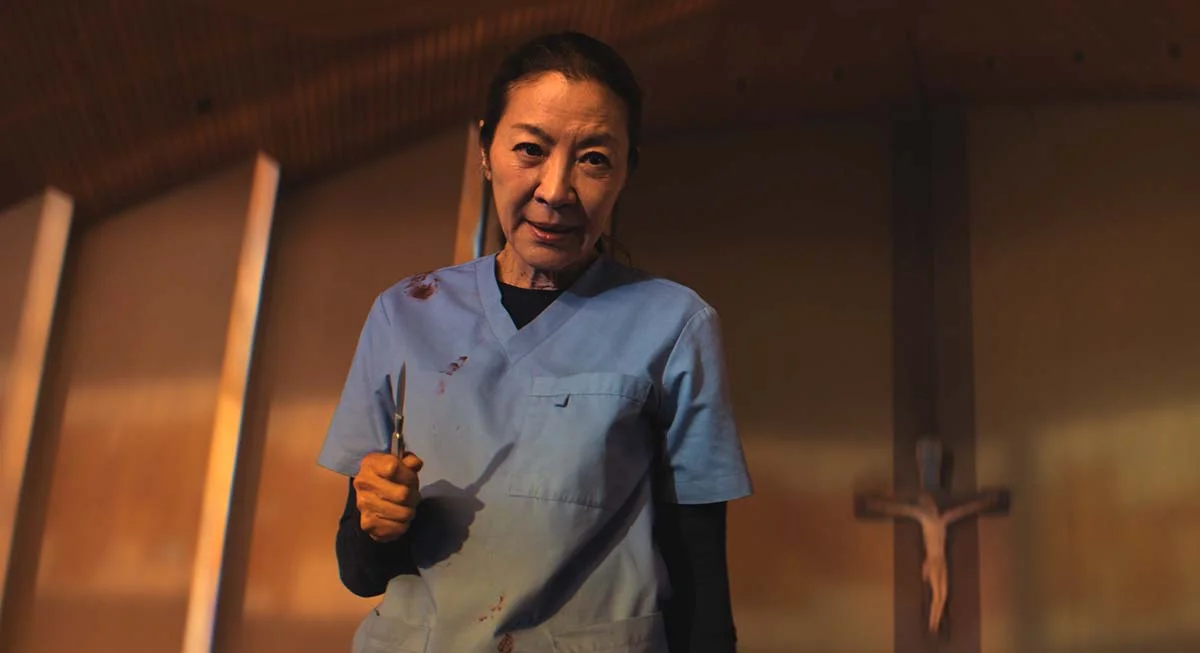

The most satisfying feeling in The Surgeon is anticipation. Once Dr. Eliza Lim has been kidnapped, surrounded by armed men, and forced to operate on a patient who may be her death sentence, every object in the room starts to look dangerous. Eliza’s danger comes entirely from being a surgeon. The excitement comes from slowly understanding what that means when somebody who knows exactly how the body works decides she would rather not die.
Roshan Sethi builds the film around that simple transformation, and Michelle Yeoh makes it feel unusually convincing. Eliza has spent roughly four decades operating on people before being pushed into retirement, a transition that leaves her restless and disconnected from the life waiting outside medicine. The kidnapping abruptly restores the thing she understands best: a human body with a problem that requires precision. Unfortunately for her captors, that precision does not have to remain therapeutic.
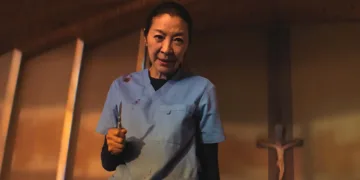
The distinction matters because Sethi resists the obvious pleasure of simply letting Yeoh become a martial arts hero again. Eliza does not suddenly start throwing people through walls. She studies them. When she attacks, she targets wrists, tendons, joints, vulnerable tissue, and the exact pieces of anatomy that can stop somebody from holding a gun or standing upright.
One particularly nasty encounter ends with her calmly informing an injured man that what is leaking from his nose is cerebrospinal fluid. The line is funny because Eliza delivers it with the clinical composure of somebody explaining a routine diagnosis. The damage itself is another matter.
That is where the movie finds its particular sensation. Conventional action often makes injury abstract. Somebody gets punched, shot, or stabbed, and the scene moves forward. Sethi keeps asking you to think about what happened beneath the skin. At several points the film visualizes Eliza’s attacks by exposing bones, tendons, or internal structures, briefly showing the body as she understands it. These images turn medical knowledge into a kind of action grammar. The suspense shifts from who Eliza will hit next to which part of a person she has decided to disable.
For a movie this gleefully gruesome, the key emotion is strangely calm. Yeoh rarely plays Eliza as frightened in an obvious way. She speaks softly, watches people carefully, and even weaponizes the assumptions her captors make about her. She points out that she is older, smaller, apparently harmless. The satisfaction comes from watching those claims become camouflage.
Sethi understands that Yeoh’s face can generate suspense before the screenplay reveals the mechanism behind it. When the camera stays with her, a passive expression can become a puzzle. Eliza has noticed something. The audience simply has to catch up. That gap between her knowledge and everyone else’s ignorance is responsible for much of the film’s tension, and it makes her eventual attacks feel like payoffs rather than random bursts of violence.
Even her insistence on listening to Thin Lizzy while she operates becomes part of that control. Music is one of the rituals that keeps Eliza centered, and Sethi carries some of that energy into the violence surrounding her. The contrast is playful without turning her profession into a joke. Surgery remains serious work to Eliza even after surgical knowledge becomes her escape route.
There is another feeling underneath the action, though, and it gives the film enough weight to keep its gimmick alive past the first few bloody surprises. Eliza has spent years telling dying patients to accept what cannot be changed. Faced with her own possible death, she discovers that resignation is considerably easier to prescribe than to practice. Retirement had already forced her to confront a smaller version of the same fear. If medicine has structured her identity for decades, what remains when the hospital decides her hands should stop working?
The film only pushes that question so far, while Yeoh keeps it present. Eliza’s tentative connection with Bill, a man she meets through a retiree book club, hints at another kind of life without developing into much of a relationship. Her blankets stitched with patients’ names provide a stronger detail. They suggest someone whose emotional life may have been narrow, yet hardly empty. She has simply expressed care through work.
That also complicates Sean, the criminal boss played by Martin Freeman. Flashbacks establish that Eliza knew about his condition before the kidnapping, turning the climactic conflict into something messier than doctor versus villain. Freeman arrives relatively late, and his restrained manner suits the film better than several of the interchangeable henchmen surrounding him. His scenes with Yeoh have a sharper charge because Eliza has to look at him simultaneously as the man responsible for her captivity and as a patient whose failing body she understands intimately.
The crime material around them is less interesting. The abandoned hospital, armed guards, ticking clock, and mysterious patient give Sethi an efficient thriller structure, but the gang itself rarely develops much personality. Some of the first half feels slower than the premise suggests it should, particularly before Eliza begins exploiting the medical knowledge that separates her from her captors. The film becomes far livelier whenever Sethi returns to that imbalance.
Its strongest set pieces understand this. A confrontation in the hospital chapel places the violence against bright stained glass rather than burying everything in darkness. A later home invasion expands Eliza’s predicament beyond the operating room while keeping her improvisational intelligence central. Even when the production can look somewhat plain, Sethi finds enough visual invention in bodies, instruments, and spaces to keep the medical concept active.
The final stretch gets a little untidy as the film spreads its climactic action across several encounters, yet the pleasure never completely disappears because Eliza remains such a specific action protagonist. Every time the movie threatens to become another story about criminals underestimating the wrong retiree, Yeoh reaches for a scalpel and reminds us why this one feels different.
What stays with me is the strange emotional reversal Sethi and Yeoh pull off. Eliza begins retirement deprived of the work that gave her purpose. By the time survival requires her to use that same knowledge to injure people with frightening accuracy, competence itself has become thrilling again. The feeling is exhilarating, disgusting, and slightly sad, which is a richer combination than this pulpy setup initially promises.
The Surgeon had its world premiere in the Centrepiece section of the Toronto International Film Festival on September 12, 2026. The Irish-American action-thriller follows a retired doctor who is forced to perform one last operation under high-stakes circumstances.
Where to Watch The Surgeon (2026) Online
Full Credits
Title: The Surgeon
Distributor: Thunder Road Films, Tango Entertainment, Wild Atlantic Pictures
Release date: September 12, 2026 (Toronto International Film Festival)
Running time: 1 hour 32 minutes (92 minutes)
Director: Roshan Sethi
Writers: Roshan Sethi
Producers and Executive Producers: Basil Iwanyk, Erica Lee, Diarmaid McGrath, Tim Headington, Lia Buman
Cast: Michelle Yeoh, Martin Freeman, Laurie Davidson, Yuri Kolokolnikov, Joseph Mydell
The Review
The Surgeon
The Surgeon turns medical knowledge into an action language that feels nasty, clever, and oddly exhilarating. Roshan Sethi gets the best results whenever Eliza’s anatomical precision shapes the tension, while Michelle Yeoh makes her calm intelligence as exciting as any punch or kick. The crime plot and supporting villains are thinner, and the final stretch loses some structural neatness, but the film keeps recovering through the specificity of its central idea. Watching Eliza rediscover purpose through such horrifying competence gives the pulp a surprisingly melancholy edge.
PROS
- Michelle Yeoh’s controlled, calculating performance
- Inventive anatomy-based action
- Effective medical visualization
- Strong mix of disgust, tension, and humor
- Eliza’s retirement gives the violence emotional weight
CONS
- Generic supporting criminals
- Uneven momentum in the first half
- Bill’s subplot remains underdeveloped
- Climactic action becomes slightly scattered