



























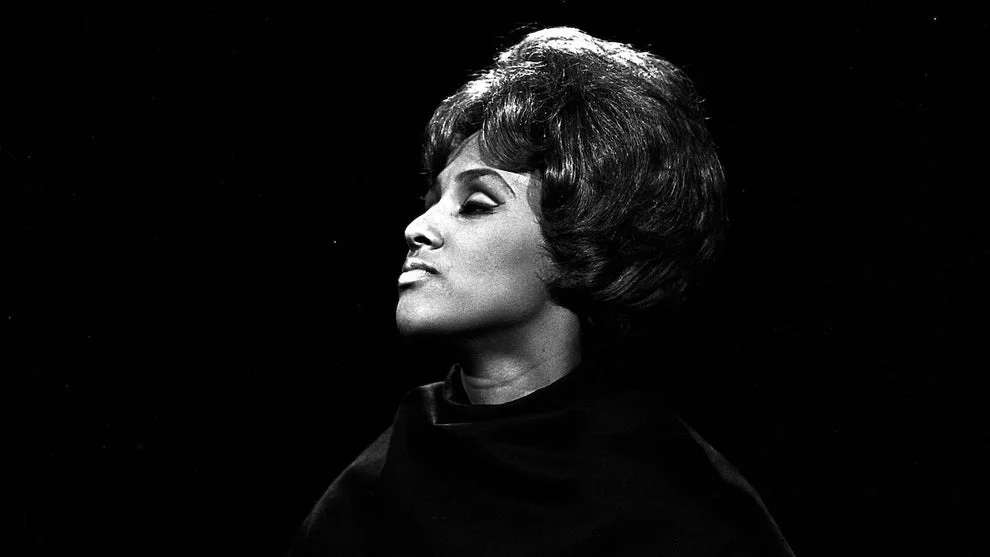

Darlene Wright grew up in a household where secular music was forbidden, then helped supply the sound of American pop. The passage between those worlds gives Barry Avrich’s Darlene Love: I Know Where I’ve Been its richest cultural subject. Gospel was part of her education before the recording industry became her workplace.
With the Blossoms, that training entered records by Sam Cooke and the Beach Boys, crossing between musical settings whose audiences could hear the contribution without knowing its origins. Love’s story asks us to listen for the working singer inside music usually remembered through its headliners.
Phil Spector made that distinction painfully concrete. He renamed Wright, employed her voice, and released “He’s a Rebel,” on which she sang lead, under the Crystals’ name. Calling her an overlooked background vocalist misses the particular injustice. The lead performance was already hers; public attribution went elsewhere.
Avrich’s radio-themed opening credits acquire significance here. Radio allowed a performance to reach listeners independently of its singer’s visible presence, while the record’s billing supplied an identity for what they heard. In Love’s case, the separation between sound and name was built into the product.
The newly filmed Power Station performances give the documentary a practical means of repairing that separation. Accompanied by Paul Shaffer and his band, Love returns to songs including “He’s a Rebel” and “A Fine, Fine Boy.” Her forceful singing makes the argument available to the ear, while her presence supplies the person absent from the old credit.
These sessions are essential to the film’s value. A sequence of admirers could establish her reputation; a current performance establishes her continuing ability. The archival Shindig! appearances and later television material also show a performer capable of commanding attention once the medium makes her visible.
Love’s interview gives that visibility a speaking voice. She recalls the restrictions on her career without letting resentment determine every anecdote, and her humor prevents the account from becoming a procession of injuries. That manner matters because the documentary’s celebratory purpose could easily flatten her into an emblem of endurance.
Her recollections preserve an individual temperament within the historical argument. Cher’s memories of watching her record are useful for a related reason: they describe someone at work. Such testimony offers a firmer basis for admiration than declarations that Love belongs among the greatest singers.
The film’s account of the Beatles’ arrival introduces an international shift into this American recording history. British pop appears as another pressure on opportunities for American acts, though it cannot explain Spector’s earlier control or the misattribution of Love’s recordings.
Her present-day rendition of “We Can Work It Out” gives that account an interesting counterpoint. Music associated with the British group now belongs within her own performing repertoire. The relationship changes from commercial competition to artistic use. There is no need to read the performance as a deliberate historical reply to appreciate how a singer can carry a song into a different musical life.
The movement from Los Angeles to New York is equally important. After a period when Love supported herself by cleaning houses, Steven Van Zandt encouraged her relocation. The Bottom Line and Leader of the Pack offered settings in which audiences could encounter her as a named performer.
Geography changes the institutions through which recognition becomes possible: recording work gives way to live appearances and a theatrical account of pop history. The comeback also depends on people who can open those routes. Love’s ability persists across the change, but ability alone had not protected her livelihood.
Letterman’s annual Christmas performances make that new relationship with an audience especially clear. “Christmas (Baby Please Come Home)” becomes attached to a recurring appearance by an identifiable singer, rather than remaining a recording whose provenance listeners might never investigate.
Television gives recognition repetition, a face, and a name. The expanding choirs lend the performances a communal scale, while Love retains the featured position. Association with one seasonal song can provide only a partial picture of a career, yet the documentary supplies good reason to understand this ritual as a substantial form of recognition, not a trivial consolation.
Avrich’s mixture of interviews, archive, and new music serves these episodes well. The problem appears in the movement between them. The career unfolds through successive highlights, with the 2011 Rock & Roll Hall of Fame induction providing institutional confirmation of the acclaim heard throughout.
This makes an accessible tribute, but important questions receive less development than the milestones. Spector’s acquisition of another contract, for example, shows that his power could survive a change in Love’s professional circumstances. The documentary recounts the intervention without examining its continuing effects with the same attention it gives the comeback.
The family interviews expose another limit to that emphasis. Love’s sons acknowledge a career that often took her away from them, introducing a cost that professional recognition cannot resolve. Their presence opens a different scale of experience, one measured through relationships rather than performances or honors.
The film gives relatively little space to developing that perspective. Respect for a subject need not require an invasive account of private life, but once those absences enter the story, moving onward to the next achievement leaves a meaningful part of her working history insufficiently examined.
The discussion of “River Deep, Mountain High” also shows the hazards of organizing a career around missed chances. Love was set to record it before Spector chose Tina Turner, and the film entertains the possibility that Love’s version would have succeeded commercially.
That remains an imagined outcome. A lost opportunity can be established; the success it might have produced cannot. Dwelling on the hypothetical risks making an unknowable career the measure of the actual one. Love’s recordings, her contractual restrictions, and her periods without singing work already provide substantial evidence for assessing what happened.
The Power Station material opens a less retrospective possibility. Love’s return to familiar songs certainly draws on their history, but the sessions place them alongside the title number, “I Know Where I’ve Been.” That repertoire makes room for an artist whose current work extends beyond repeating the recording that brought her Christmas recognition. With Shaffer and his band, she is performing songs from different points in her life in the same present-day setting, giving the old hits another occasion to be heard in her company.
Darlene Love: I Know Where I’ve Been world-premiered at the Toronto International Film Festival on September 13, 2026. The documentary chronicles the remarkable life and legendary career of iconic American singer and actress Darlene Love, charting her journey through the music industry.
Full Credits
Title: Darlene Love: I Know Where I’ve Been
Distributor: Melbar Entertainment, TPH Entertainment
Release date: September 13, 2026 (Toronto International Film Festival)
Running time: 1 hour 55 minutes (115 minutes)
Director: Barry Avrich
Writers: Barry Avrich
Producers and Executive Producers: Taraji P. Henson, Barry Avrich, Mark Selby, Jamila Jordan-Theus, Len Evans, Tim Drake, Randy Lennox, Jeffrey Latimer
Cast: Darlene Love, Cher, Bruce Springsteen, Dionne Warwick, David Letterman, Steven Van Zandt, Nancy Sinatra, Paul Shaffer, Lou Adler, Marc Shaiman, Robert Smigel, Jimmy Fallon
The Review
Darlene Love I Know Where I've Been
Avrich restores a performer’s identity to an American pop history that often credited her voice elsewhere. Love’s testimony and new studio performances give that restoration substance, tracing gospel talent through recording work and belated public recognition. The chronological tribute leaves contractual power and family relationships underexamined, while speculation about missed hits proves less persuasive than the music she actually made. An engaging portrait whose strongest historical evidence remains its working singer.
PROS
- Powerful new performances with Paul Shaffer and his band.
- Love’s candid, humorous account of her career.
- Archival appearances illuminate changing forms of recognition.
CONS
- Milestone structure limits examination of industry control.
- Family relationships receive little development.
- Hypothetical commercial success weakens the historical argument.