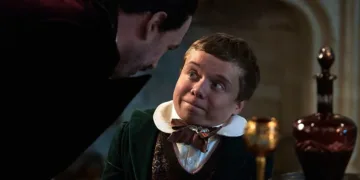










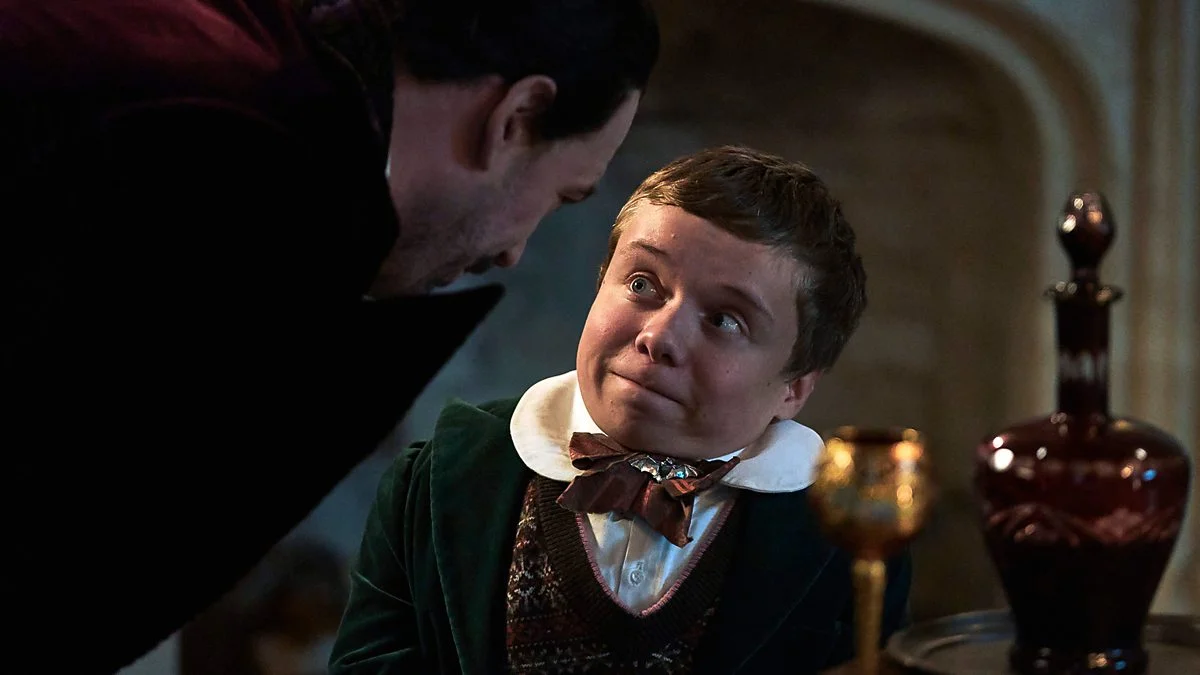

Val interrupts a vampire raid because he needs the toilet. His father has brought him along to learn the family business, and the boy’s body refuses to cooperate with the occasion. It is an efficient invitation to younger viewers: the supernatural hierarchy becomes comprehensible through the familiar embarrassment of needing something from a parent at an inconvenient time. For a BBC One Sunday-evening sitcom, that small interruption does useful work. It gives children a place inside the joke before asking them to admire the adults performing it.
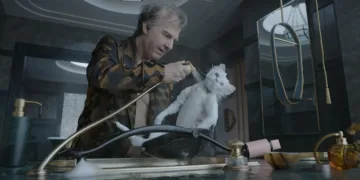
Joe Wilkinson’s werewolf Wilf asks for a different kind of attention. Leaning over an uneasy maid, he presents his monthly transformation as a qualification for understanding women. The target is recognizable: male self-absorption dressed as empathy. His defense of Jekyll’s medical career requires another set of references, however, and the extended advocacy for misunderstood monsters allows the adult routine to occupy the foreground. These scenes expose the slightly uneven arrangement within The Reluctant Vampire. Its audiences sometimes share a joke; sometimes one has to wait while the other is entertained.
Neil and Rob Gibbons have adapted Eric Morecambe’s The Reluctant Vampire and The Vampire’s Revenge into six half-hour episodes. Their experience writing Alan Partridge supplies pedigree, but the BBC’s decision to put this material into a family slot creates its own demands. Producer Shane Allen has credited the success of Ghosts with helping the adaptation reach television, an unusually direct acknowledgment of how one supernatural ensemble can make another institutionally imaginable. The BBC has found room for a children’s-book adaptation through a successful adult comedy precedent. The programme’s shifting address reflects that combination.
Sexual innuendo is not automatically a breach of the family-viewing contract. Victor and Valeeta’s attraction gives the parents a relationship independent of their children, and Wilf mounting a dinner table supplies physical absurdity accessible without a literary education.
The difficulty is the length of the verbal detours. Wilf’s defense of monsters keeps elaborating after the basic joke is clear, making the scene feel less nimble than Val’s interrupted raid. The writing is hospitable to adult recognition, occasionally at the expense of the younger protagonist’s momentum. A distinguished comedy cast cannot settle that allocation of attention by itself.
Lenny Rush gives the series a stronger reason to gather its viewers together. His Valentine, known as Val, is treated as a disappointing vampire: no fangs, no taste for blood, no ability to become a bat. His family understands these absences as developmental delays until his mother admits that he is human. Valeeta rescued him from a fire while Victor was away and raised him as her own. The revelation changes the meaning of every parental expectation. A boy who seemed unable to master his inheritance discovers that the inheritance was never his to begin with.
Sian Clifford’s Valeeta complicates the reassurance of that discovery. She initially considered eating the baby, then loved him and expected upbringing to supply the vampire abilities he lacked. Her affection is real, but her explanation exposes how completely the household’s customs have governed her thinking.
Val’s incredulity punctures the idea that supernatural physiology can be acquired like an ordinary skill. The exchange lets a child identify the fault in an adult’s assumptions without requiring him to stop wanting her protection. This is where the adaptation’s warmth acquires substance: love has sheltered him inside a dangerous misunderstanding.
Tom Davis makes Victor’s parental pride inseparable from his appetite. His enthusiasm for hunting humans establishes the threat behind the initiation ceremony he believes Val is ready to undergo. Rush’s difficulty participating in vampire life therefore carries an uncomfortable double obligation: conceal himself and satisfy his father. Gabriel Nagy’s Vernon, meanwhile, relishes the family culture, even discerning characteristics of blood by taste. The younger brother performs belonging with an ease the heir cannot manufacture. The comic contrast gives the royal hierarchy a domestic sting, with the preferred successor struggling to imitate the apparently ideal son.
The human world offers no uncomplicated escape. Val meets Gertie, played by Ellie-May Sheridan, while fleeing villagers, and her father turns out to lead the pursuit. Their growing friendship makes contact possible across a division that both households maintain. It also gives Val something to discover beyond the task of evading exposure. The show earns this account of conditional belonging through specific pressures, without needing its species distinction to stand for a particular real-world identity. Val is wanted at home under a false description and threatened outside under another. His encounters with Gertie begin to loosen those descriptions.
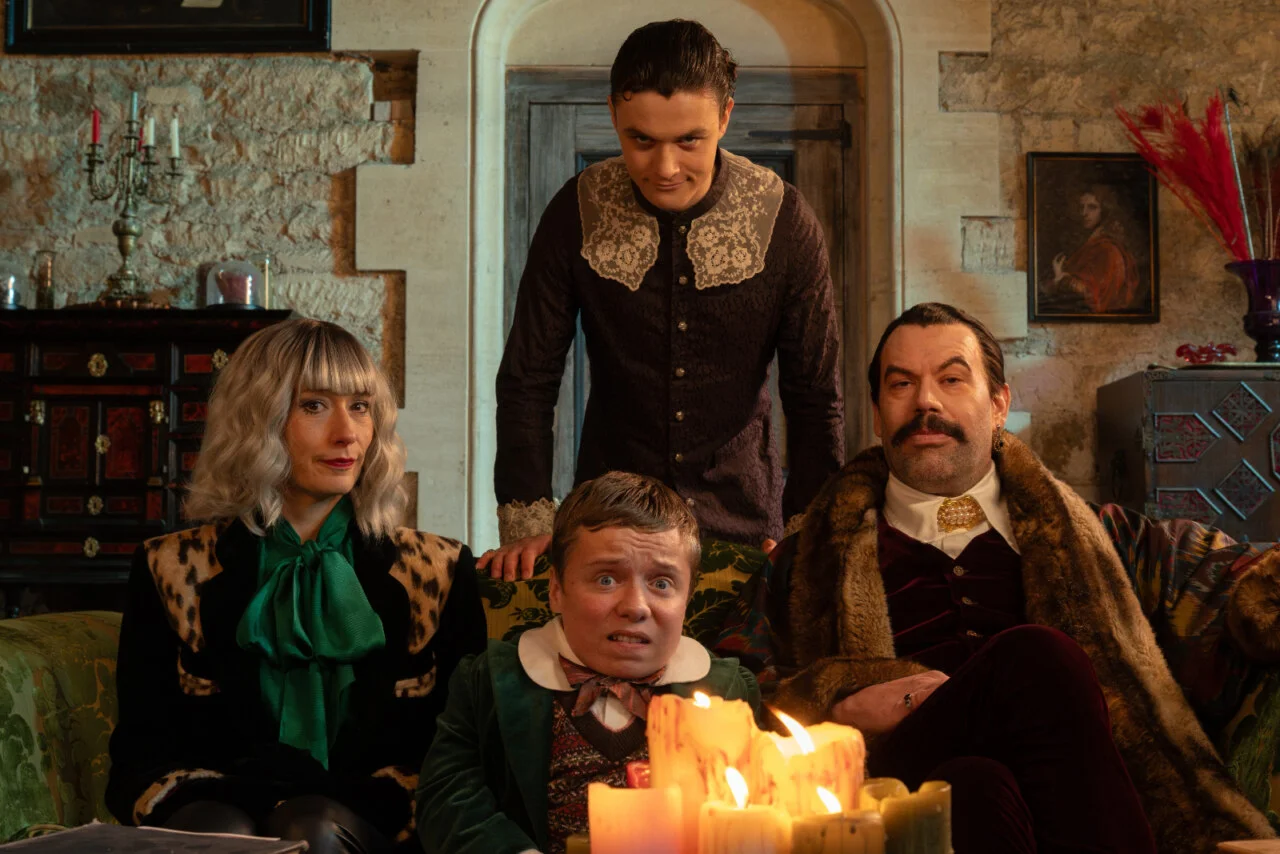
The production’s retro styling places that story inside a peculiar version of the present. An Airbnb reference coexists with castle furnishings associated with the 1970s and 1980s and a conspicuous absence of smartphones. The visibly artificial werewolf tail suits a world that invites viewers to accept its theatrical construction.
Bill Bailey and Ross Noble’s gargoyles, Guy and Gary, offer an especially useful bridge between the old setting and contemporary expectations: they can observe events around the castle but are distractible and ineffective at surveillance. A recognizable modern function has been handed to creatures temperamentally unsuited to performing it, giving the ensemble business that needs no nostalgic password.
The more demanding inheritance arrives when Val tries to assemble a ham sandwich in a human household. His trouble with the arrangement reworks Morecambe’s celebrated routine about correct components in the wrong order. Adult recognition is built into the adaptation, yet the situation gives an unfamiliar viewer an independent point of access. Val has learned that he belongs biologically among humans; he still lacks their everyday competence. Rush’s awkwardness lets the borrowed routine remain attached to that discovery. For a child encountering the joke for the first time, the sandwich belongs to a boy learning how to live outside the castle, before it belongs to television history.
The Reluctant Vampire premiered on BBC One and BBC iPlayer on October 4, 2026. Adapted from Eric Morecambe and Gary Morecambe’s novel, the supernatural comedy follows a quirky vampire family attempting to blend into a regular village while managing their unusual nocturnal habits.
Full Credits
Title: The Reluctant Vampire
Distributor: BBC One, BBC iPlayer
Release date: October 4, 2026
Rating: TV-PG
Running time: 30 minutes per episode
Writers: Neil Gibbons, Rob Gibbons
Producers and Executive Producers: Boffola Pictures
Cast: Lenny Rush, Tom Davis, Sian Clifford, Charlie Cooper, Asim Chaudhry, Joe Wilkinson, Kiell Smith-Bynoe
The Review
The Reluctant Vampire
The Reluctant Vampire gives the BBC’s family-comedy ambitions a likable human anchor in Lenny Rush. Val’s concealed identity lends substance to the supernatural silliness, while the Morecambe homage works through character rather than recognition alone. The balance occasionally slips: extended adult routines interrupt the younger protagonist’s momentum. Its warmest achievement is making a child’s uncertain place within his family accessible across generations.
PROS
- Rush anchors the comedy in Val’s predicament.
- Family affection carries believable contradictions.
- Retro design supports accessible supernatural absurdity.
- The sandwich homage serves character and nostalgia.
CONS
- Extended verbal riffs slow Val’s story.
- Some adult references make shared viewing uneven.