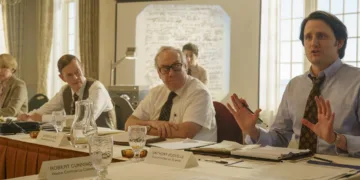






















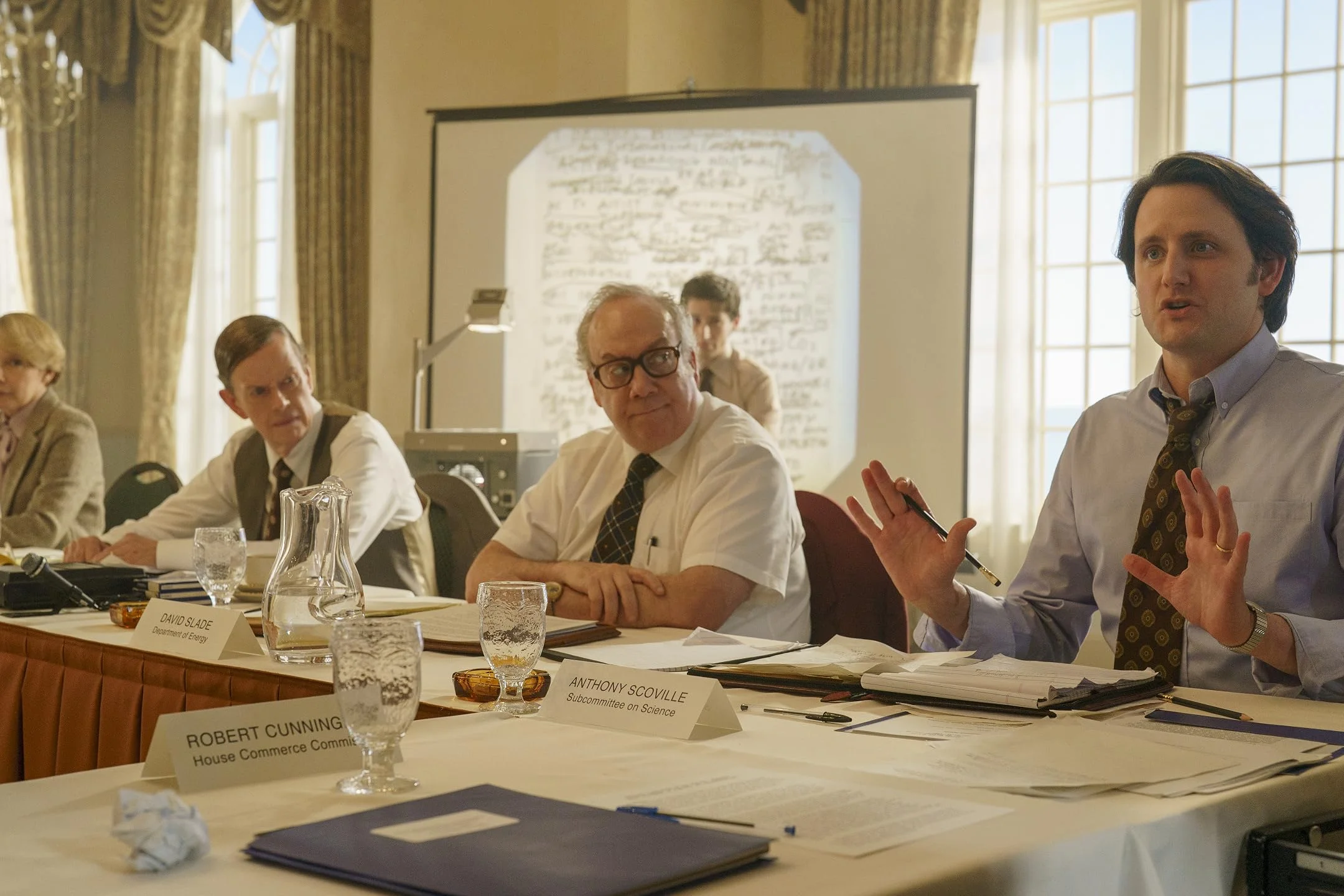

Two men consider how to arrange the tables in a hotel conference room overlooking the ocean. Congress has commissioned a response to the threat of carbon dioxide emissions, and the furniture must accommodate the people expected to formulate it. Tom McCarthy’s A Statement gives this modest preparation room to breathe. It is October 1980, shortly before Ronald Reagan’s election. Twenty specialists will gather at Florida’s Don CeSar hotel, bringing scientific knowledge, professional obligations, and incompatible expectations of what a useful recommendation should say.
Once discussion begins, Stuart Dryburgh’s cinematography and Jane Rizzo’s editing distribute attention between the person speaking and the people obliged to listen. That distinction carries moral weight. Evan Peters’s Rafe Pomerance can occupy the discussion through his mounting impatience while someone else controls its language. Paul Rudd’s moderator, Tom Jorling, keeps trying to reconcile these competing forms of participation. The room’s organization promises that everyone can be heard; the faces suggest that being heard and being answered are separate privileges.
McCarthy, Thomas Bidegain, and Noé Debré adapt an episode from Nathaniel Rich’s Losing Earth, using the conference transcript for the dialogue spoken during the sessions. Occasional onscreen passages underline its documentary provenance. Yet the record supplies words, while the film supplies attention.
A listener’s disbelief can qualify an argument before anyone formally challenges it. Selection and juxtaposition remain judgments, however scrupulously the dialogue has been preserved. McCarthy’s restrained treatment makes those judgments less conspicuous, which sometimes gives the material an appearance of neutrality it has not quite earned.
The early assembly of experts carries a faint procedural-thriller charge: a task, a deadline, the necessary personnel. John Turturro’s nuclear engineer David Rose presents projected graphs of rising CO₂ levels and anticipated damage. Evidence arrives with the promise of making the next step clearer. Then the film settles into qualifications, wording disputes, and competing assessments of urgency.
Its suspense concerns the conversion of knowledge into an institutionally acceptable sentence. This is a credible source of tension, though credibility offers limited protection against repetition. Some exchanges expose a fresh obstacle; others keep the same obstacle talking. The distinction becomes especially noticeable when technical caution occupies time without substantially changing our understanding of its speaker.
Paul Giamatti makes that caution difficult to dismiss. His David Slade, a Department of Energy official, knows that recommendations must return to government, where uncertainty and feasibility acquire practical consequences. Giamatti’s brusqueness gives administrative experience an abrasive surface.
Slade has attended hundreds of these conferences and has another scheduled. That detail supplies both his authority and a reason to distrust it: repeated participation may have taught him how policy works, or how to endure its failure. The performance allows both possibilities to remain active while he challenges the room’s proposals.
Pomerance’s urgency presses against that seasoned resistance. Peters makes listening feel effortful, as though each additional qualification requires him to swallow another objection. The invented nighttime exchange between Pomerance and Slade releases this tension from the meeting’s formal procedures.
Their disagreement becomes an encounter between people who must live with their respective definitions of responsible action. McCarthy gains emotional access here, but he also changes the evidentiary basis of the film. The transcript establishes their public arguments; fiction supplies an intimacy through which we interpret them.
Other disagreements prevent this opposition from becoming too tidy. Jason Clarke’s John Perry suggests that Americans could relocate inland and assumes a generous interval for adaptation. The abstraction is almost offensively comfortable. Moving a population sounds manageable when the population exists chiefly as an item in one’s argument.
Rose’s objection to recommendations that include solar and wind while excluding nuclear power raises a different problem. The reference to Three Mile Island gives resistance to nuclear energy an immediate historical pressure. Agreement about the danger leaves unresolved the risks people will accept in responding to it. McCarthy is strongest when these positions retain their different moral costs, rather than dissolving into a universal diagnosis of human indecision.
Leaving the room changes those costs again. Rose crashes a wedding with atmospheric-science specialist Robert Cunningham and stenographer Bernadette, and Turturro lets the cerebral disputant become unexpectedly sociable. The change of setting loosens the authority his professional identity carries. It also gives the audience a pleasurable release that the conference itself cannot provide. These invented encounters are effective character drama, though their generosity creates a risk: affection for a participant can begin to soften scrutiny of his conduct. A welcome wedding guest may still be an obstacle at the table.
Bernadette, played by Nina Arianda, offers the sharper connection between these spaces. She describes emotional detachment as necessary to her work, then becomes increasingly affected by the discussion and her conversations with Cunningham. Her position at the side of the room allows recording and observation to coexist. Glances and nervous silences enter her experience without becoming equivalent entries in the transcript. Through her, the film makes the official record feel partial without questioning the accuracy of the words it contains.
Its treatment of Annemarie Crocetti is less assured. Amy Ryan gives her frustration force, particularly in the hotel-room telephone call where she speaks about feeling unheard to a husband asleep at the other end. Public exclusion continues in private, with painfully little ceremony.
Her late intervention urging the group to address the problem’s human urgency is persuasive, but the movement from neglected participant to corrective speaker is rather clean. Tatiana Maslany’s Edith Brown Weiss likewise has to assert her expertise within the male-dominated proceedings. Concentrating their authority into forceful interventions gives them dramatic impact while narrowing the forms through which the film permits that authority to register.
Crocetti’s appeal arrives when time is running out, making plain speech feel like a possible escape from the meeting’s accumulated qualifications. Ryan supplies the emotional clarity the discussion has lacked. The closing title card then records that no statement was produced.
Coming after the private encounters, it leaves a difficult imbalance: the film has furnished the audience with access, sympathy, and several satisfying recognitions, while Congress receives no recommendation. Those human connections remain real within the drama. They also make it easier to leave the hotel feeling that something has been accomplished.
A Statement world-premiered at the New York Film Festival on October 3, 2026, ahead of its theatrical release by Sony Pictures Classics. Based on Nathaniel Rich’s book Losing Earth, the biographical drama follows a 1980 conference in Florida where scientists, activists, and policymakers gathered to draft a crucial directive on carbon dioxide emissions.
Where to Watch (2026) Online
Full Credits
Title: A Statement
Distributor: Sony Pictures Classics
Release date: October 3, 2026 (New York Film Festival)
Running time: 1 hour 45 minutes (105 minutes)
Director: Tom McCarthy
Writers: Thomas Bidegain, Noé Debré
Producers and Executive Producers: Jonathan King, David Levine, Jim Whitaker, Tom McCarthy, Jonathan Schwartz, Nick Shumaker, Bard Dorros, Mary Aloe
Cast: Paul Rudd, Paul Giamatti, Evan Peters, Tatiana Maslany, John Turturro, Amy Ryan, Dylan Baker, Jason Clarke, Zach Woods, Christopher Denham
The Review
A Statement
McCarthy turns a conference room into a study of responsibility, with speakers and listeners offering competing accounts of the same debate. Giamatti and Peters give caution and urgency persuasive human faces. The transcript-based exchanges sometimes repeat rather than deepen the conflict, while the invented private scenes risk making affection a substitute for scrutiny. Its sharpest tension survives the meeting: we understand these people better, yet their understanding produces no statement.
PROS
- Camera and editing make listening morally consequential.
- Giamatti and Peters sustain the conflict between caution and urgency.
- Bernadette connects the official record to its unspoken tensions.
- Private encounters complicate the participants’ professional identities.
CONS
- Repeated qualifications sometimes stall dramatic development.
- Private warmth can soften scrutiny of public failure.
- Women’s authority is concentrated too neatly into corrective speeches.