


























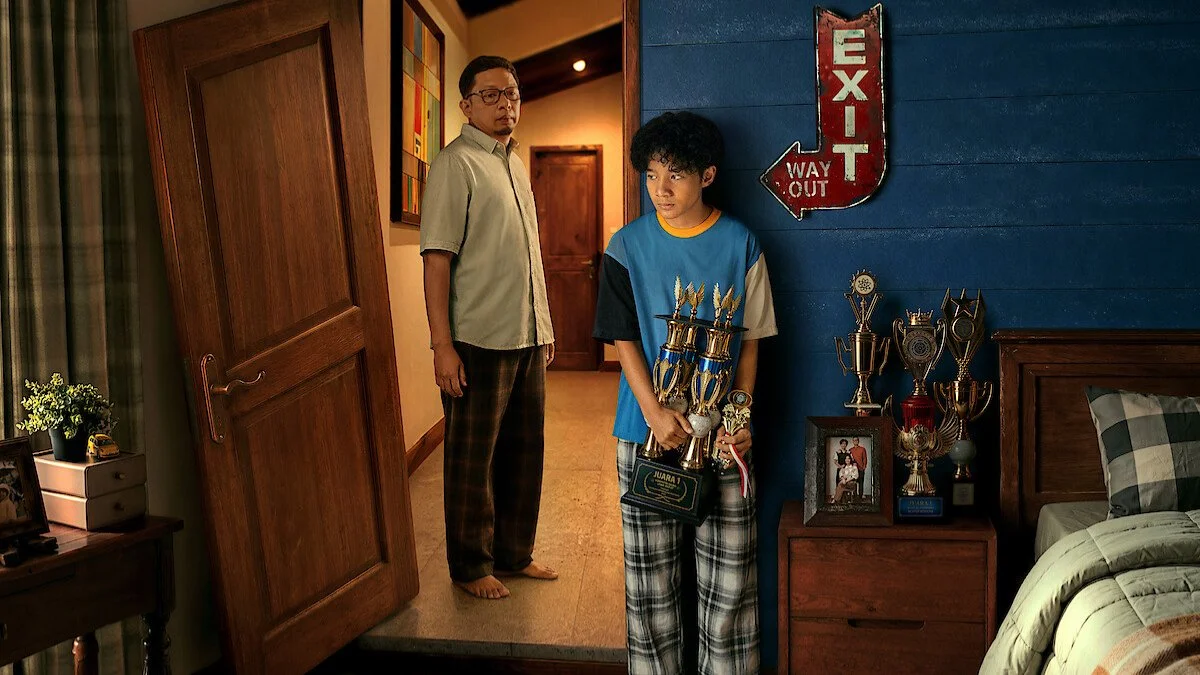

Finishing sixth in a race earns Jati a reprimand from his father. His academic achievements offer little protection against this latest disappointment: success in one area has simply left another available for inspection. Gina S. Noer’s Me Before Me, also titled Aku Sebelum Aku, establishes the father-son conflict through that inability to let an ordinary failure remain ordinary. Pak Jaya treats the result as something requiring correction. For Jati, it becomes another occasion on which his father’s approval depends on a performance he cannot reliably deliver.
Bima Sena makes the consequences legible across Jati’s difficulty speaking, his withdrawal, and his anger. Freezing during a presentation and becoming involved in a fight express different failures of control, and the performance preserves the connection between them.
The quieter passages matter because they prevent the outbursts from becoming the character’s entire emotional vocabulary. Jati can excel at school while struggling to make himself understood. Sena gives that discrepancy enough weight that the boy’s distress registers before the family history supplies an explanation for it.
The first practical response comes from his mother, who changes his school. This is a useful intervention in a story otherwise governed by Jaya’s conviction that effort will solve whatever effort has failed to solve. Moving Jati changes the conditions around him instead of demanding another improvement from him. It also gives the screenplay somewhere to go after establishing the damaging pattern at home.
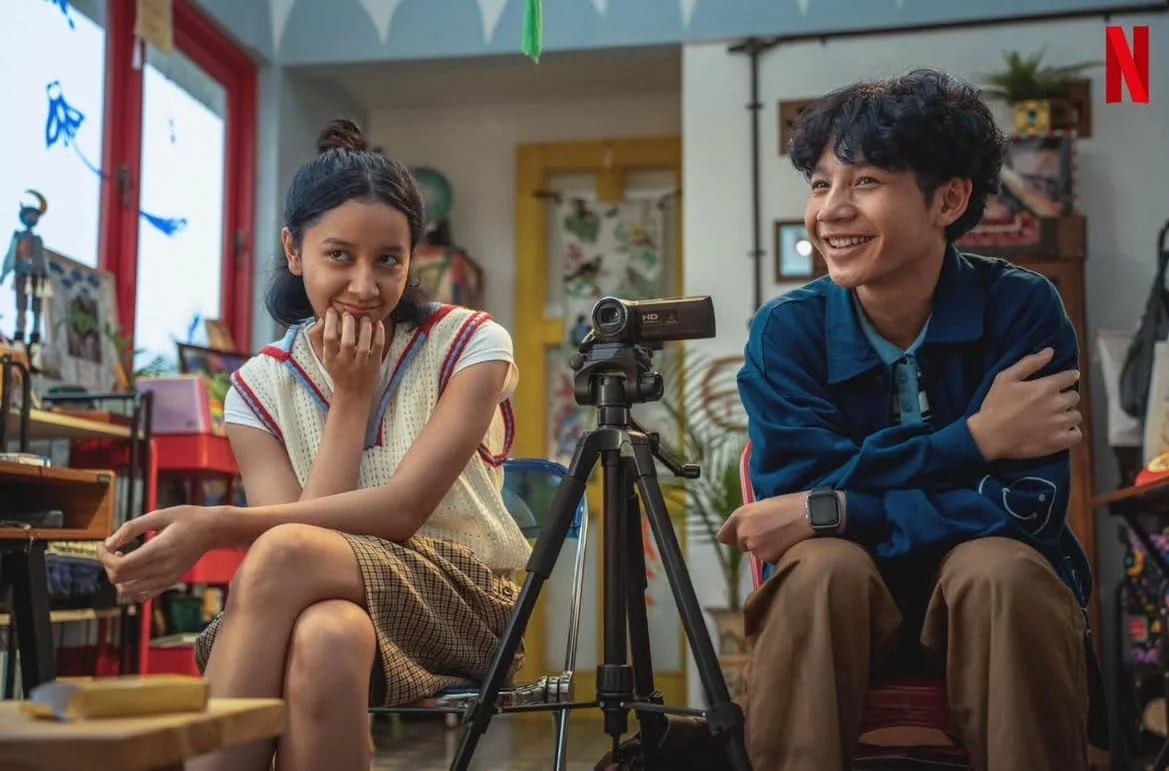
That activity arrives through a family-history assignment. A familiar classroom exercise becomes the film’s principal structural device, allowing Jati to investigate the adult who has been evaluating him. The shift gives his curiosity a purpose beyond uncovering a secret.
He needs to understand why Jaya believes so firmly in a method that is making his son miserable. Discoveries involving his father’s upbringing and brother connect the present conflict to experiences Jati did not share and could not have been expected to understand. The assignment earns its place because the information it produces bears directly on the relationship already under strain.
Ringgo Agus Rahman gives Jaya enough paternal concern to make those discoveries matter. His insistence on further competitions, even when Jati is exhausted, carries the logic of someone who regards achievement as insurance against future suffering. That conviction makes him recognizable without making him right.
Rahman sustains the uncomfortable coexistence of love and damage: the father’s investment in his son is real, and so is his inability to recognize what his demands are doing. Their exchanges work because Jaya’s intentions cannot settle the argument. Jati still has to live with the decisions those intentions produce. The race remains a father berating his child for finishing sixth. Knowledge of an earlier generation can change how that encounter is read; it cannot change what Jati experienced.
Asa, played by Widuri Puteri, gives the assignment a second personal stake. Her discovery that she was adopted unsettles her understanding of a family whose love is already present. Jati is looking for an explanation of conflict, while Asa has to absorb information that changes the meaning of familiar relationships. The parallel gives the school project reach without requiring the teenagers to have interchangeable problems.
Their platonic friendship is valuable here. Asa becomes someone Jati can confide in, allowing his connection with another person to develop outside the system of achievement and approval that governs his relationship with Jaya. Her uncertainty also deserves attention in its own right, rather than serving solely as assistance for his.
At 127 minutes, the film has room for these different responses to family knowledge, but its allocation of that time is uneven. The withdrawal, presentation anxiety, and fight establish distinct effects of pressure; cutting them indiscriminately would flatten Jati’s experience. The drag comes from the distance between recognizing the pattern and developing the investigation that can disturb it.
Once the assignment connects the teenagers’ questions to their families, the narrative has a clearer source of movement. Earlier, it can feel as though Jati must accumulate enough distress to qualify for the next stage of his own story. The acting keeps those passages human, but it cannot entirely resolve the delay built into the telling.
The investigation also places a new demand on Jati. Having spent so much effort trying to satisfy his father, he is now asked to understand him. That can be a meaningful change in their relationship, provided understanding leaves room for the son’s exhaustion and anger.
His mother’s decision to move him offers a useful measure of care: she responds to his difficulty by doing something that changes his circumstances. Set beside that action, the discoveries about Jaya raise a practical question that knowledge alone cannot answer. A father who sees competition as protection still has to recognize the point at which his son needs permission to stop.
Me Before Me premiered globally on Netflix on July 16, 2026. Directed and written by Gina S. Noer, the Indonesian family drama follows a high-achieving student dealing with intense academic pressure who must confront a strained relationship with his demanding father after a school history project triggers a personal reckoning.
Where to Watch Me Before Me (2026) Online


Full Credits
Title: Me Before Me (Indonesian: Aku Jati Aku Asperger)
Distributor: Netflix
Release date: July 16, 2026
Rating: TV-PG / TV-14
Running time: 2 hours 7 minutes (127 minutes)
Director: Gina S. Noer
Writers: Gina S. Noer, Salman Aristo
Producers and Executive Producers: Gina S. Noer, Wahana Kreator
Cast: Bima Sena, Ringgo Agus Rahman, Widuri Puteri, Prastiwi Dwiarti, Aming Sugandhi, Ronal Surapradja, Verdi Solaiman, Poppy Sovia
Director of Photography (Cinematographer): Sigit Pratama
The Review
Me Before Me
Me Before Me finds its strongest dramatic direction when Jati’s family-history assignment turns paternal pressure into something he can investigate. Bima Sena and Ringgo Agus Rahman keep the conflict emotionally credible, preserving the damage alongside the father’s loving intentions. The film takes too long to connect its careful portrait of distress to that investigation, but the relationship rewards the attention. Understanding a parent’s fear remains a complicated task for a child already exhausted by his expectations.
PROS
- Bima Sena’s convincing restraint and anger.
- Rahman’s affectionate, damaging father.
- Family discoveries that deepen the central conflict.
- A platonic friendship with distinct personal stakes.
CONS
- Prolonged setup delays the family investigation.