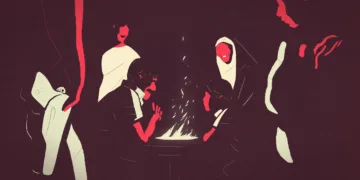



















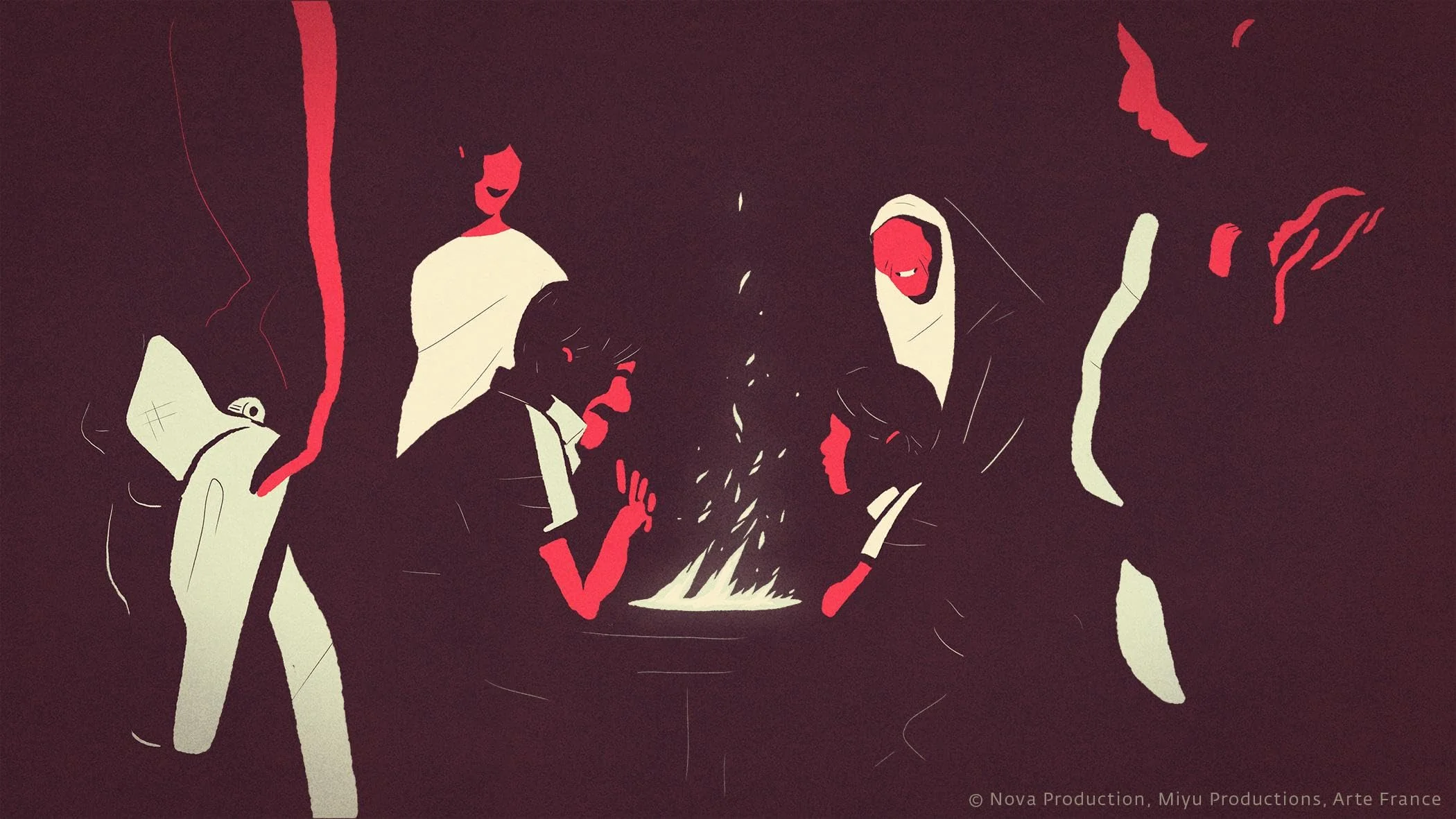

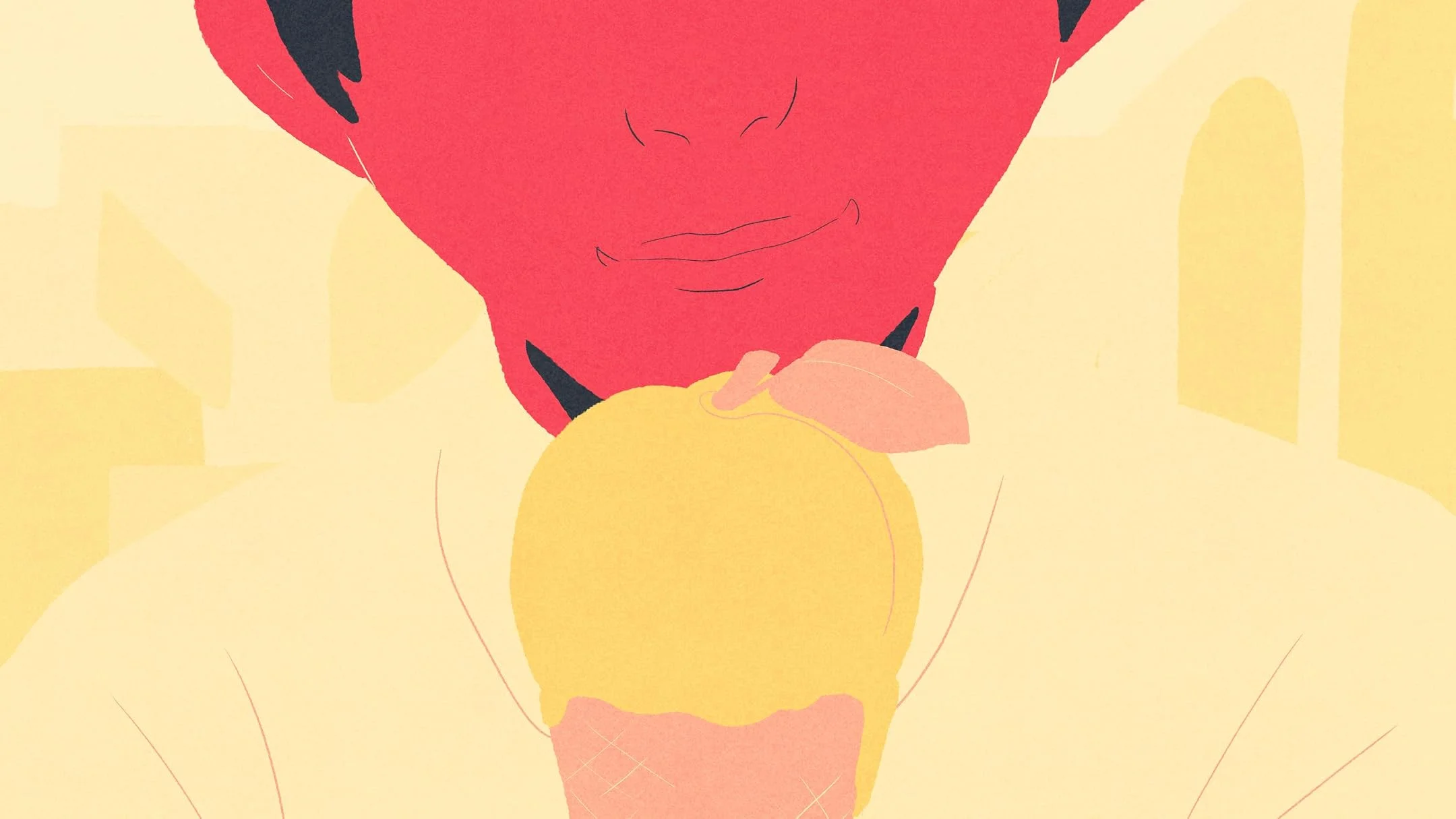
Léonard Cohen gives the people in Flavors of Iraq remarkably little facial equipment. Eyes, sunglasses, a moustache: recognition proceeds through features that a realistic portrait would surround with other information. Against flat fields of color, these abbreviated figures seem to have survived a process of selection. Something has been kept because someone remembers it. The animation makes that selection visible, allowing the autobiographical account of French-Iraqi journalist Feurat Alani to retain the incompleteness of recollection without looking unfinished.
The sensory memories are much less economical. Apricot ice cream and the fragrance of hair oil supply a precision that the faces decline to provide. This discrepancy gives the childhood passages their peculiar intimacy. Alani can recover the attraction of a place without reconstructing everything that was happening around him, and Cohen’s restricted palettes, sometimes red, sometimes yellow or black and gray, accommodate that partial knowledge. The images establish the intensity of an impression rather than certify the completeness of a record. A country first encountered through relatives and small pleasures can feel entirely welcoming to a child whose father knew reasons to flee it.
The father’s death provides the occasion for those different experiences to meet. At the gathering of mourners, members of the Iraqi leftist diaspora contribute anecdotes, and the son’s memories enter a history already being told by other people. Born in France, Alani has inherited a relationship with Iraq whose earliest chapters occurred without him. His father’s opposition to Saddam Hussein and departure from the country belong to that inaccessible past. The funeral framework gives the flashbacks a persuasive uncertainty: the man being recovered was somebody’s comrade before he was somebody’s father, and neither account can simply absorb the other.
That matters because the father has remained reluctant to discuss his Iraqi life. Silence leaves the son with a practical problem of knowledge, alongside the emotional problem of understanding a parent. Here the spare drawings acquire an ethical dimension. They let the film present a person without suggesting that everything about him has become available for inspection. A few identifying features can establish familiarity while leaving considerable interior space unfilled. The anecdotes do not abolish that space. They disclose how much of a family’s history can remain outside the child’s field of vision, even when he is standing among the people who lived it.
Saddam’s indirect representation gives absence a harsher function. Evoked through Dajjal, the false messiah of Islamic tradition, the ruler acquires the dimensions of a feared presence rather than the reassuring limits of a recognizable public face. This is expressionistic distortion with a clear psychological purpose. Political power occupies speech and imagination; the person exercising it need not appear in conventional portraiture to govern the scene. Set beside the father’s reticence, the choice makes fear perceptible through the difficulty of naming and depicting its source. The child’s pleasure during visits survives within that fear. It cannot be used as evidence against it.
Returning as an adult journalist changes Alani’s position again. He enters US-occupied Iraq with professional access and a French identity, carrying familial attachments that offer no simple protection against estrangement. His anger at the occupation coexists with his alienation from Islamist extremism. The film gives jihadism a ghostly, caterpillar-like form, compressing a dispersed political threat into a creature the eye can follow. The image makes menace immediately legible. It is also less discriminating than the family recollections: an emblem can communicate dread very efficiently while leaving the human routes into that dread indistinct.
The occasional archival footage introduces a different demand on the viewer. After Cohen’s silhouettes and restricted color fields, recorded images require attention to the visible surfaces of places and events, rather than to the way those things have settled in memory.
Their force comes partly from the interruption. Yet treating them as the film’s only reliable evidence would misunderstand what the animation has already established. The taste of an ice cream and the account of a father’s silence concern experiences that news footage could scarcely recover. The two forms have different responsibilities, and the film is most persuasive when their difference remains perceptible.
Its later compression makes that distinction harder to sustain. As successive upheavals demand coverage, people arrive with less time to acquire the particularity that gives the childhood encounters their weight. The uncles’ brief contributions of affection and humor suggest how effectively a relative can register through a small amount of personal detail. Later introductions have less room for such recognition.
The film’s visual economy remains consistent, but the narrative increasingly asks each reduced figure to carry information about a changing country before a relationship has had time to develop. The viewer must absorb another change before fully inhabiting the consequences of the previous one. The feature can feel hurried precisely when its subject needs patience.
Alani’s profession makes this difficulty especially uncomfortable. Reporting gives him a means of approaching Iraq, naming its conflicts, and making its transformations intelligible to an audience. Family memory asks something less manageable of him. The father recovered through mourners’ stories remains partly beyond the son’s reach, while the childhood country preserved in tastes and smells cannot be entered with a press credential. His adult access brings obligations that the visiting child never had, including the obligation to describe a place whose familiarity no longer guarantees that he feels at home.
Flavors of Iraq premiered at the FIPADOC International Documentary Film Festival in January 2024 before its theatrical and broadcast rollout across Europe via Mediawan Rights and ARTE France. Directed and edited by Léonard Cohen and written by French-Iraqi journalist Feurat Alani based on his graphic novel and personal memoirs, the acclaimed animated documentary follows Alani’s recollection of his family’s history and five decades of geopolitical upheaval in Iraq, spanning from Saddam Hussein’s regime to the American occupation.
Full Credits
Title: Flavors of Iraq (French: Le parfum d’Irak)
Distributor: Mediawan Rights, Nova Production, Miyu Productions, ARTE France, Lumière
Release date: January 18, 2024 (FIPADOC), September 18, 2024 (France)
Rating: 15
Running time: 1 hour 34 minutes (94 minutes)
Director: Léonard Cohen
Writers: Feurat Alani
Producers and Executive Producers: Emmanuel-Alain Raynal, Thomas Zribi, Annemie Degryse
Cast: Malik Zidi, Feurat Alani
Editors: Léonard Cohen
Composer: Pierre Bertaud du Chauzaud
The Review
Flavors of Iraq
Flavors of Iraq makes its sparse drawings answer difficult questions about memory, fear, and belonging. A face reduced to a few features can preserve familiarity without pretending to disclose an entire life. The childhood passages and the father’s guarded history give that method emotional precision. Later historical compression leaves relationships underdeveloped, while political symbolism sometimes substitutes a recognizable threat for human complexity. Its finest images respect the distance between remembering someone and fully knowing them.
PROS
- Expressive animation makes incomplete memory visible.
- Sensory details give childhood recollections intimacy.
- Father-son history connects political fear with familial silence.
- Archival footage productively interrupts the animated testimony.
CONS
- Later compression limits character development.
- The jihadism emblem leaves human causes indistinct.