






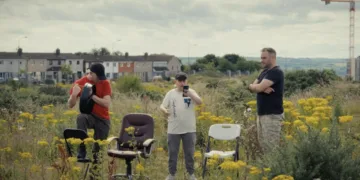






Rosa Friedrich takes her friend Timo’s wish to make a sex film from Vienna to Berlin’s Venus Expo and on to an encounter with a professional performer in Budapest. Across those stops, the same proposed film acquires different meanings. Timo wants an experience of intimacy that can survive being recorded.
Friedrich wants to document his attempt, without sharing his enthusiasm for pornography. The people they consult already know sexual visibility as work. My Friend the Porn Star finds its richest material in these encounters, where the vocabulary of personal expression meets expectations that desire alone cannot satisfy.
At Venus, a performer describes the loss of privacy attached to appearing publicly in pornography. Friedrich conducts interviews with a penis-shaped microphone, a joke whose breeziness sits awkwardly beside that warning. Adrineh Simonian, a former opera singer turned porn producer, brings practical experience to the pair’s inquiries.
Their trip to Budapest ends with performer Donna declining to participate, though her reasons remain insufficiently established to explain on her behalf. What these encounters expose is Timo’s difficulty translating an intimate wish into a proposition another person can evaluate. His insistence on being in the moment leaves the prospective production without a clear concept.
The distance between Vienna’s aspiring collaborators and the professionals they approach is cultural without being a matter of national character. They differ over what a sexual image is for, what making one entails, and how much another person should contribute to someone’s self-discovery. Friedrich’s repeated expressions of discomfort with pornography make her an uneasy intermediary.
This gives her exchanges with Timo friction, but it also limits the inquiry when she returns to asking people about their willingness to have sex on camera. Numerical rankings of sex and intimacy promise clarity by reducing experiences to comparable answers. The more useful distinctions emerge when people describe the conditions under which they would participate.
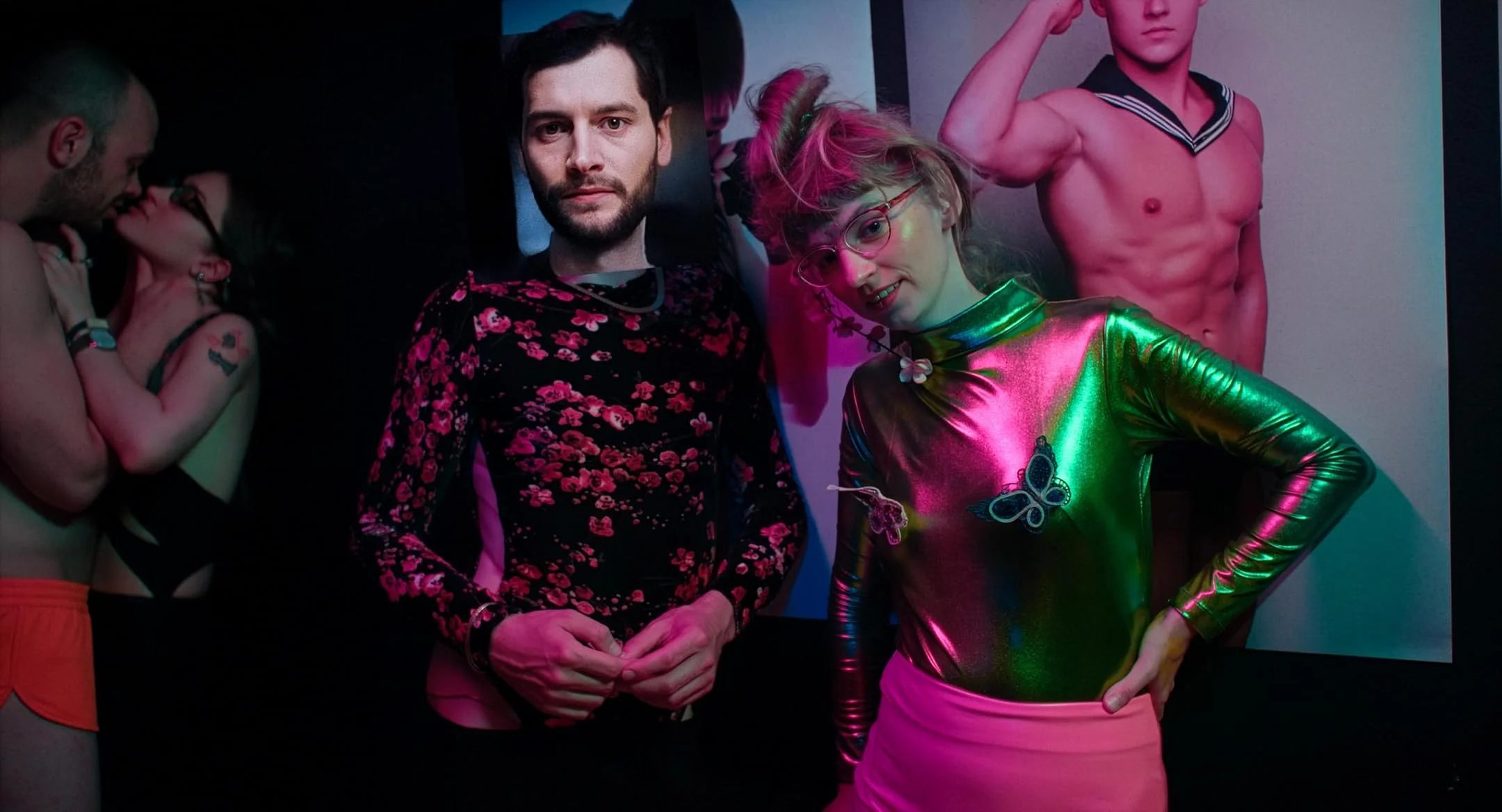
Timo eventually withdraws, and the film’s handling of his absence makes the performer’s warning about privacy newly pertinent. An early studio sequence introduces Aaron, an actor coached through facial expressions against a green screen. His face is then digitally attached to Timo’s body in the existing footage.
The effect remains conspicuous: a hazy rectangular patch refuses to settle into the surrounding image. Documentary familiarity becomes difficult to sustain when the person speaking has visibly acquired another face. The device keeps the broken collaboration present in the film’s texture, interrupting any comfortable impression that Friedrich has simply recorded events and passed them along.
Yet the substitution leaves a peculiar division of visibility. Timo’s face disappears while his naked body remains available to the camera and his conduct remains subject to Friedrich’s arrangement. The precise terms governing that retained footage are unclear, so the image cannot support a confident accusation about consent. It does, however, complicate the film’s account of self-expression.
A participant may cease collaborating while continuing to furnish material for someone else’s work. The visibly artificial face acknowledges intervention, but acknowledgment does not settle who controls the meaning of the person underneath it. Timo’s failed production survives inside Friedrich’s completed one.
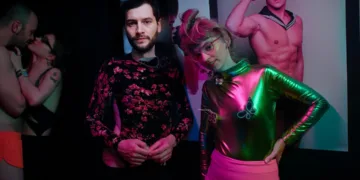
Intercut with this material are seven erotic shorts made with people Friedrich encounters through the project. Here, the film begins finding forms adequate to different desires. Three trans women in a polyamorous relationship cuddle; shadowed kissing places emphasis on contact; Alice Eric BigClit, a non-binary food-porn creator, appears in a bathtub with fruit and whipped cream arranged over their body.
These images offer different answers to the production problem Timo cannot resolve. Desire becomes something participants can give a shape, a duration, and a particular arrangement of bodies or objects. Their differences register through choices that a numerical scale could scarcely accommodate.
Friedrich’s invitation to these collaborators produces some of the film’s most engaging material, though the juxtaposition with Timo carries a simplifying pressure. His uncertain explanations and stalled ambitions repeatedly meet other participants’ apparent creative ease. The arrangement risks making one man’s difficulties stand for a constricted sexuality while the collective inherits openness and invention.
Those are judgments about how footage has been placed together, not truths established by the contributors’ identities. The shorts are valuable because they permit specific people to articulate specific pleasures. Treating them as evidence of an enlightened community would flatten the differences that make them worth watching.
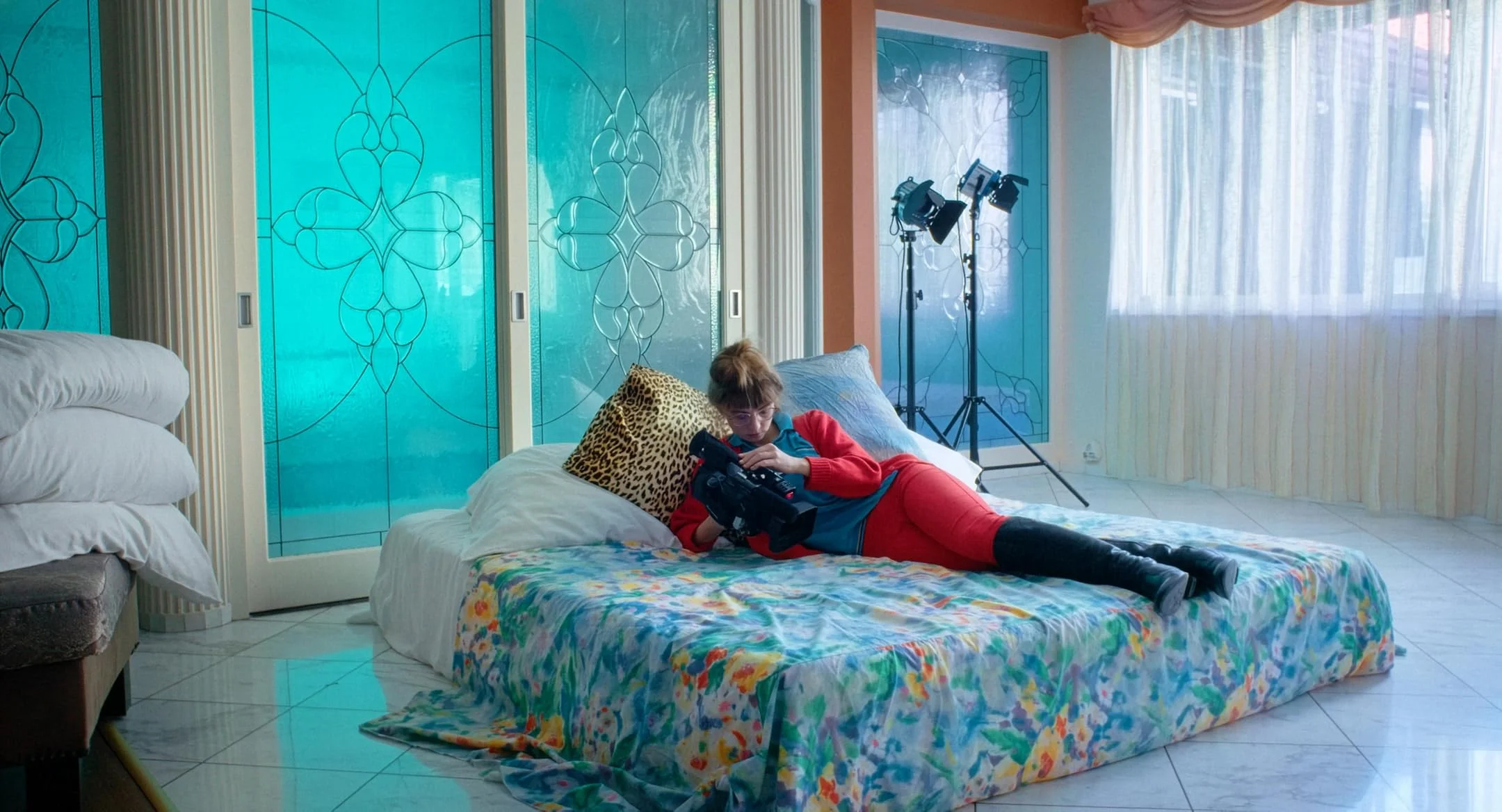
Laura Ettel’s playful camera angles, the pink-heavy grading, childlike typography, and upbeat music place these experiments within an insistently friendly visual world. This presentation gives unfamiliar practices room to appear without an atmosphere of threat or shame. It also sometimes decides the mood too eagerly.
Friedrich taking a bite from a large sausage supplies an anatomical joke whose obviousness exhausts it almost immediately. Suggestively presented fruit can have the same effect. Alice’s bathtub performance deserves a different reading: there, food belongs to a participant’s chosen erotic image. Repeated elsewhere as shorthand, fruit allows the filmmaking to avoid the specificity that the collaborative shorts achieve.
The film’s cheerful register is recognizable as the language of a particular creative milieu moving between Vienna, Berlin, adult-entertainment events, and erotic-film screenings. Its intimacy with that circuit is an asset when it lets people explain pleasures routinely reduced to labels. It becomes restrictive when recurring questions and buoyant presentation make their differences feel readily reconciled.
Explicit sexual activity would not automatically deepen the inquiry. The cuddling and shadowed kisses already demonstrate how erotic meaning can inhabit comparatively restrained images. What feels missing in the weaker conversations is sustained attention to disagreement, including Friedrich’s own reluctance and the practical demands encountered outside her immediate circle.
At the screening of the completed shorts, Friedrich holds on the participants’ faces as they watch themselves. After so much discussion of exposure, the camera records a concrete experience of receiving one’s own image in public. Their pleasure gives the collaborative process an observable consequence.
The commercial fair’s warning about surrendered privacy and Timo’s conspicuously substituted face remain part of the same film, but this audience has a different relationship to what appears on screen. For a while, Friedrich lets that relationship occupy the shot, without asking anyone to rank it.
My Friend the Porn Star premiered at the Karlovy Vary International Film Festival on July 7, 2026, before screening on the international festival circuit and releasing on MUBI. Directed and written by Austrian filmmaker Rosa Friedrich, this hybrid documentary-comedy centers on a director who agrees to help her friend film an artistic erotic movie starring himself, only to take creative control alongside an eclectic crew after he backs out shortly before production.
Full Credits
Title: My Friend the Porn Star (German: Mein Freund der Pornostar)
Distributor: ostblok KG, MUBI
Release date: July 7, 2026 (Karlovy Vary International Film Festival)
Running time: 1 hour 34 minutes (94 minutes)
Director: Rosa Friedrich
Writers: Rosa Friedrich
Producers and Executive Producers: Dominic Spitaler
Cast: Rosa Friedrich, Hanna Teglasy, Jane Kosto, Timo, Dominic Spitaler
Director of Photography (Cinematographer): Bernadette Maria Leitner
The Review
My Friend the Porn Star
Friedrich’s encounters across Vienna, Berlin, and Budapest reveal the distance between sexual self-expression and the practical demands of making an image with other people. The conspicuous face replacement keeps control and privacy unsettled, while the collaborative shorts give individual desires tangible form. Simplified interviews and insistent cuteness soften those discoveries, but the participants watching their own films provide a persuasive glimpse of what this uneven experiment achieves.
PROS
- Cultural encounters expose differing expectations of sexual filmmaking.
- Visible face substitution complicates documentary identity.
- Participant-made shorts give distinct pleasures expressive space.
- Screening reactions make collaboration’s rewards tangible.
CONS
- Numerical interview questions flatten complex experiences.
- Timo’s difficulties become an overly convenient foil.
- Broad anatomical jokes simplify the material.