






















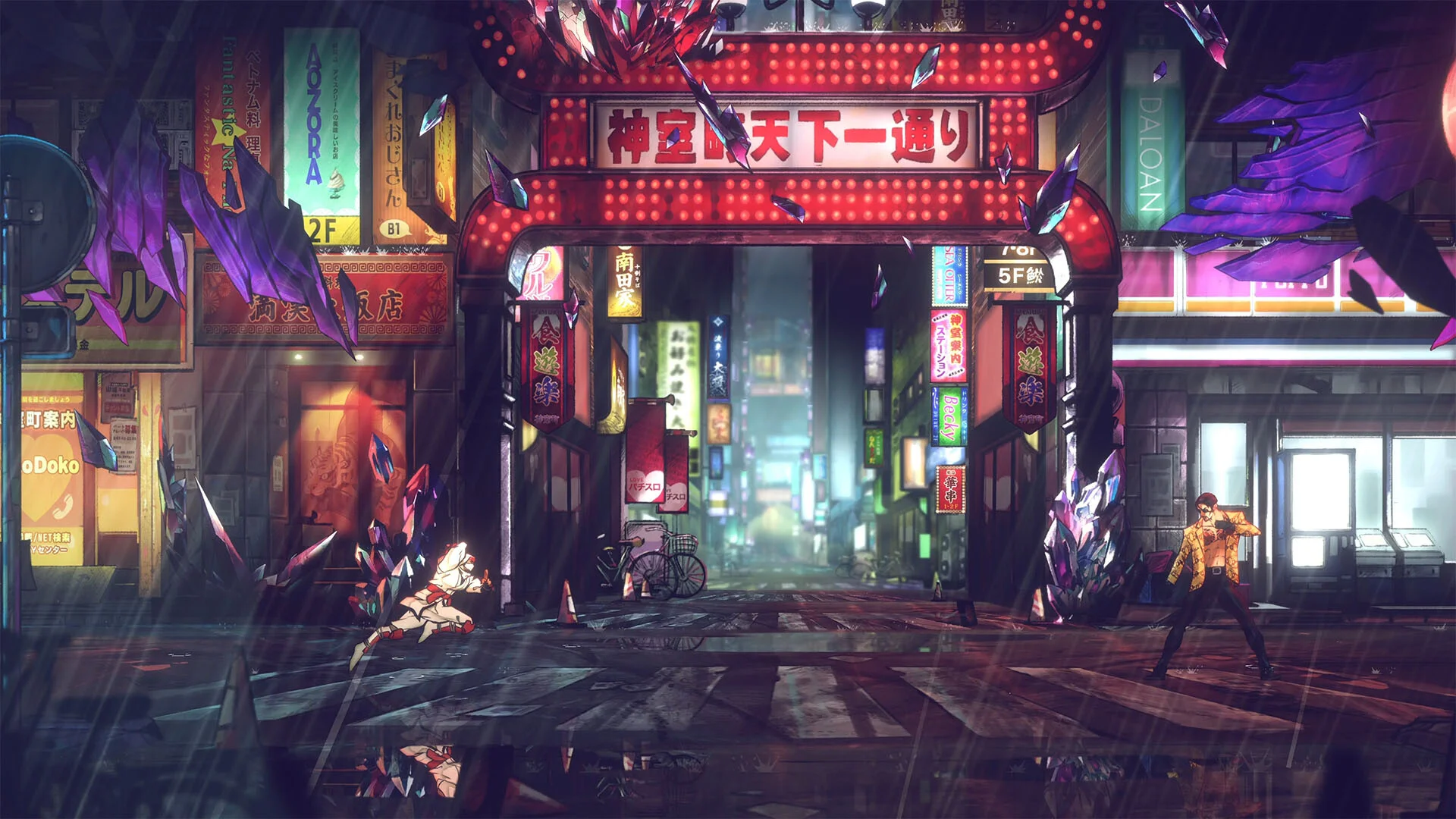

Joe Musashi’s sword does some of its most useful work in the Yakuza-themed stages before Goro Majima ever appears. Striking floating crystals creates temporary platforms, giving an attack familiar from Art of Vengeance a second job. Combined with Joe’s gliding and hookshot, these platforms turn a crossing into a sequence of actions rather than a straightforward jump. The interaction carries into combat, where activating a platform can provide access to an otherwise unreachable enemy. Returning players already know the individual tools; the adjustment comes from fitting them together while their footing is temporary.
The surrounding encounters make a similar demand through tighter spaces. Enemy waves share arenas with pits and environmental hazards, so movement remains important even when the immediate task is clearing opponents. Compared with the main campaign, the emphasis shifts toward concentrated tests of an established repertoire. There are fewer alternate paths and secrets to draw Joe away from the direct route, and the reduced exploratory variety is noticeable. The crystal platforms give the stages a useful local variation, but the expansion offers less of the discovery that helped the base game sustain its length.
SHINOBI: Art of Vengeance’s SEGA Villains DLC distributes that challenge across five stages: two associated with Golden Axe, two with Yakuza/Like a Dragon, and a Sonic encounter built around Dr. Eggman. Interdimensional portals supply the connection, bringing Joe into contact with Death Adder, Majima, and Eggman without requiring a substantial continuation of his revenge story. That modest narrative framework suits the encounter-led structure. The crossover becomes worth examining through how these visitors fight and how their worlds accommodate Shinobi’s mechanics.
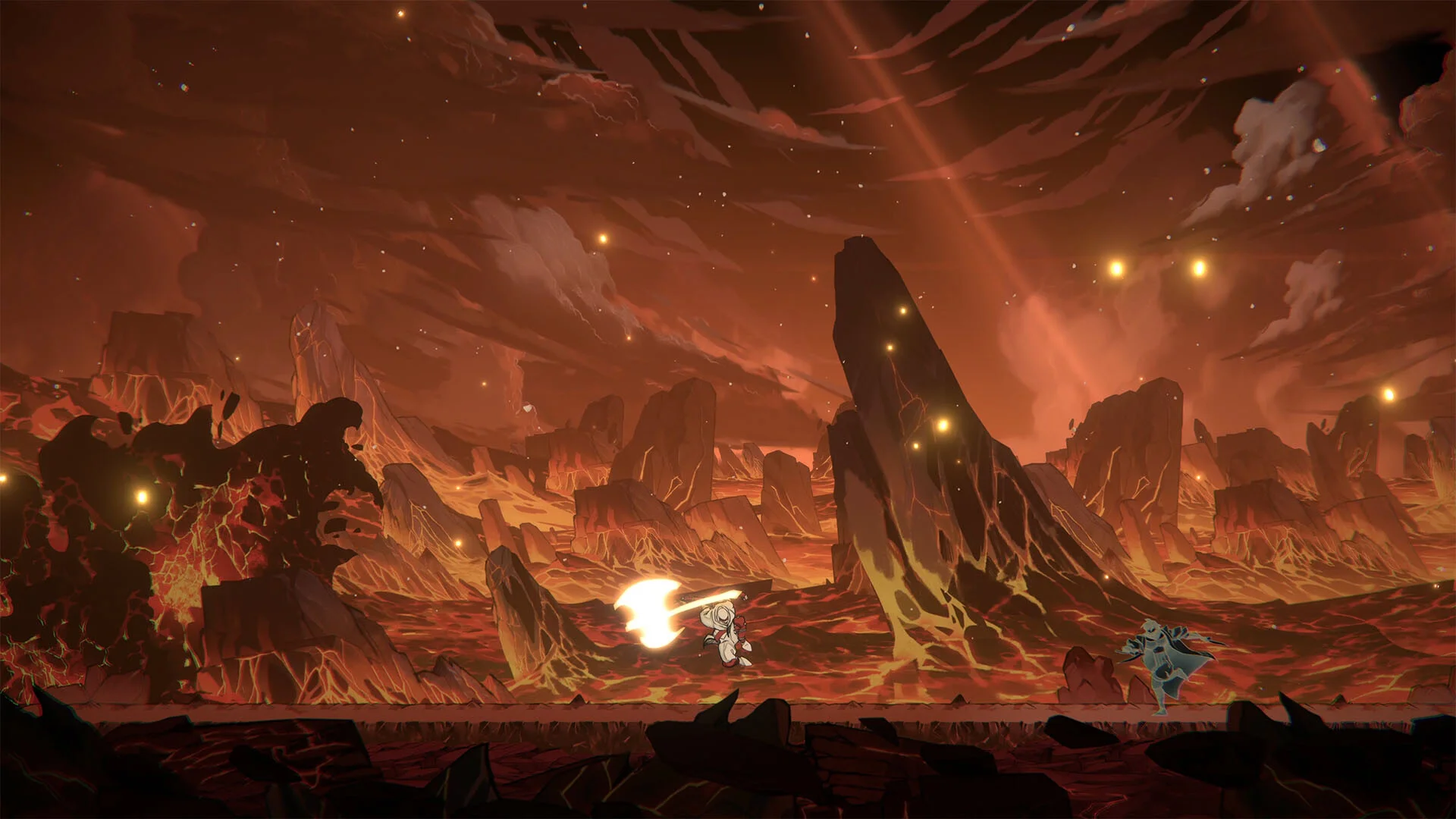
The environments establish their origins clearly, though the connection is stronger in some places than others. Golden Axe’s giant turtle and Death Adder’s throne offer recognizable details within Lizardcube’s hand-drawn scenery. The Yakuza approach is stranger than a straightforward recreation of a city district: signs and references occupy a floating crystal environment before the neon streets of Majima’s arena bring the setting into sharper focus. Familiar regular enemies weaken the impression of entering completely separate worlds. There is enough visual identity to distinguish the destinations, but their inhabitants and stage structures often keep Joe close to the main game’s established experience.
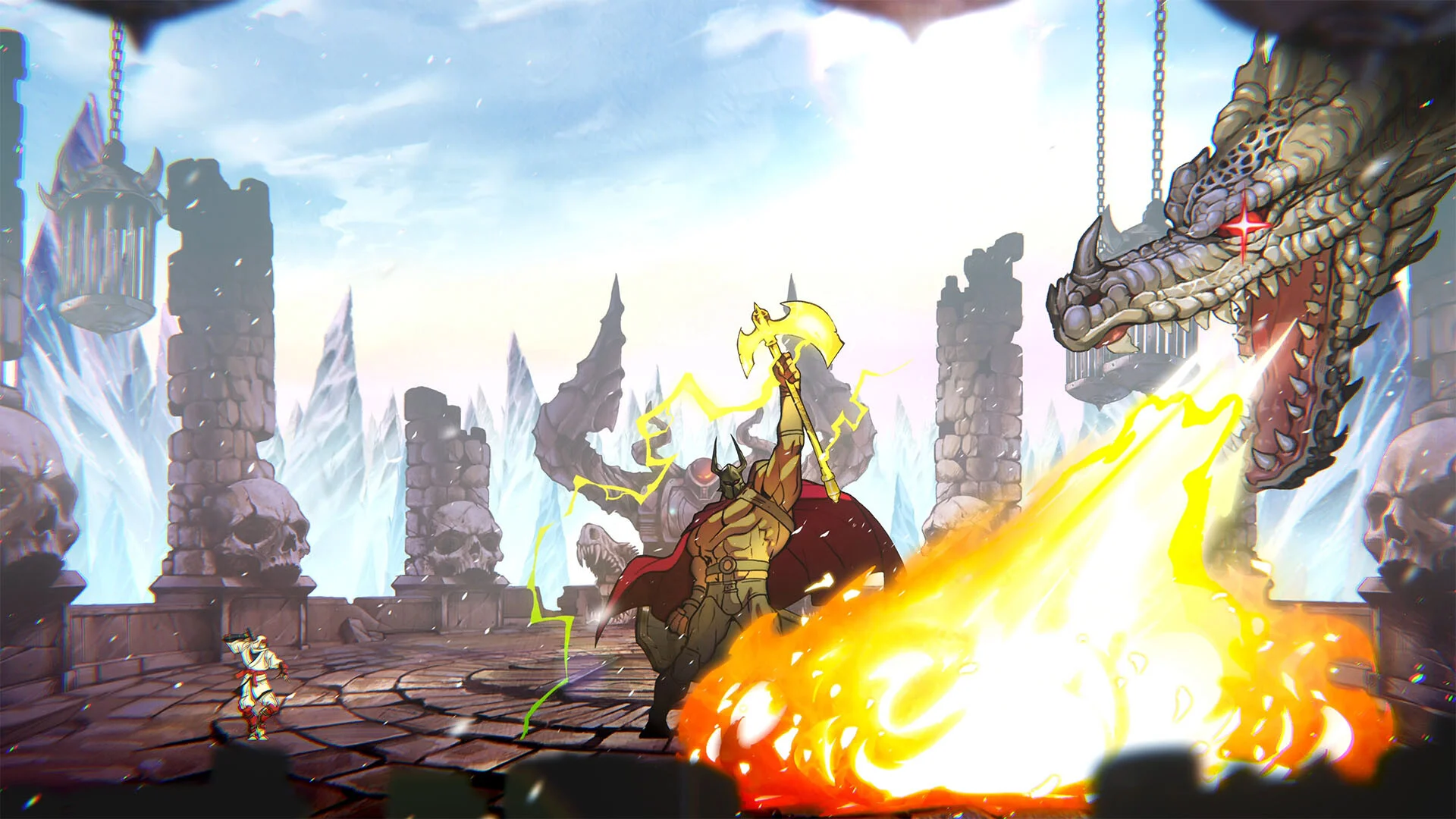
Death Adder gives the Golden Axe material a firmer mechanical identity. His imposing size and axe attacks make the encounter revolve around reading a powerful opponent’s commitments. Clear tells allow the player to anticipate a strike, but recognizing the animation and executing the dodge are separate tasks.
His second phase brings fire into the confrontation, increasing the pressure on that timing. The available Ninpo and other attacks matter because successful evasion creates opportunities to answer him. The fight preserves his physical presence while making Joe’s mobility the practical means of dealing with it.
Majima changes the scale of the confrontation. He and Joe stand at comparable height, making the fight resemble a duel rather than an encounter with a towering obstruction. Throwing knives extend his reach, while doubles complicate the task of tracking the principal opponent.
These attacks give his identity a place in the player’s decisions: avoiding one threat cannot mean losing sight of the others. The neon arena and energetic music reinforce the association with Yakuza/Like a Dragon, but the knives and clones do the essential adaptation work. A relatively manageable fight can still be a distinctive one, and Majima’s smaller scale provides a welcome change from Death Adder’s force.
Eggman receives the most elaborate transformation. The first phase puts him in his Egg Mobile against a Green Hill backdrop, retaining the recognizable pairing of scientist, machine, and Sonic scenery. The encounter then moves to Chemical Plant, where a ninja-themed robot makes the crossover more specific to Joe’s world.
It is a substantial escalation, demanding careful dodging alongside effective kunai use and management of Ninpo and Ninja Magic. Death Adder tests responses to forceful attacks, and Majima complicates a duel with additional threats; Eggman pushes Joe through a two-part encounter whose later pressure makes the whole arsenal relevant.
That fight also exposes the uneven allocation of the guest worlds. Golden Axe and Yakuza receive traversal approaches that build toward their villains, while Sonic contributes the boss encounter without a comparable stretch of platforming. Seeing Green Hill and Chemical Plant redrawn in Lizardcube’s style makes that absence particularly noticeable.
These environments suggest possibilities for Joe’s aerial movement, yet there is little opportunity to explore them. The criticism concerns the limited use of the locations, rather than any need to reproduce Sonic’s speed or bring in the hedgehog himself. Eggman works convincingly as a Shinobi opponent; his world gets a much smaller role.
The rewards encourage another pass through these encounters. Villain-inspired costumes extend the visual crossover, while new Ninpo include an axe throw, clone summoning, and a destructive bomb. They add options to an existing combat system rather than replacing its foundations.
A first completion occupies roughly a few hours, with retries making the duration highly dependent on familiarity and execution. Hardcore difficulty and the accompanying settings improvements belong to a separate free update, so they should not inflate the paid expansion’s value. Access to tutorials through Settings is useful for restoring forgotten controls before taking on these demands.
Boss Rush gives the new encounters a different relationship to one another. With a shared health bar across the DLC gauntlet, defeating a boss is only part of the task; the condition Joe leaves that fight in matters for the next one. Compared with replaying the main campaign for missed routes and secrets, this is a narrower reason to return, built around improving known performances. The additional Ninpo provide tools to experiment with, but the accumulated cost of mistakes keeps that experimentation under pressure. A victory scraped out against one opponent can leave very little room for error against the next.
The Review
SHINOBI Art of Vengeance - SEGA Villains DLC
SEGA Villains trades some of Art of Vengeance’s exploratory variety for concentrated combat challenges. Death Adder, Majima, and Eggman retain recognizable identities while demanding different uses of Joe’s established abilities, and the temporary crystal platforms give familiar traversal a useful variation. The surrounding worlds receive uneven treatment, particularly Sonic’s abbreviated contribution. Returning players seeking demanding encounters and repeat mastery have good reason to revisit Joe, though the expansion offers less discovery than the main campaign.
PROS
- Distinctive bosses that adapt each villain’s fighting identity.
- Crystal platforms connect traversal and combat.
- Hand-drawn settings and music reinforce franchise recognition.
- New Ninpo and Boss Rush encourage repeat play.
CONS
- Fewer alternate routes and secrets than the main campaign.
- Sonic locations receive little traversal development.
- Familiar regular enemies weaken the guest worlds’ identities.