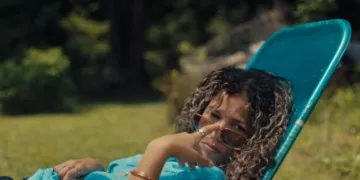










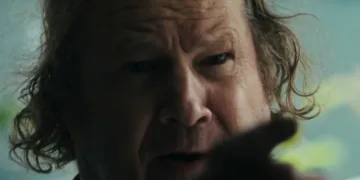









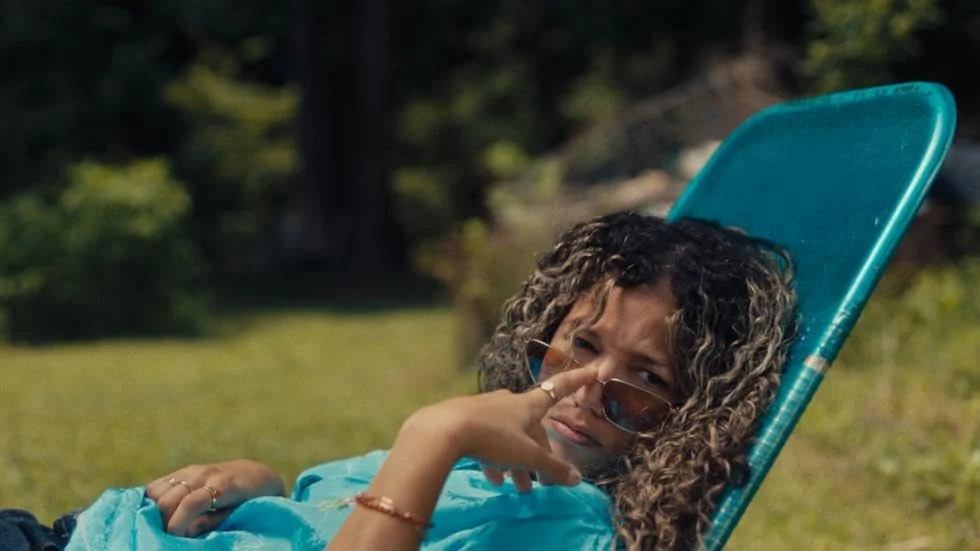

Watching Bird study an advertisement for her father’s band, you start wanting something the video cannot possibly give her. Bower can be considered as wedding entertainment, a musician available for a booking. As the father she has never known, he is considerably harder to approach. Alisha Wainwright lets anticipation, embarrassment, and frustration crowd into this encounter with a screen. Bird has found a practical excuse to make contact, but the distance between arranging a performance and asking to be recognized feels enormous.
The wedding gives her a task to hide inside. She can discuss venues and musicians without announcing how badly she needs answers about herself. Melody C. Roscher’s Bird in Hand unsettles that apparent practicality from its opening minutes. A bloodied bridal gown turns out to be a Halloween costume; a wedding video belongs to someone else. Each correction makes the prospect of marriage feel less solid. Bird keeps encountering the outward forms of a settled life while struggling to imagine herself securely occupying one.
Her actual engagement hardly provides firmer ground. After a children’s Halloween party, she vomits in a bathroom while her boyfriend Frank, dressed as John Lennon, proposes with remarkably little ceremony. The incongruity is funny, but it also makes the offer difficult to read emotionally. A proposal should clarify what two people want from each other. Here it enters an already uncomfortable exchange, leaving Bird with another expectation to interpret. Roscher uses the gap between the occasion and its delivery to make a familiar romantic milestone feel faintly alien.
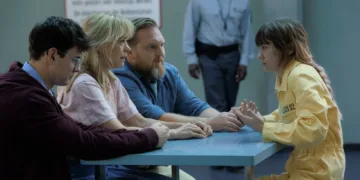
Bird leaves Brooklyn for her mother’s home in rural Virginia, ostensibly to plan the wedding. The welcome is immediately discouraging: Carlotta is away and will not drive three hours back to provide a key. Before this biracial daughter can investigate the history her white mother has withheld, she has to solve the basic problem of getting inside. It is a useful, painfully ordinary obstacle. The visit carries all the emotional weight of returning to a parent, while Carlotta treats it as a logistical inconvenience. You can understand the impracticality of the drive and still feel the sting of being left to manage.
Christine Lahti gives Carlotta’s resistance a sharp comic energy without making her entirely unreadable. Her dismissiveness about marriage emerges from unconventional beliefs and a painful account of Bower leaving during her pregnancy, but explanation offers Bird little comfort.
Lahti’s caustic manner and occasional, guarded sincerity keep changing what a response from this mother might mean. Wainwright makes those changes matter. The longing visible during the band advertisement remains present when Bird becomes difficult with Carlotta, so irritation with her behavior never quite displaces concern for what she is trying to obtain.
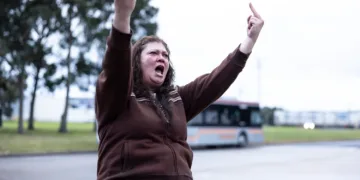
Their confrontation becomes especially uncomfortable when Bird tells her mother to “stop being comfortable.” She wants Carlotta’s composure to crack, partly because that composure makes her own distress feel solitary. Yet an emotional reaction cannot guarantee the reassurance she seeks.
Roscher allows that contradiction to remain active between them. Bird wants her mother to absorb the force of her anger and answer as a mother, even while she conceals the real purpose of the visit and searches the house for clues about Bower. The secrecy makes her understandable and frustrating at once. We have access to the need behind it; Carlotta has to deal with the behavior.
The neighboring plantation property changes the quality of that discomfort. Dennis and Leigh, played by James Le Gros and Annabelle Dexter-Jones, are white owners renovating the estate and “updating the narrative.” Their hospitality comes with an interest in appearances that becomes brutally clear when Bird is asked to pose for photographs in front of the plantation.
The request makes her presence useful to their preferred account of the place. A seemingly friendly invitation becomes an experience of being assigned a role. Le Gros’s uneasy friendliness helps explain how Bird can find companionship with Dennis without making the encounter feel safe.
This material carries a sharper threat than the family’s evasions, and the film is strongest when it lets that difference register. Carlotta possesses information Bird wants; the plantation owners want Bird’s image to help manage information about their property. Those pressures meet in her experience without becoming interchangeable.
The photograph request gives the satire a concrete emotional consequence, making the welcome feel conditional. The larger business of rehabilitating the plantation’s history receives less development, though. The rebranding language exposes the owners quickly, but the film moves through implications that could sustain a longer examination. Its account of Bird’s relationship with her mother has greater room for conflicting motives than this social satire does.
Roscher’s increasingly outrageous comedy creates a similar tension between immediate effect and sustained attention. Carlotta’s near-theft of a horse pushes the film toward farce, where the pleasure comes from watching someone behave beyond the limits of ordinary embarrassment. Those excursions occasionally pull us away from the uncertainty Wainwright has made so absorbing.
They also prevent the family conflict from settling into a predictable sequence of disclosures and reconciliations. Bird’s search becomes less orderly as her coping strategies fail, and the loosened storytelling makes that loss of control felt. The harder adjustment is emotional: laughing at Carlotta’s extravagance does not necessarily bring us closer to understanding her, while Bird still needs a response from the same woman who has just entertained us.
Bird in Hand was released theatrically in the United States on October 2, 2026, following its festival run. The comedy-drama follows a woman who returns home to visit her mother under the guise of finding a wedding venue, only to secretly search for something entirely unexpected.
Where to Watch Bird in Hand (2026) Online
Full Credits
Title: Bird in Hand
Distributor: The Future of Film Is Female, Persimmon
Release date: October 2, 2026 (United States)
Running time: 1 hour 27 minutes (87 minutes)
Director: Melody C. Roscher
Writers: Melody C. Roscher
Producers and Executive Producers: Craig Shilowich, Alex Schepsman, Danielle Massie, Cody Ryder, Sam Bisbee, Saba Zerehi
Cast: Alisha Wainwright, Christine Lahti, James Le Gros, Annabelle Dexter-Jones, Jeffrey Nordling, K. Todd Freeman
The Review
Bird in Hand
Bird in Hand makes you care about Bird without asking you to excuse her. Alisha Wainwright keeps her hunger for recognition palpable, while Christine Lahti makes maternal reassurance feel painfully uncertain. Roscher’s misleading wedding imagery and uncomfortable encounters turn that uncertainty into an experience we share. The plantation satire needs room to develop, and the broader comedy occasionally loosens our attachment, but the mother-daughter exchanges make this small, unruly film worth seeking out.
PROS
- Wainwright preserves sympathy through Bird’s difficult behavior.
- Lahti gives Carlotta’s detachment emotional complexity.
- Wedding misdirection makes commitment feel uncertain.
- The plantation photograph request turns hospitality into discomfort.
CONS
- Plantation satire receives limited development.
- Broader comic excursions sometimes weaken emotional proximity.