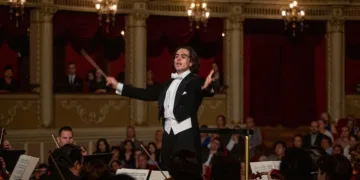


























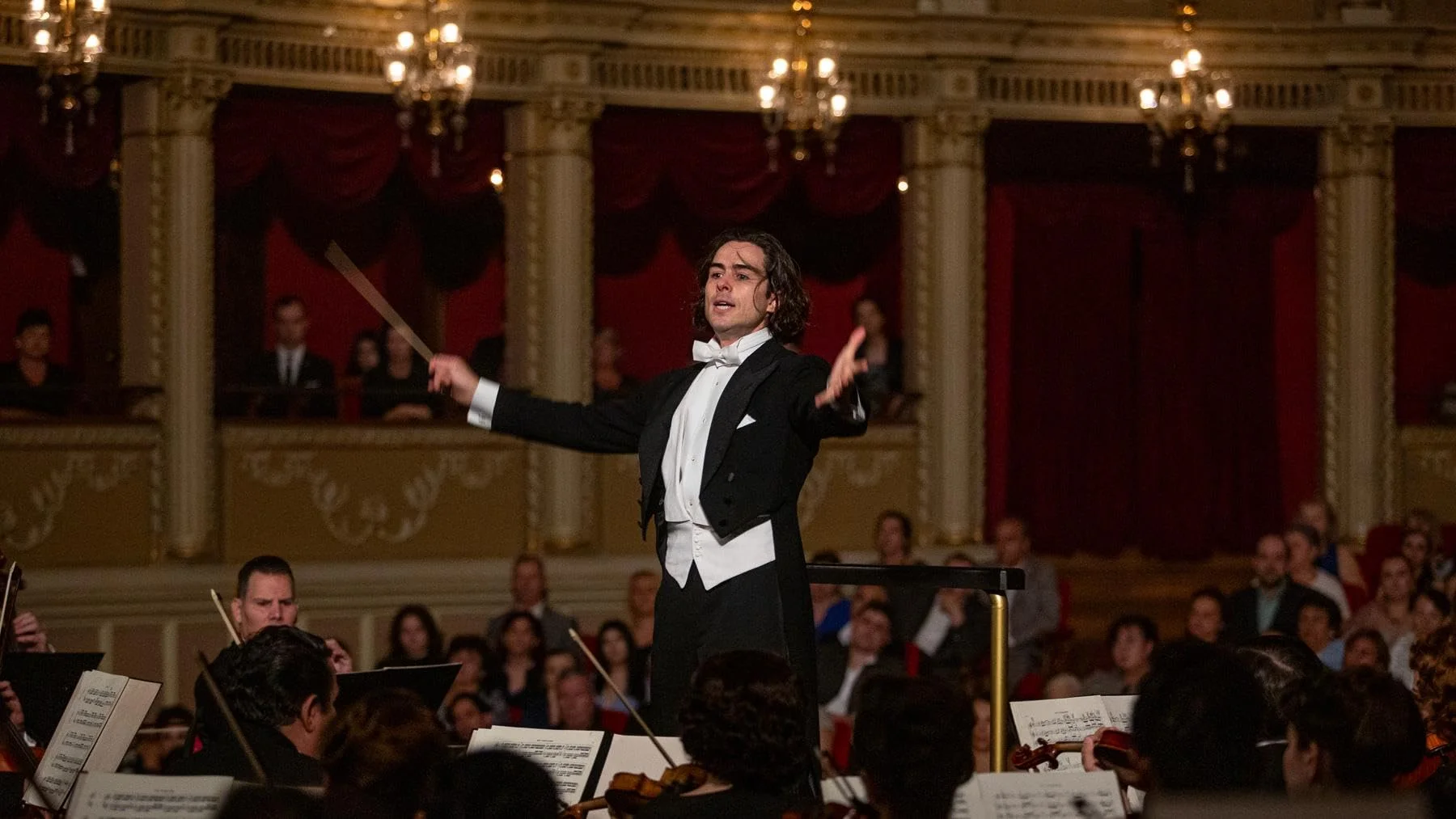

Ben Schnetzer’s explanation of how Stravinsky should be performed gives musical conviction a human shape. Playing the younger Sergiu Celibidache, he makes the act of interpretation feel like an effort to bring another person within reach of something he hears.
The authority comes from his absorption in the music. For a passage, the Romanian conductor ceases to be a distinguished name awaiting its biographical milestones, and becomes someone trying to communicate an experience that language can approach only imperfectly. The Yellow Tie finds an intimacy here that its long account of achievement cannot always sustain.
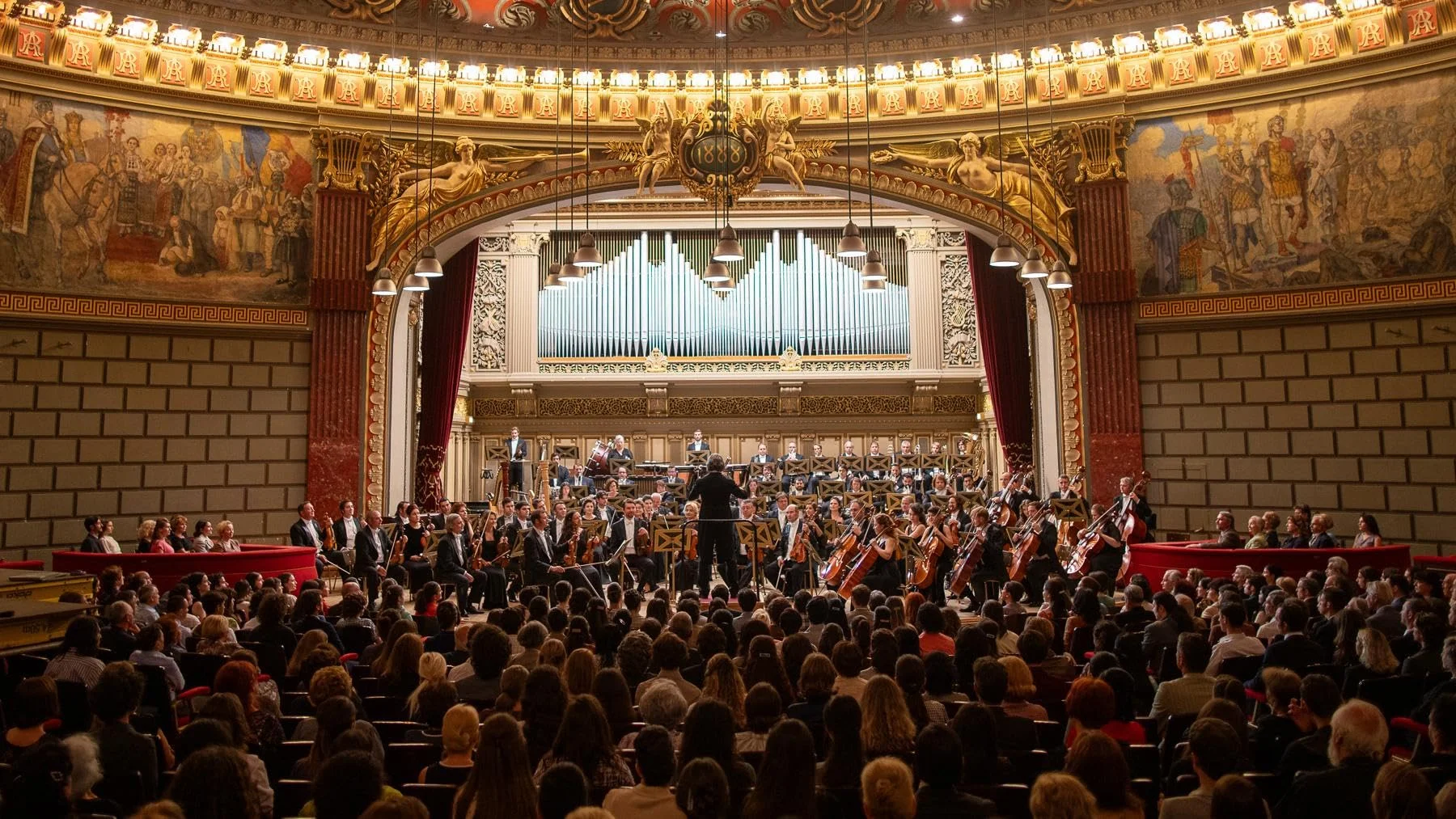
That intimacy expands during the concert sequences. Peter Menzies Jr.’s camera moves around the performances, while the orchestral sound gives the images a sense of inhabited space; the concert halls, including Bucharest’s Sala Palatului, become places in which attention gathers.
Their beauty has a dramatic purpose. We are brought close enough to understand why Celibidache might regard a performance as inseparable from the people and circumstances surrounding it. The film’s reconstruction cannot place us at the original event, but its movement and sound make the desire to have been there palpable.
Celibidache’s rejection of commercial recordings, informed by his study of Zen Buddhism, grows from this insistence upon presence. Music happens, and then the conditions that made it happen disappear. The film is persuasive when it lets performance give that belief substance.
It becomes less searching when conviction itself appears to supply the answer. An experience can lose something through reproduction without becoming worthless to the person hearing it afterward. The concert passages allow us to feel the conductor’s attachment to the unrepeatable; they offer little reason to dismiss every other kind of listening. His severity protects an encounter while restricting access to it.
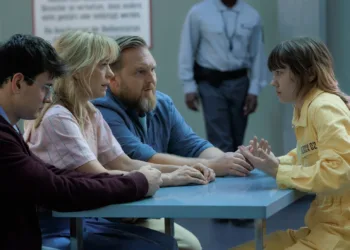
The yellow tie brings a different kind of exclusion into view. Celibidache’s father, played by Sean Bean, expects his son to enter public life, continuing a family tradition that leaves little room for a musical vocation. When the son resists, the father demands the return of his birthday gift, a tie of the kind worn by generations of the family’s men. The object becomes painful through that withdrawal. What had appeared to be a gift is revealed as conditional, something the son may possess only while becoming the man his father has already imagined. Musical ambition costs him a visible token of belonging.
The wound matters because independence cannot make the wish for acceptance disappear. Celibidache can choose music; he cannot choose to become someone who never needed his father’s approval. Schnetzer’s credibility in the conducting passages gives that choice weight, keeping it from becoming a merely dutiful episode in the manufacture of greatness.
We can sense what the young man is choosing before professional success arrives to vindicate him. The tie dispute leaves a more difficult question behind: how much can public recognition repair when the recognition desired came from one particular person? The film’s career narrative repeatedly approaches an answer that its family material makes uncertain.
John Malkovich’s older Celibidache carries conviction into a harsher register. In the opening encounter with Japanese executives offering a recording deal, his anger makes the principle unmistakable, but the performance gives us little room to discover it. The scene arrives at full volume, with the conductor’s contempt already established.
Malkovich makes resistance imposing; he also makes it familiar, drawing the man toward the recognizable silhouette of an imperious genius. Beside Schnetzer’s explanation of Stravinsky, the limitation becomes clear. One passage brings us into a musical understanding. The other confronts us with a position whose force must stand in for its complexity.
Directed by Celibidache’s son, Serge Ioan Celebidachi, who wrote the screenplay with James Olivier, the film has an intimate reason to remain attached to this difficult man. Its authorship gives the withdrawn paternal gift an additional poignancy: a son is preserving the life of a father whose own need for paternal acceptance remained so charged.
That relationship does not establish the film’s emotional meaning by itself. Still, the combination of affectionate concert reconstruction and the older conductor’s combative entrance leaves the portrait pulled between closeness and deference. It admits abrasiveness, yet does less to investigate the distance that such abrasiveness might create between people.
Across approximately 145 minutes, the account moves from interwar Romania through wartime hardship in Germany, Celibidache’s appointment to the Berlin Philharmonic in 1945, his removal, and his subsequent work across Europe and Latin America. The breadth gives his life a sense of displacement, but it also places the most intimate material inside a familiar progression toward professional distinction.
Hardship precedes recognition; renewed resistance maintains the identity of the exceptional artist. The stately accumulation sometimes dulls the film’s attention. The tie dispute and the musical explanation have pressures that can be felt within an encounter, while the succession of places and appointments asks duration to supply emotional depth.
The concert filmmaking leaves a question that the biographical progression cannot settle. These are reconstructed performances, preserved through cinema, made available to viewers who could never have stood in the rooms Celibidache valued so fiercely. Their mediated nature does not prevent them from awakening an appetite for the live experience.
For someone encountering this music at a distance, the film may provide the beginning of an attachment that the conductor’s insistence on physical presence would have denied them. Watching the camera move among the players, it becomes difficult to determine how much of the encounter has been lost, and how much has become possible only because someone chose to preserve its imperfect likeness.
The Yellow Tie premiered in Bucharest in November 2025 before expanding to streaming via Netflix and theatrical markets. The biographical drama traces the extraordinary life and musical journey of renowned Romanian conductor Sergiu Celibidache as he overcomes exile, wartime struggles, and immense personal hardship.
Where to Watch The Yellow Tie (2025) Online
Full Credits
Title: The Yellow Tie
Distributor: Netflix, Icon
Release date: November 14, 2025 (Bucharest) / June 10, 2026 (Netflix) / October 9, 2026 (UK Cinemas)
Rating: 15
Running time: 2 hours 25 minutes (145 minutes)
Director: Serge Ioan Celebidachi
Writers: Serge Ioan Celebidachi, James Olivier
Producers and Executive Producers: Andrei Boncea, Adela Vrinceanu Celebidachi, Cristina Dobritoiu
Cast: Ben Schnetzer, John Malkovich, Ewan Horrocks, Sean Bean, Kate Phillips, Miranda Richardson, Charlie Rowe, Anton Lesser
Director of Photography (Cinematographer): Peter Menzies Jr.
Composer: Kathryn Kluge, Kim Allen Kluge
The Review
The Yellow Tie
The Yellow Tie makes musical devotion tangible through Schnetzer’s conducting and concert sequences that draw us into the performance. The withdrawn paternal gift exposes a wound professional acclaim may never repair. Yet the stately career narrative gives that emotional complexity insufficient space, while Malkovich’s anger sometimes hardens the older conductor into a familiar figure of imperious genius. The film listens closely to his music, less searchingly to the distances his convictions create.
PROS
- Schnetzer makes musical understanding dramatically persuasive.
- Immersive concert sound and moving camerawork.
- The tie dispute gives paternal rejection emotional specificity.
CONS
- Expansive career chronology sometimes dulls momentum.
- Malkovich’s opening confrontation narrows the older conductor’s complexity.
- Artistic purity receives limited scrutiny.