




























Narong and Pannee arrive at the hospital with different needs. He requires assessment for dementia; she requires treatment for the injury he has inflicted on her. Before attacking his wife, he believed she was Phii Pong, the feared spirit invoked around their village. Chayan Laoyodtrakool’s Thai Netflix series Delusion places a medical explanation beside a wounded person, leaving their daughter Wan to work out what recognizing one means for protecting the other.
I find myself wanting to defend Narong before the investigation has properly begun. An elderly man losing his grip on reality, surrounded by people willing to call him possessed, invites that response. Pannee’s injury interrupts it. Her husband’s vulnerability creates obligations toward him, but she cannot be asked to disappear inside our sympathy. The series is most unsettling when Wan’s love for her father has to accommodate knowledge that makes loving him practically difficult.
Wan receives the emergency call while attending a reception connected to Yote’s company. She takes their son Aim and leaves against Yote’s objections, carrying an existing conflict over money and their child into another family crisis. The departure makes care visible as an interruption: someone must abandon what she was doing because someone else cannot manage. Natapohn Phornprapha’s contained performance suits this accumulation of demands. Wan’s strain registers without turning every responsibility into an emotional announcement.
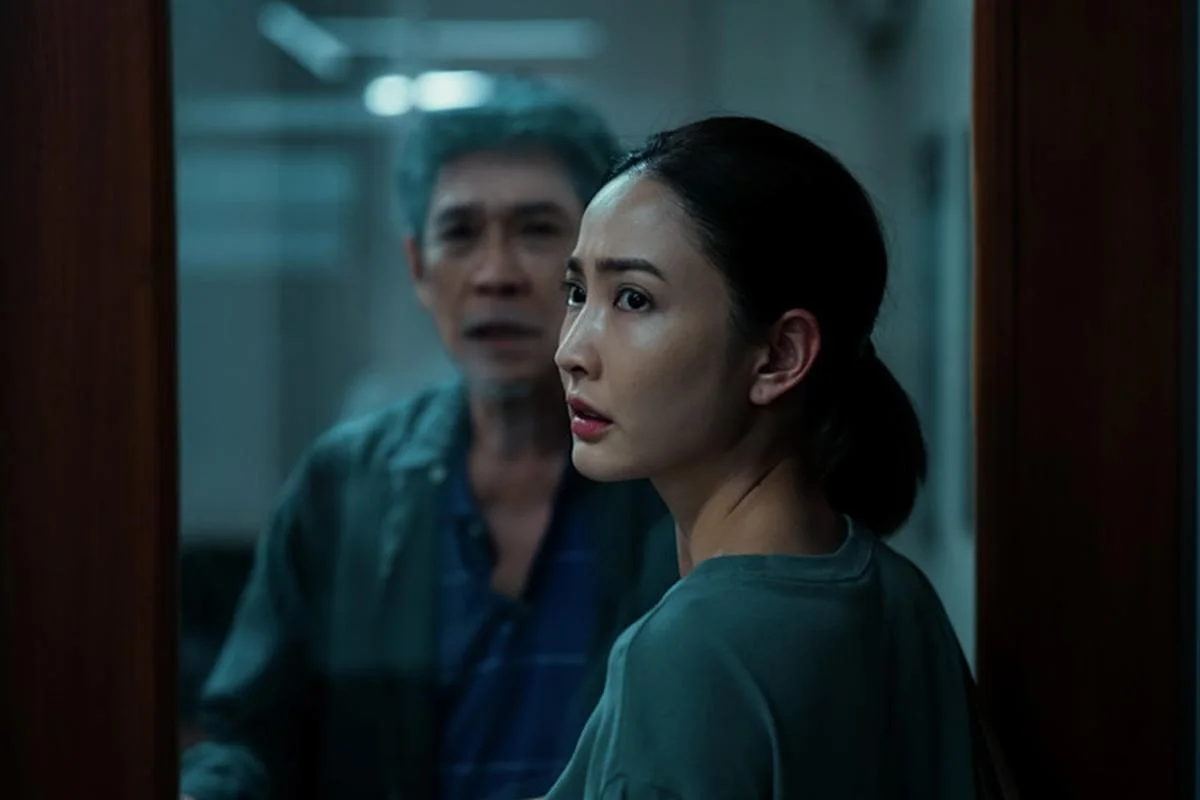
Her brother Wat offers a medical perspective and rejects possession, yet his work initially keeps him away. That separation matters. The person equipped to explain the condition is unavailable to help with its immediate consequences. Wan must translate knowledge into decisions while continuing to be a mother, daughter, and participant in an unhappy relationship. The reception and Wat’s absence establish the unequal distribution of that work without requiring a speech about it. Knowing what is happening does not settle who has to deal with it.
In Na Sao, the disappearance of a girl named Mued gives Narong’s behavior a second, increasingly threatening significance. Pete, a newly transferred police officer played by Jespipat Tilapornputt, investigates while villagers attach the case to Phii Pong. A man who frightens his family becomes a suspect in something larger. The gap between those propositions is where an investigation should operate. Fear makes crossing it feel remarkably easy.
Sak, the village shaman, promotes the possession account, and his position is complicated by his being Pannee’s brother. Supernatural authority enters the household through an existing relationship. Pannee herself finds possession plausible, while Wan and Wat reject it. These differences prevent the conflict from dividing neatly into an enlightened family and a credulous village. The family contains competing explanations before anyone outside it contributes an accusation.
Pannee’s belief also deserves some hesitation from the viewer. Possession might offer a way to imagine that the frightening figure in her house is temporarily separate from the husband she knows. The series does not establish that motive firmly enough to make it a diagnosis of her thinking. Still, her attachment to the explanation makes simple ridicule inadequate. People can cling to an account because it preserves something they fear losing. Its emotional usefulness supplies no evidence for its truth, but it helps explain why correcting someone may fail to reassure them.
Wan has her own investment in an answer. Defending Narong’s dignity and establishing his innocence are separate undertakings, and affection can obscure the distinction. Pete’s professional task gives the story another route through the evidence, free of Wan’s particular filial obligation. Their different purposes are productive. Sak’s certainty, meanwhile, threatens to settle the matter before either inquiry has finished (a considerable saving on detective work).
The camera complicates our position too. Aim searches for his grandfather in the nighttime woods, runs from someone, and drops his tablet. At the first episode’s close, Narong looks into its camera. A grandfather sought by his grandson becomes an alarming figure encountered through a screen. Darkness and restricted perspective leave us with an image whose force exceeds what it can prove.
That image made me suspicious of the series’ use of dementia as a source of menace. Then I had to account for Pannee again. The danger in the household is real, and a purely reassuring presentation would evade the family’s predicament. The tablet shot works because the person Aim wants to find can also frighten him. Delusion briefly makes our desire to protect Narong coexist with our desire to get away from him. Its forests, isolated homes, and point-of-view passages sustain that unstable relationship to what can be seen.
The difficulty is sustaining thought alongside suspense. The early material establishes the injury, diagnosis, disappearance, family pressures, and possession accusations with enough substance to support several difficult questions. Later stretches revisit suspicion without consistently changing our understanding of those obligations. Slow pacing can give a family drama room to register exhaustion or revise loyalties. Here, returning to the illness-or-possession problem too often keeps attention on the explanation still to come.
There is a defensible reason for delaying certainty in a story about unstable perception. Wan cannot immediately know everything about her father or her family, and the viewer should not enjoy effortless access to answers she lacks. Yet the concentration of explanation in the finale exposes the limits of that defense. Information arrives in a mass that earlier episodes might have used to develop consequences. Late nonlinear disclosure further unsettles an account after the mystery has already supplied an explanation, making the handling of knowledge feel increasingly governed by the next surprise.
The cost falls on the family material. Learning a secret can revise Wan’s understanding of someone; it cannot, by itself, show how she learns to live with that revision. The hospital has already established needs that require action rather than interpretation. As the series spends its remaining attention arranging disclosures, it leaves less space for the practical questions its opening made urgent: who can stay with Narong, what protection Pannee can rely on, and how much help Wan can ask from a brother whose expertise has not made him available.
Delusion premiered globally on Netflix on September 24, 2026. The Thai crime thriller series follows a small-town school teacher racing to uncover the truth when her father’s worsening dementia makes him a prime suspect in a murder case.
Where to Watch Delusion Online


Full Credits
Title: Delusion (also known as Phap Luang Tai)
Distributor: Netflix
Release date: September 24, 2026
Rating: TV-MA
Running time: 45 minutes per episode
Director: Chayan Laoyodtrakool
Writers: Chayan Laoyodtrakool, Kanokphan Ornrattanasakul, Pete Kasidej Sundararjun
Cast: Natapohn Tameeruks, Jespipat Tilapornputt, Vachiravit Paisarnkulwong, Surasak Chaiat, Sirani Yankittikan, Suttawat Settakorn, Boombim Samtone
Editors: Harin Paesongthai, Wachrakorn Thaweesab
The Review
Delusion
Delusion finds its strongest horror in the difficulty of protecting an ill father without overlooking the wife he has injured. Wan’s divided obligations and the tablet-camera encounter give that dilemma emotional and visual force. The mystery is less disciplined: repeated suspicions, concentrated exposition, and late nonlinear disclosure consume time the family’s changing relationships needed. Its questions about care deserve the sustained attention its secrets receive.
PROS
- Caregiving examined through conflicting obligations.
- Wan’s restrained performance grounds the family pressures.
- Possession beliefs complicate relationships within the household.
- The tablet-camera encounter tests sympathy through suspense.
CONS
- Repeated suspicions yield limited new understanding.
- Finale-heavy exposition leaves family consequences underdeveloped.
- - Late nonlinear disclosure adds uncertainty after an explanation arrives.