








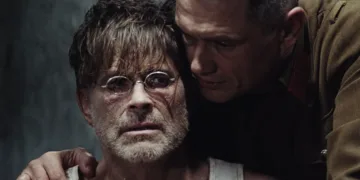

















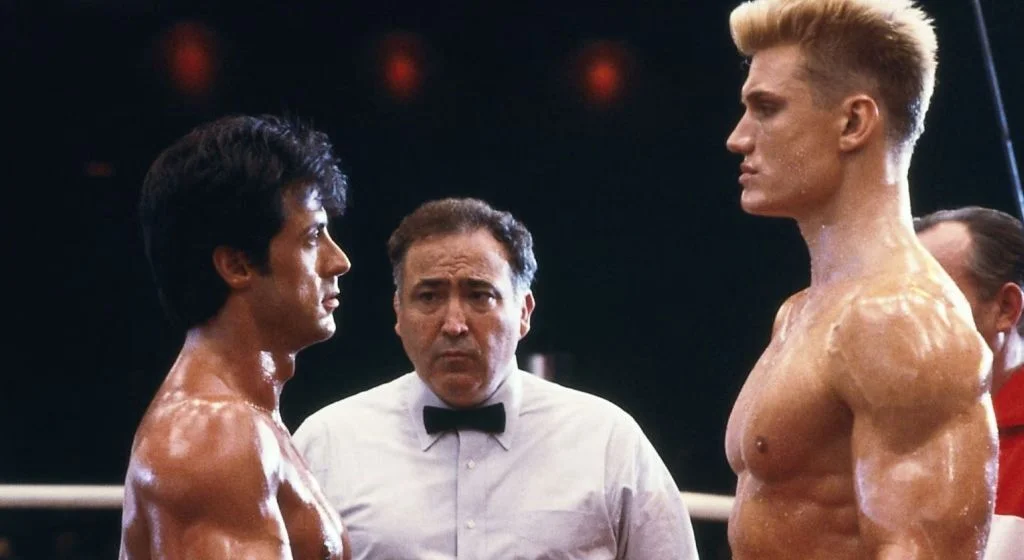

Dolph Lundgren wonders if his cancer might be punishment for his past mistakes. It is an uncomfortable admission, particularly from someone whose screen career has made physical power look like an answer to almost everything. In Andrew Holmes’ Dolph: Unbreakable, the actor acknowledges infidelity, substance abuse, and failures as a father, then entertains the possibility that his body is collecting the debt. He is trying to make suffering intelligible. The explanation he reaches for gives him responsibility for something that responsibility cannot explain.
There is a strange comfort in that bargain. Punishment implies an orderly universe, with someone keeping accounts; illness leaves a person confronting events that refuse to explain themselves. Lundgren’s struggle to contain his tears makes this distinction painfully human. His composure falters while he discusses a condition that physical discipline could not prevent. Holmes allows that distress to register within a film whose title seems to have promised us a sturdier product.
Lundgren’s childhood supplies a history for his attachment to control. He describes a father who beat and rejected him, followed by a gentler period living with his grandparents. A karate magazine helped direct him toward martial arts, giving him a discipline he could practice and a body he could develop. The distinction matters: his father inflicted harm; other people and activities offered resources for living with it. Turning those experiences into a seamless origin story for an action hero risks crediting cruelty with achievements that belong to the person who endured it.
His academic life complicates the familiar image without requiring astonishment that a large man can think. Chemical engineering and an opportunity at MIT were real possibilities before entertainment became his occupation. Grace Jones brought him into a social and professional world that study alone would never have opened. The documentary’s account of their relationship makes contingency visible: ambition needed an encounter, and an encounter changed the available future.
Stallone’s selection of Lundgren for Rocky IV then gave that future a remarkably specific shape. Their intensive training converted a martial artist’s physical discipline into Ivan Drago’s intimidating presence. Hollywood had found a use for the body (the engineering qualifications were less immediately castable).
Holmes devotes substantial attention to this breakthrough, and the friendship that followed gives the recollections warmth. Yet the most revealing connection arrives through Creed II, whose fatherhood story mattered to Lundgren because of his own paternal history. A character originally built to threaten somebody else became a way for him to think about an injury of his own.
That connection has greater interpretive value than a procession of career milestones. Holmes’ brisk treatment of later films, commercial disappointments, and direct-to-video work is informative, but it often registers change without investigating it. Lundgren’s admission that some productions were draining jobs undertaken for money briefly unsettles the glamour. Work continued; fulfillment did not necessarily accompany it. The film could stay with that distinction longer, particularly given how firmly it links persistence to personal identity.

I began to suspect that every difficult disclosure would eventually become another credential for the same admirable man. Childhood abuse proves endurance; career decline proves persistence; illness proves courage. That reading becomes too convenient once Lundgren discusses his own conduct.
Admitting infidelity and parental absence introduces failures that cannot simply be blamed on hostile circumstances. His willingness to name them deserves weight. Calling the film an exercise in image repair would dismiss the very evidence that makes its portrait less comfortable. Still, admitting harm leaves questions about the people who experienced it.
His daughters’ brief appearances give limited space to the effects of his absences from their perspective. The documentary contains family members and affectionate colleagues, including Stallone and Schwarzenegger, but its principal authority remains Lundgren’s retrospective account. The problem is the limited development of consequences after he has acknowledged them. His regret is accessible; the shape of other people’s lives around his choices is less clear. No scandal is required to notice that imbalance.
Holmes’ conventional documentary materials serve this emphasis efficiently. Archival footage and photographs recover the public figure, while interviews allow Lundgren to interpret that figure and present-day footage brings his illness into view. The combination makes the distance between recognizable star and vulnerable individual easy to grasp.
The treatment material complicates that organization again. Lundgren continued working on Aquaman and the Lost Kingdom and The Expendables 4 while seriously ill, enduring discomfort and demanding schedules. The determination is impressive. It also raises a question the heroic vocabulary tends to obscure: how difficult was stopping for someone who had spent decades making continued effort the proof of his worth? The film establishes his attachment to work clearly enough to make the question legitimate, without establishing an answer.
Medical treatment remains essential to this story. Intelligence, discipline, and courage describe how Lundgren faced illness; they cannot bear the explanatory weight of his survival. Holmes’ attention to treatment difficulties and bodily vulnerability keeps the cancer narrative from becoming entirely a motivational anecdote. Seeing him struggle is moving because the struggle exposes the limits of the abilities through which he has understood himself.
His turn toward meditation and reflection opens a quieter possibility. Here, peace becomes something to practice alongside continued activity, rather than something awarded after the next achievement. That adjustment changes the question his life poses. Having learned to train, perform, and persist, Lundgren is now trying to live with uncertainty without treating every day as another test he must pass.
Dolph: Unbreakable released on VOD platforms on October 6, 2026, following its initial festival run. The documentary explores the life and career of action icon Dolph Lundgren, detailing his rise to global stardom alongside his private battles with childhood trauma, chronic injuries, and cancer.
Where to Watch Dolph: Unbreakable (2025) Online



Full Credits
Title: Dolph: Unbreakable
Distributor: Super Channel Fuse, VOD
Release date: September 5, 2025 (Festival) / October 6, 2026 (VOD)
Running time: 1 hour 45 minutes (105 minutes)
Director: Andrew Holmes
Writers: Andrew Holmes
Producers and Executive Producers: Adam Scorgie, Shane Fennessey
Cast: Dolph Lundgren, Sylvester Stallone, Arnold Schwarzenegger, Randy Couture, Jean-Claude Van Damme, Emma Krokdal, Ida Lundgren, Greta Lundgren
The Review
Dolph Unbreakable
Dolph: Unbreakable earns its intimacy through Lundgren’s willingness to discuss fear, regret, and conduct that complicates his heroic image. I distrust its instinct to turn persistence into proof of character, yet his vulnerability resists an easy dismissal as publicity. Holmes gives us an absorbing portrait with uneven depth: career disappointments pass quickly, and family consequences receive limited attention. The most valuable passages let strength become a question Lundgren is still trying to answer.
PROS
- Candid admissions complicate the heroic image.
- Cancer material makes vulnerability tangible.
- Creed II connects screen identity with personal history.
CONS
- Career setbacks receive limited examination.
- Family harm is acknowledged without sufficiently developing its consequences.