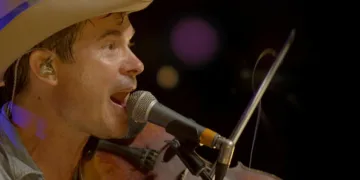

























At the ROMP Bluegrass Festival in Kentucky, Ketch Secor can lead a discussion about guns and then pick up an acoustic guitar to sing “Louder Than Guns.” The movement between those roles makes sense within the gathering: people have come to hear a musician, and his music gives him a reason to address them. Doug Pray’s documentary Louder Than Guns draws on that relationship throughout its travels. Country, folk, and bluegrass provide an existing attachment through which Secor can introduce a subject that might otherwise make listeners withdraw.
The significance of this approach lies in who gets to raise the question. Secor speaks from within a musical culture his audience recognizes, carrying the familiarity of Old Crow Medicine Show into discussions led with journalist David Greene. The Covenant School shooting in Nashville in 2023, which killed three children and three adults, gives his involvement a painful local urgency. His distress connects the public subject to the place he calls home. The film asks musical belonging to accommodate that distress, allowing a conversation about guns to occur without making agreement a condition of membership.
For a viewer unfamiliar with these musical communities, the festival workshop helps explain the documentary’s method. Enjoying the same performer establishes a modest bond between people whose convictions may differ sharply. It cannot tell us how those people vote or what they will accept as a remedy.
Pray sensibly extends the inquiry beyond the concert audience, visiting a Chicago barbershop, a Missoula gun store, and a gathering of Covenant victims’ relatives and survivors’ parents in Nashville. These encounters give the film several Americas to listen to, rather than allowing the band’s audience to stand for the country.
The differences become clearest around protection. Gun owners describe firearms as a means of keeping themselves and their families safe; the Nashville gathering places the consequences of gun violence within the same inquiry. The word “safety” can accommodate both positions while concealing the distance between their practical implications.
Pray’s encounters make the human concern behind gun ownership available to listeners who might dismiss it, and give grief room to be heard by people who approach the subject through responsible possession. Recognition has value here. Agreement about a desired condition leaves the means of achieving it unsettled.
Secor and Greene’s moderated gatherings preserve enough calm for those positions to coexist. People become tearful, disagreements surface, and the exchanges avoid the prolonged shouting that could turn participants into opposing attractions. The different venues matter: a gun store, a church, and a halfway house bring the conversation into spaces with distinct relationships to trust and vulnerability.
Yet the documentary is cautious about developing the friction it uncovers. Participants can explain what they feel without their assumptions receiving sustained examination. The gentle format lowers the cost of speaking, then often leaves the harder work of answering one another unfinished.
That limitation grows sharper when Pray, who also edits the film, returns to the stage. Cuts from emotional testimony to energetic Old Crow Medicine Show performances change the viewer’s relationship to the preceding discussion. The music offers release, but it can interrupt attention to a statement that still needs consideration.
At the festival workshop, performance and conversation occupy a shared occasion. Across the documentary, the repeated concert returns sometimes seem to close an encounter by restoring the familiar pleasure of watching the band. The difficult voices recede while the performer remains available.

Secor’s repeated renditions of the title song create a related problem. A song can acquire different associations as it meets different experiences, but these appearances too often reaffirm the same appeal for people to hear one another. Their cumulative effect is insistence rather than discovery.
The musician’s sincerity need not be doubted to question the space devoted to him. His position as the person who enables these meetings already gives him considerable prominence; the performances repeatedly renew it. A documentary seeking to distribute attention among strangers keeps returning that attention to its recognizable host.
The itinerary supplies geographical movement without an equivalent development in the inquiry. Each new gathering establishes that people can discuss guns respectfully, while the film gives little sense of what a later conversation learns from an earlier one.
There is no sustained follow-up through which a participant’s changed understanding becomes a choice or an ongoing relationship. This matters even on the documentary’s modest terms. Listening could itself sustain a film if the encounters altered its questions. Here, changing the room often produces another demonstration of the method rather than a deeper test of its possibilities.
Demanding a legislative victory would impose an unreasonable measure on these meetings. The absence of policy decision-makers does, however, restrict what their shared concern can encounter. Bereavement and a gun owner’s account of protection have consequences for questions of regulation and public responsibility, even when the gathering avoids partisan confrontation.
The film does not need to endorse a particular proposal to examine where its participants’ wishes collide. Its restraint becomes frustrating when it protects the aspiration to mutual understanding from the decisions that would give that understanding practical weight.
The church, public library, and halfway house suggest another scale of possibility: local places capable of hosting relationships after a visiting musician has left. Pray brings the discussion into these settings but does not establish how they might carry it forward. Hosting another conversation would require someone in those communities to take responsibility for it, a transfer the documentary leaves unexplored.
Louder Than Guns debuted in limited theaters across North America on May 8, 2026, distributed by Abramorama Films. Directed by Emmy-winning filmmaker Doug Pray, the music-driven documentary follows Grammy Award-winning musician Ketch Secor and journalist David Greene as they navigate America’s polarized gun debate through honest conversations and music in the wake of the Covenant School shooting in Nashville.
Where to Watch Louder Than Guns (2026) Online
Full Credits
Title: Louder Than Guns
Distributor: Abramorama Films
Release date: May 8, 2026
Running time: 1 hour 29 minutes (89 minutes)
Director: Doug Pray
Writers: David Greene, Ketch Secor
Producers and Executive Producers: Stephanie Meurer, Ashley York, Doug Pray, Ketch Secor, David Greene, Foster Phillips
Cast: Ketch Secor, David Greene, Old Crow Medicine Show
Director of Photography (Cinematographer): Not publicly specified
Editors: Doug Pray
Composer: Ketch Secor, Old Crow Medicine Show
The Review
Louder Than Guns
Louder Than Guns understands the cultural trust a country musician can bring to an American argument about firearms. Its encounters give grief and the desire for protection room to coexist, but repeated performances redirect attention toward Secor, while successive gatherings rarely deepen the inquiry. The film earns credit for making difficult conversations possible. Its account of what those conversations might change remains frustratingly thin.
PROS
- Music provides a credible route to cultural trust.
- Different community settings complicate the national picture.
- Calm moderation allows difficult testimony to emerge.
CONS
- Repeated performances interrupt testimony and recenter Secor.
- Participants’ assumptions receive limited examination.
- New gatherings rarely develop the inquiry.
- Little follow-up establishes lasting consequences.







