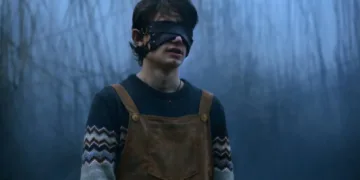























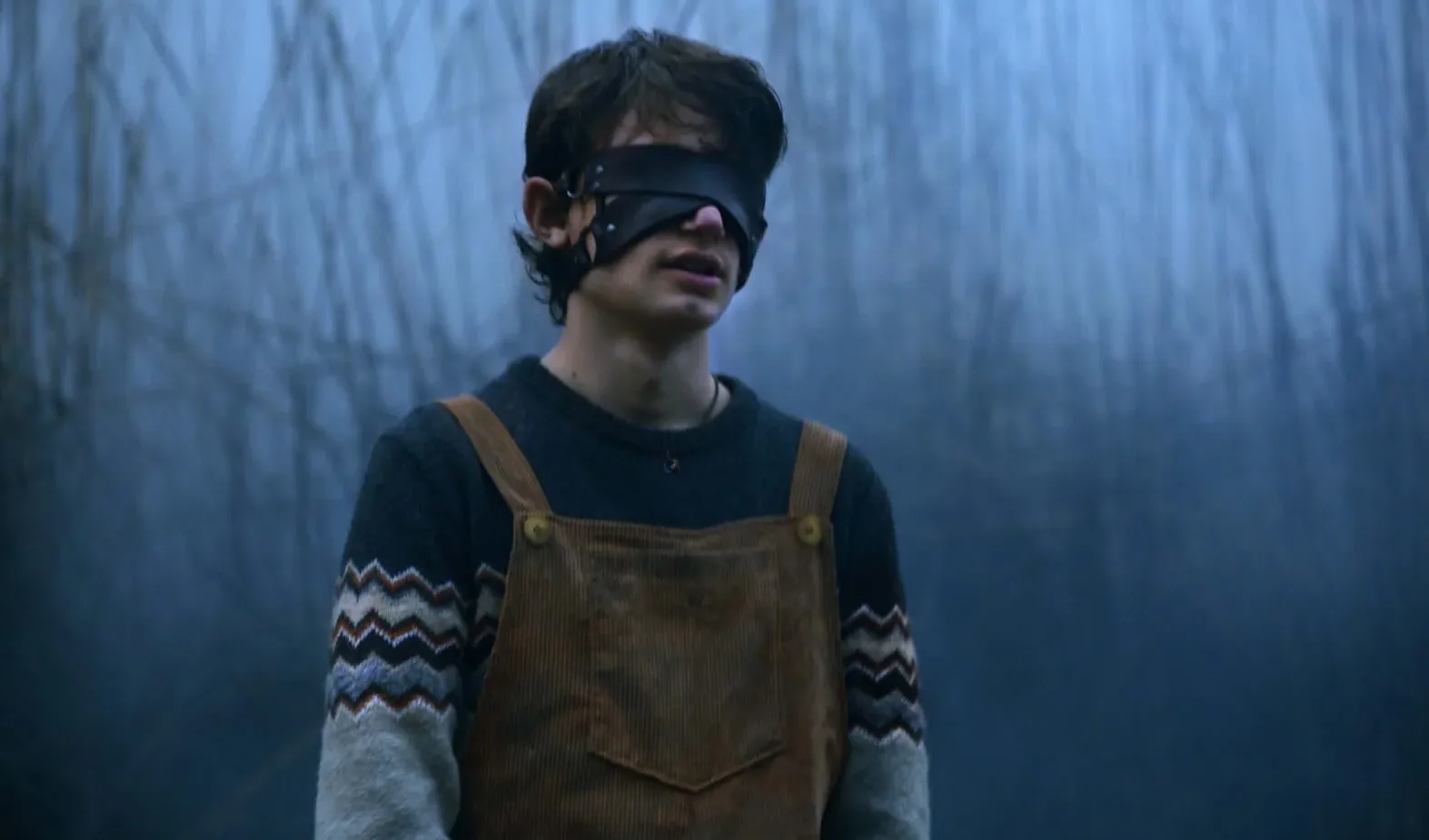

Petros’s family has an explanation for keeping him in the dark. His eyes are acutely sensitive to light, they say, so the teenager must wear protective goggles and accept the restrictions that accompany them. His mother, Lemonia, supervises him with anxious devotion. His grandmother, Margarita, extends that supervision into something resembling public policy. In Thanasis Neofotistos’s debut feature, The Boy with the Light-Blue Eyes, growing up requires challenging people who have made his dependence their responsibility.
The trouble is that dependence can supply its own justification. Petros dresses in dungarees, behaves younger than his age, and approaches independence with the uncertainty of someone allowed little practice. Each quality could reassure his guardians that their vigilance remains necessary. Neofotistos encourages a less comfortable reading: their protection has helped produce the helplessness they claim to manage. Lemonia’s love, conveyed through Syrmo Keke’s overbearing attentiveness, makes this arrangement especially difficult to resist. Petros has to struggle against affection without being able to dismiss it as false.
Margarita supplies the more openly coercive explanation. Petros’s pale blue eyes carry the evil eye, making his body a possible threat to the remote Greek village she leads. Sofia Filippidou gives her authority a commanding presence; private superstition acquires the force of communal judgment through her certainty. Mother and grandmother offer different reasons for restricting the same boy. Between medical caution and inherited belief, almost any attempt at freedom can be classified as irresponsible. Petros has very little room to disagree.

That lack of room becomes literal in Djordje Arambasic’s cinematography. Close-ups keep us near Petros while frequently denying him a comfortable position within the image. He appears isolated or pushed toward its edge, visible to us yet awkwardly accommodated by the world around him. The goggles compound the difficulty. Giorgos Karydis must communicate a guarded adolescent’s inner life while one of an actor’s principal expressive resources remains covered. His restraint suits someone accustomed to taking cues from other people before trusting his own responses.
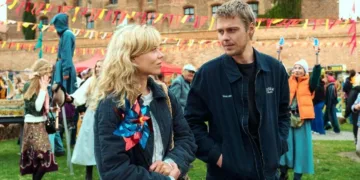
With Aemon, played by Pablo Soto, the arrangement changes. Petros can occupy the centre of the image alongside another person, on equal footing. Their reciprocal affection gives the film’s queer allegory its most persuasive evidence. Acceptance registers through the distribution of space before it needs an explanation. Someone can stand beside Petros without treating proximity as a duty, a precaution, or an act of surveillance.
This is where the familiar coming-of-age material earns its place. The family has already assigned a meaning to Petros’s body, while his feelings for Aemon belong to an understanding of himself still taking shape. His identity is publicly interpreted before he gets much opportunity to express it.
The village’s hostility toward difference makes the queer reading clear without requiring explicit declarations of homophobia. Aemon’s tenderness offers an experience against which Petros can measure the care he receives at home. The difference is practical: with one person, he is permitted to exist without constant correction.
Margarita’s concern for dangerous influences also extends to a nearby wind turbine. She wants the villagers to leave, convinced that the machine brings misfortune. Her jurisdiction apparently includes both adolescent eyesight and electricity generation. The parallel matters because Petros and the turbine become things around which collective fear can organize itself. Neither has to explain anything; Margarita’s interpretation arrives first.
Valia Tserou’s sound design makes that certainty harder to dismiss than its explanation deserves. The turbine remains unseen, its blades persistently audible, while reeds, thunder, whistles, low beats, and rumbles turn the environment into an uneasy field of warnings. We can reject the villagers’ belief and still feel the menace they attach to its object. That is a precise achievement. The film lets us experience the distance between finding something frightening and knowing that it means harm.
Mist, cramped streets, weathered buildings, and swamp terrain reinforce the sense of a community with few exits. Old-fashioned clothes and homes might suggest a safely distant past, except that modern machinery keeps sounding nearby. Neofotistos refuses that comfortable historical separation. The village’s beliefs coexist with the present. Its inhabitants have found a contemporary object for an inherited fear.
I initially took the supposed curse as the family’s prejudice translated into folklore. The disturbing developments around an accident and Petros’s unmasking make that reading insufficient. His eyes may possess consequences that cannot be explained away as collective suspicion. The film’s uncertainty changes the question: how does a story about stigmatized difference handle the possibility that its feared outsider can cause harm?
Here the screenplay, co-written by Neofotistos and Grigoris Skarakis, becomes less assured. The return to an opening sequence first experienced in darkness gives withheld information a productive function. We encounter something again with an altered capacity to understand it.
Elsewhere, Petros’s repeated excursions into situations he has been warned against keep reproducing the same conflict. The boat trip through the swamp toward the turbine offers striking terrain, yet its dramatic motivation remains thin. Further trouble does not always deepen our understanding of his choices. At times the film keeps restaging his confinement after its emotional logic is already clear.
The late invocations of Medusa and Oedipus sharpen the connection between sight, dangerous knowledge, and punishment, but they bring a weight of fatalism that the personal drama has not fully worked through. Likewise, the wider 1.85:1 frame at the bookends, surrounding the main portion’s Academy ratio, offers spatial release without making freedom straightforward.
Petros can acquire knowledge, remove the covering, or occupy a wider image and still face a world whose terms were established without him. The unresolved supernatural threat leaves him with a particularly harsh burden: even his first attempts to understand himself must answer accusations made before he could see clearly.
The Boy with the Light-Blue Eyes had its world premiere at the SXSW London Film Festival on June 4, 2026, before screening at key international film festivals including Helsinki and Manaki Brothers. Directed by Thanasis Neofotistos, the coming-of-age Greek dark folktale follows a teenager in a remote mountain village who is forced to conceal his eyes under a mask due to local superstitions surrounding blue eyes, embarking on a quest to discover the truth about his condition and identity.
Where to Watch The Boy with the Light-Blue Eyes (2026) Online
Full Credits
Title: The Boy with the Light-Blue Eyes (Greek: Το Αγόρι με τα Γαλάζια Μάτια)
Distributor: Argonauts Productions, Gersh
Release date: June 4, 2026
Running time: 1 hour 39 minutes (99 minutes)
Director: Thanasis Neofotistos
Writers: Thanasis Neofotistos, Grigoris Skarakis
Producers and Executive Producers: Ioanna Bolomyti, Elizabeth Woodward, Lauren Mann, Miranda Bailey, Yannis Economides, Vladimir Anastasov, Angela Nestorovska, Zvonimir Munivrana, Maja Popovic Milojevic, Irina Malcea-Candea, Panos Papahatzis, William Olsson, Jason Beck
Cast: Giorgos Karydis, Pablo Soto, Syrmo Keke, Sofia Filippidou
Director of Photography (Cinematographer): Djordje Arambasic
Editors: Panagiotis Angelopoulos
Composer: Igor Vasilev Novogradska
The Review
The Boy with the Light-Blue Eyes
Neofotistos makes protection frightening by showing how easily affection can become authority. Petros’s relationship with Aemon and the film’s enclosing images give that argument emotional substance, while exceptional sound design makes collective fear disturbingly contagious. I’m less persuaded by the supernatural complications: they raise difficult questions that the repeated escapes and late mythic references cannot fully develop. The film understands enforced dependence with greater precision than it understands the freedom that might follow.
PROS
- Sound design makes superstition physically persuasive.
- Framing gives queer intimacy expressive weight.
- Family affection complicates the portrayal of control.
- Restrained lead performance conveys guarded vulnerability.
CONS
- Repeated forbidden excursions slow dramatic development.
- The swamp expedition lacks clear motivation.
- Mythic fatalism exceeds the personal drama’s development.